Understanding Smooth Eye Pursuit
July 2, 2007 Smooth Eye Pursuit

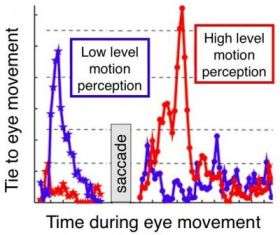
During smooth pursuit eye movement, both low and high level motion perception have their influence. Credit: Jeremy Wilmer

Researchers at the University of Pennsylvania have shed new light on how the brain and eye team up to spot an object in motion and follow it, a classic question of human motor control. The study shows that two distinctly different ways of seeing motion are used — one to catch up to a moving object with our eyes, a second to lock on and examine it.

“Without the ability to lock our eyes onto a moving target, something called smooth pursuit, athletes cannot ‘keep their eye on the ball,’ and a person walking down the street cannot examine the facial expression or identity of a passerby,” said Jeremy Wilmer, postdoctoral fellow in the Department of Psychology in Penn’s School of Arts and Sciences and lead author of the study.

Researchers found that volunteers showed a range of capabilities when it came to sensing and following motion, and the careful measurement of such differences produced novel insights into the workings of the smooth pursuit system.

“Our automatic tendency is to assume you and I see the same baseball, or color, or face, but in fact our experiences can be quite different,“ Wilmer said. “The assumption of a common visual experience can backfire when we assume wrongly that the person next to us perceives the same flying projectile, or red hexagonal sign, or emotion that we do.”

Researchers explored the two ways of perceiving motion to see how each contributes to smooth pursuit. The first, called low-level motion perception, is the sense one gets of disembodied motion before knowing what is moving. The second, called high-level motion perception, is the ability to watch an object move through time and space after it has been recognized.

Participants who were good at low-level motion perception caught up to a moving object with their eyes more easily. A completely different set of volunteers exhibited skill at high-level motion perception and were much better at locking onto a moving target once their eyes caught up to it. This result shows that distinct experiences of motion drive different stages of smooth pursuit.

“Our experience of the world normally appears quite seamless,” Wilmer said, “but in fact our brain sees many aspects separately and knits them together into one experience of the world.“

The study result builds on research into how piecemeal processing in the brain leads to holistic experience and seamless behavior. It also provides insight into a smooth pursuit system important for both social skills and sports. The first in-depth study of how individuals differ from each other in their ability to sense and follow motion, this research sets the stage for future studies of genetic and environmental influences that shape conscious visual experience.

Smooth pursuit ability is rare in the animal kingdom and only well developed in primates such as humans, and in praying mantises.

“It could be,” Wilmer said, “that a penchant for high-level motion perception is essential for our incredibly handy ability to lock onto and examine moving objects.”

Wilmer and Ken Nakayama, professor of psychology at Harvard University, reported their findings in the current issue of Neuron.

Source: University of Pennsylvania


print this article email this article download pdf blog this article bookmark this article     Stumble it Digg this share on Facebook retweet share on Reddit add to delicious
Rate this story - 4.6 /5 (16 votes)


July 2, 2007 all stories

Comments: 0

4.6 /5 (16 votes)
  • Stumble this up

  • Digg this

  • share this

  • hide
  • Related Stories

  • Epson's new 4K panel for 3LCD projectors
    created Nov 10, 2009 | popularity not rated yet | comments 0
  • Sony Develops High Frame Rate Single Lens 3D Camera Technology
    created Oct 01, 2009 | popularity not rated yet | comments 0
  • From nature, robots
    created Sep 25, 2009 | popularity not rated yet | comments 0
  • New Panasonic LUMIX DMC-FZ35, 18x Optical Superzoom Digital Camera Features HD Video Recording
    created Jul 27, 2009 | popularity not rated yet | comments 0
  • Study Reveals Small Lizard Tucks Legs and Swims Like a Snake Through Desert Sand (w/ Video)
    created Jul 16, 2009 | popularity not rated yet | comments 0


  • hide
  • Relevant PhysicsForums posts

  • 23 Years in a Vegetative State....or not?
    created 1hour ago
  • Has the H1N1 vaccine been scientifically proven to work?
    created 21 hours ago
  • nesfatin
    created Nov 22, 2009
  • Obsessive Compulsive Disorder
    created Nov 20, 2009
  • More from Physics Forums - Medical Sciences

Other News

Dentistry, a high-tech version: Robots not far off, doctor says

Medicine & Health / Health

created 3 hours ago | popularity not rated yet | comments 0

Robots may practice dentistry one day, but there will always be humans telling you to open wide, said a teacher on the cutting edge of tooth care.


High salt intake directly linked to stroke and cardiovascular disease

Medicine & Health / Health

created 6 hours ago | popularity 4.7 / 5 (3) | comments 0

High salt intake is associated with significantly greater risk of both stroke and cardiovascular disease, concludes a study published in the BMJ today.


Serotonin Made in Breast Cancer Cells, Researchers Show

Serotonin Made in Breast Cancer Cells, Researchers Show

Medicine & Health / Cancer

created 8 hours ago | popularity 5 / 5 (2) | comments 0

(PhysOrg.com) -- Researchers at the University of Cincinnati have documented that the brain hormone serotonin is made in human breast cancer cells and functions abnormally, contributing to malignant growth.


Eye floaters and flashes of light linked to retinal tear, detachment

Eye floaters and flashes of light linked to retinal tear, detachment

Medicine & Health / Research

created 5 hours ago | popularity not rated yet | comments 0

Suddenly seeing floaters or flashes of light may indicate a serious eye problem that - if untreated - could lead to blindness, a new study shows.


Autism treatment: Risky alternative therapies have little basis in science

Medicine & Health / Diseases

created 6 hours ago | popularity not rated yet | comments 0

James Coman's son has an unusual skill. The 7-year-old, his father says, can swallow six pills at once. Diagnosed with autism as a toddler, the Chicago boy had been placed on an intense regimen of supplements and medications ...