Mother-of-pearl -- Classic beauty and remarkable strength
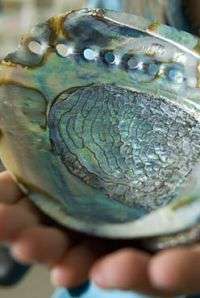
While the shiny material of pearls and abalone shells has long been prized for its iridescence and aesthetic value in jewelry and decorations, scientists admire mother-of-pearl for other physical properties as well.
Also called nacre ("NAY-ker"), mother-of-pearl is 3,000 times more fracture-resistant than the mineral it is made of, aragonite, says Pupa Gilbert, a physicist at the University of Wisconsin-Madison. "You can go over it with a truck and not break it - you will crumble the outside [of the shell] but not the [nacre] inside. And we don't understand how it forms - that's why it's so fun to study."
Understanding the mechanism by which nacre forms would be the first step toward harnessing its strength and simplicity, she says. "We don't know how to synthesize materials that are better than the sum of their parts."
Writing in the June 29 issue of Physical Review Letters, Gilbert and her colleagues in the UW-Madison department of physics and School of Veterinary Medicine, the Institute for the Physics of Complex Matter in Switzerland and the UW-Madison Synchrotron Radiation Center, now describe unexpected elements of nacre architecture that may underlie its strength and offer clues into how this remarkable material forms.
Like our bones and teeth, nacre is a biomineral, a combination of organic molecules - made by living organisms - and mineral components that organisms ingest or collect from their environment. The aragonite mineral in nacre is made of calcium carbonate, which marine animals form from elements abundant in seawater.
Though a mere 5 percent of abalone nacre is organic, this small fraction somehow lays enough foundation for the mineral components to assemble spontaneously, Gilbert says.
"Ninety-five percent of the mass of this biomineral is self-assembled, while only 5 percent is actively formed by the organism," she says. "It is one of the most efficient mechanisms you can think of."
To gain insight into this self-assembly process, Gilbert and graduate student Rebecca Metzler examined the structure of abalone nacre using synchrotron radiation - light emitted by electrons speeding around a curved track.
When used to examine a cross-section of an abalone shell, previously seen to resemble a brick wall with layers of organic "mortar" separating individual crystalline "bricks," the polarized light from the synchrotron revealed that the nacre wall was not uniform.
Instead, the wall contained distinct clumps of bricks, each an irregular column of crystals with identical composition but a crystal orientation different than neighboring columns.
Since orientation affects how crystals emit electrons, "some of the columns of bricks appear white and others appear black and more appear gray, depending on their crystal orientation," Gilbert explains.
The overall effect resembles a camouflage pattern, each roughly columnar cluster a slightly different shade.
She suggests that this mosaic architecture of nacre, with numerous non-aligned crystals, could lead to a stronger material by preventing the formation of natural cleavage planes - like those that form the facets of a cut diamond - where a single crystal can easily break. "It is intuitive that a poly-crystal is mechanically stronger than a single crystal, so perhaps that is an advantage for the animal," Gilbert says.
With this new information about nacre structure and the help of UW-Madison theoretical physicist Susan Coppersmith, the group turned to modeling to try to understand how such a structure could form.
"By looking at the final result and comparing it to the result of different growth models, you get insight into what the actual mechanism of the growth is," Coppersmith says.
The group developed a model that suggests that the animal creates the organic "mortar" layers first, peppered with randomly distributed crystal nucleation, or seeding, sites.
From their observations, they predict that mineral crystals start growing inside the shell and extend horizontally until they contact another growing crystal and vertically until they hit the overlying mortar. If that crystal contacts another of the scattered crystal formation sites on the next tier up, it should trigger growth of a new crystal with the same crystal orientation, gradually building a rough column of irregular width.
With further experiments, the researchers hope to test and refine their model as well as examine other biominerals, such as human teeth and the nacre of other species such as pearl oysters, mussels, or nautiluses, to improve their understanding of biomineral formation and assembly.
"If you understand how it forms, you could think of reproducing it, producing a synthetic material that's inspired by nature - a so-called 'biomimetic' material," Gilbert explains. "If we learn how to harness the mechanism of formation, then we could, for example, produce cars that absorb all the energy at the impact point but do not fracture.
"But from my point of view, it's most interesting because of the fundamental mechanisms of how it forms - these natural self-assembly mechanisms we are only just beginning to understand."
Source: University of Wisconsin-Madison


