Marine worm opens new window on early cell development
July 2, 2007
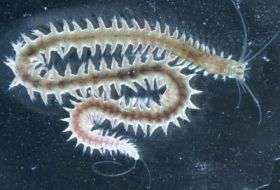
Platynereis dumerilii, a marine bristle worm, is becoming a new model for studying early stages of cell development. Credit: Photo by Kristin Tessmar-Raible, European Molecular Biology Laboratory
University of Oregon biologists studying a common ocean-dwelling worm have uncovered potentially fundamental insights into the evolutionary origin of genetic mechanisms, which when compromised in humans play a role in many forms of cancer.
Their research, appearing in the July issue of the journal Developmental Cell, also increases the visibility of a three-year effort at the UO to promote use of the bristle worm Platynereis dumerilii as a model organism for the study of evolutionary origins of cell types and animal forms.
The marine worm develops by a stereotypic pattern of asymmetric cell divisions generating differently sized embryonic cells. Platynereis dumerilii, the researchers wrote, “appears to have retained ancestral morphological and genomic features, including a slowly evolving protein complement,” and, therefore, can be considered a living fossil.
“Our studies of this organism, called a polychaete annelid, a marine relative of earthworms, have provided potentially fundamental insights into the evolutionary origin of the genetic mechanisms that determine how different cell types are produced during animal embryogenesis,” said lead author Stephan Q. Schneider, a postdoctoral researcher in the UO Institute of Molecular Biology.
The genetic mechanism, in this case, is the beta-catenin signaling pathway and its regulation after cell divisions. Beta-catenin is a cellular protein, which regulates cell proliferation and communication between cells.
“This ancient mechanism remains a central feature of animal development in all animals today, and malfunction of this mechanism in humans is associated with some of the most common and deadly forms of cancer, including colon cancer and melanoma,” Schneider said.
Schneider and co-author Bruce Bowerman, a professor of molecular biology, identified a highly conserved beta-catenin in this ancient worm and documented the protein’s subcellular accumulation in 390 cells produced during the division of fertilized eggs during 195 separate embryonic cell cycles.
Surprisingly, they said, they found an accumulation of beta-catenin in only one of the two daughter cells after each cell division. They showed that the regulation of beta-catenin accumulation forms a molecular switch between two new daughter cells, causing the cells to be different from one another. This universal mechanism operates in embryos as a binary decision-maker, creating an organism with a diversity of cell types.
Beta-catenin has been the focus of research in other model systems, such as mice, fruit flies and roundworms, but never in these ancient slowly evolving invertebrates used in the UO research. The protein appears to be conserved throughout the animal kingdom.
In humans suffering from a variety of cancers, a breakdown in the normal regulation of beta-catenin signaling is thought to be responsible for the growth of related tumors. Coupled with similar findings involving beta-catenin in the nematode Caenorhabditis elegans, a roundworm found in soil, the new UO report suggests an ancient metazoan origin and role for beta-catenin protein in the earliest stages of cellular development.
The findings, Bowerman said, suggest that the genetic pathway in the marine worm may be one of the earliest mechanisms used in embryogenesis to make cells adopt different roles during development. The worms used in the UO study originated from the Mediterranean.
“It is intriguing that key components of the widely conserved beta-catenin cell-signaling pathway appear to specify cell fate throughout development in an embryo that, given the invariance of the embryonic cell lineage and the prevalence of asymmetric cell divisions, has been viewed as a classic example of mosaic development,” Schneider and Bowerman wrote in their conclusion.
There are some 10,000 species of polychaete annelids, dating back to the Paleozoic era, which started 542 million years ago. Polychaete refers to “many hairs” or “many bristles” that come off protrusions of the worms’ bodies, which consist of fluid-filled tubes within tubes. These worms are bilaterally symmetrical with closed circulatory systems. Their ancient simplicity, Bowerman said, makes the Platynereis a rather uncomplicated model system for studying such protein interactions.
Source: University of Oregon
-
Study of diving beetles suggest sperm evolution may be driven by changes in female reproductive organs
Feb 06, 2012 |
not rated yet |
0
-
Worms reveal new role for hormones in Bardet-Biedl syndrome
Dec 13, 2011 |
not rated yet |
0
-
Neuroscientists visualize neural circuitry at once-unattainable depths
Dec 12, 2011 |
4 / 5 (1) |
1
-
Aging human bodies and aging human oocytes run on different clocks
Dec 06, 2011 |
not rated yet |
0
-
Researchers discover new way to form extracellular vesicles
Nov 17, 2011 |
not rated yet |
0
-
Engineers build first sub-10-nm carbon nanotube transistor
Feb 01, 2012 |
4.9 / 5 (33) |
30
-
Something old, something new: Evolution and the structural divergence of duplicate genes
Jan 31, 2012 |
4.6 / 5 (7) |
1
-
The hidden nanoworld of ice crystals: Revealing the dynamic behavior of quasi-liquid layers
Jan 30, 2012 |
5 / 5 (4) |
1
-
Stock market network reveals investor clustering
Jan 27, 2012 |
3.9 / 5 (23) |
8
-
Of microchemistry and molecules: Electronic microfluidic device synthesizes biocompatible probes
Jan 26, 2012 |
5 / 5 (2) |
0
More news stories
A mitosis mystery solved: How chromosomes align perfectly in a dividing cell
Although the process of mitotic cell division has been studied intensely for more than 50 years, Whitehead Institute researchers have only now solved the mystery of how cells correctly align their chromosomes during symmetric ...
10 hours ago |
4.3 / 5 (16) |
0
|
Researchers find extensive RNA editing in human transcriptome
In a new study published online in Nature Biotechnology, researchers from BGI, the world's largest genomics organization, reported the evidence of extensive RNA editing in a human cell line by analysis of RNA-seq data, demons ...
9 hours ago |
5 / 5 (4) |
0
|
The proteins ensuring genome protection
Researchers from the University of Geneva (UNIGE), Switzerland, have discovered the crucial role of two proteins in developing a cell 'anti-enzyme shield'. This protection system, which operates at the level of molecular ...
10 hours ago |
5 / 5 (3) |
0
|
Entire genome of extinct human decoded from fossil
(PhysOrg.com) -- In 2010, Svante Pääbo and his colleagues presented a draft version of the genome from a small fragment of a human finger bone discovered in Denisova Cave in southern Siberia. The ...
Feb 07, 2012 |
4.7 / 5 (60) |
51
|
Why are there so few fish in the Earth's oceans?
(PhysOrg.com) -- A Stony Brook University researcher has found that, contrary to popular belief, there are not plenty of fish in the sea.
Feb 08, 2012 |
4.2 / 5 (18) |
27
|
Scientists discover molecular secrets of 2,000-year-old Chinese herbal remedy
For roughly two thousand years, Chinese herbalists have treated Malaria using a root extract, commonly known as Chang Shan, from a type of hydrangea that grows in Tibet and Nepal. More recent studies suggest that halofuginone, ...
New method to examine batteries -- MRI from the inside
There is an ever-increasing need for advanced batteries for portable electronics, such as phones, cameras, and music players, but also to power electric vehicles and to facilitate the distribution and storage of energy derived ...
Google might launch Drive for cloud storage soon
(PhysOrg.com) -- Google's next big move, according to the Wall Street Journal, is a cloud storage service called Drive. Hardly first to the plate, Google is simply catching up to introducing its cloud reposi ...
Lab study raises questions over nano-particle impact
Tests involving chickens have raised questions about the impact on health from engineered nano-particles, the ultra-fine grains commonly used in drugs and processed foods, scientists said on Sunday.
Starve a virus, feed a cure? Findings show how some cells protect themselves against HIV
A protein that protects some of our immune cells from the most common and virulent form of HIV works by starving the virus of the molecular building blocks that it needs to replicate, according to research published online ...
Overeating may double risk of memory loss
New research suggests that consuming between 2,100 and 6,000 calories per day may double the risk of memory loss, or mild cognitive impairment (MCI), among people age 70 and older. The study was released today and will be ...