Researchers solve mystery of how DNA strands separate
July 3, 2007 Graphic of DNA Strands Separating

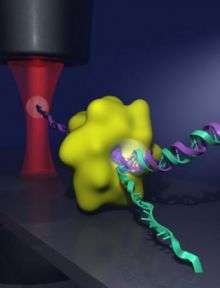
This image shows a DNA double helix (green and purple strands) being separated by a helicase enzyme (green globule) at the junction where the two strands fork. To show that helicases actively separate the two strands of DNA, the researchers attached one end of a DNA strand to a microscope cover slip and attached the end of the other DNA strand to a micron-sized plastic bead. The bead was then trapped in a tightly focused laser beam (red), which allowed the researchers to measure the motion of the helicase as it unwound the DNA. Credit: Graphic created by Chris Pelkie and Daniel Ripoll/Cornell Theory Center

Cornell researchers have answered a fundamental question about how two strands of DNA, known as a double helix, separate to start a process called replication, in which genes copy themselves.

The research, published in the current issue of the journal Cell, examined the role of an enzyme called a helicase, which plays a major role in separating DNA strands so that replication of a single strand can occur.

Scientists have known that helicases bind to the area of a double helix where the two strands fork away from each other, like the free ends of two pieces of thread wound around each other. The forked area opens and closes very rapidly. But scientists have debated whether helicases actively separate the two strands at the fork or if they passively wait for the fork to widen on its own.

The research found that the helicase appears to actively exert a force onto the fork and separate the two strands.

"A simple passive unwinding mechanism does not explain our data," said Michelle Wang, associate professor of physics and the paper's senior author.

"Defects in helicases are associated with many human diseases, ranging from predisposition to cancer to premature aging," said co-author Smita Patel, a biochemistry professor at the Robert Wood Johnson Medical School in Piscataway, N.J. "Helicases are involved in practically all DNA and RNA metabolic processes."

The researchers made their discovery by anchoring one end of one of the strands in a double helix to the surface of a microscope cover slip. The end of the other strand was attached to a micron-sized plastic bead. They then focused a laser beam on the tiny bead and trapped the bead in place within the beam of light. This setup allowed the researchers to measure the position and force on the bead, creating a very precise sensor of the helicase motion. As the helicase moved toward the fork and the double helix unwound, the tension on the two strands lessened. Using statistical mechanics models, the researchers could then compare actual measurements of movement with predictions based on both active and passive scenarios.

"The unwinding has to have some active component to it, and based on our data, we can tell you exactly how active it is," said Wang. "Basically, it is an active unwinding motor."

While helicases unwind very rapidly in cells, in test tube experiments the unwinding is much slower. The researchers believe that helicases work with other enzymes, where "accessory proteins are helping the helicase out by destabilizing the fork junction," said Wang.

Source: Cornell University News Service


print this article email this article download pdf blog this article bookmark this article     Stumble it Digg this share on Facebook retweet share on Reddit add to delicious
Rate this story - 4.3 /5 (27 votes)


July 3, 2007 all stories

Comments: 0

4.3 /5 (27 votes)
  • Stumble this up

  • Digg this

  • share this

  • hide
  • Related Stories

  • New information about DNA repair mechanism could lead to better cancer drugs
    created Jul 16, 2009 | popularity not rated yet | comments 0
  • Biologists discover motor protein that rewinds DNA
    created Oct 30, 2008 | popularity not rated yet | comments 0
  • The structure of XPD sheds light on cancer and aging
    created May 29, 2008 | popularity not rated yet | comments 0
  • Researchers probe a DNA repair enzyme
    created Feb 18, 2008 | popularity not rated yet | comments 0
  • Hepatitis C helicase unwinds DNA in a spring-loaded, 3-step process
    created Jul 26, 2007 | popularity not rated yet | comments 0


Other News

New study describes connections between Circadian and metabolic systems

Biology / Other

created 9 minutes ago | popularity not rated yet | comments 0

A paper by University of Notre Dame biologist Giles Duffield and a team of researchers offers new insights into a gene that plays a key role in modulating the body's Circadian system and may also simultaneously modulate its ...


With Help from a Bacterium, Cockroaches Develop Way to Store Excess Uric Acid

With Help from a Bacterium, Cockroaches Develop Way to Store Excess Uric Acid

Biology / Plants & Animals

created 2 hours ago | popularity 5 / 5 (1) | comments 0

(PhysOrg.com) -- What life form can use materials as nutrients that we, and most other animals, would consider waste products?


Longer toes eyed as sprinters' edge

Biology / Other

created 2 hours ago | popularity not rated yet | comments 0

(PhysOrg.com) -- Longer toes may give sprinters a leg up on other runners, according to a new study.


New explanation for nature's hardiest life form

Biology / Cell & Microbiology

created 7 hours ago | popularity 4.3 / 5 (3) | comments 0

Got food poisoning? The cause might be bacterial spores, en extremely hardy survival form of bacteria, a nightmare for health care and the food industry and an enigma for scientists. Spore-forming bacteria, present almost ...


Hoping for a fluorescent basket case: How HIV is assembled and released from infected cells

Biology / Cell & Microbiology

created 5 hours ago | popularity not rated yet | comments 0

Although recent advances have raised hopes that a protective vaccine can be developed, acquired immunodeficiency syndrome (AIDS) remains a major public health problem. Much has been learned about HIV-1, the virus that causes ...