Stellar Fireworks are Ablaze in Galaxy NGC 4449
July 3, 2007 Stellar Fireworks are Ablaze in Galaxy NGC 4449

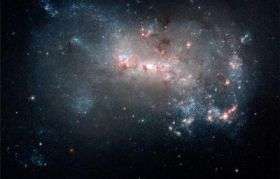
Hundreds of thousands of vibrant blue and red stars are visible in this new image of galaxy NGC 4449 taken by the NASA/ESA Hubble Space Telescope. Hot bluish white clusters of massive stars are scattered throughout the galaxy, interspersed with numerous dustier reddish regions of current star formation. Massive dark clouds of gas and dust are silhouetted against the flaming starlight. Credit: NASA, ESA, A. Aloisi (STScI/ESA), and The Hubble Heritage (STScI/AURA)-ESA/Hubble Collaboration

Hundreds of thousands of vibrant blue and red stars are visible in this new image of galaxy NGC 4449 taken by the NASA/ESA Hubble Space Telescope.

Hot bluish white clusters of massive stars are scattered throughout the galaxy, interspersed with numerous dustier reddish regions of current star formation. Massive dark clouds of gas and dust are silhouetted against the flaming starlight.

NGC 4449 has been forming stars since several billion years ago, but currently it is experiencing a star formation event at a much higher rate than in the past. This unusual explosive and intense star formation activity qualifies as a starburst. At the current rate, the gas supply that feeds the stellar production would only last for another billion years or so.

Starbursts usually occur in the central regions of galaxies, but NGC 4449 has a more widespread star formation activity, since the very youngest stars are observed both in the nucleus and in streams surrounding the galaxy.

A "global" starburst like NGC 4449 resembles primordial star forming galaxies which grew by merging with and accreting smaller stellar systems. Since NGC 4449 is close enough to be observed in great detail, it is the ideal laboratory for the investigation of what may have occurred during galactic formation and evolution in the early Universe.

It’s likely that the current widespread starburst was triggered by interaction or merging with a smaller companion. NGC 4449 belongs to a group of galaxies in the constellation Canes Venatici, the Hunting Dogs. Astronomers think that NGC 4449’s star formation has been influenced by interactions with several of its neighbours.

This image was taken in November 2005 by an international science team led by Alessandra Aloisi of European Space Agency (ESA)/the Space Telescope Science Institute (STScI) in Baltimore. Other team members include Francesca Annibali (STScI), Claus Leitherer (STScI), Jennifer Mack (STScI), Marco Sirianni (ESA/STScI), Monica Tosi (INAF-OAB), and Roeland van der Marel (STScI).

Hubble’s Advanced Camera for Surveys observed the NGC 4449 in blue, visible, infrared, and Hydrogen-alpha light.

Source: Hubble Information Centre


print this article email this article download pdf blog this article bookmark this article     Stumble it Digg this share on Facebook retweet share on Reddit add to delicious
Rate this story - 3.9 /5 (11 votes)


July 3, 2007 all stories

Comments: 0

3.9 /5 (11 votes)
  • Stumble this up

  • Digg this

  • share this

  • hide
  • Related Stories

  • Maps Unveil the Source of Starburst Galaxy's Winds
    created Nov 18, 2009 | popularity not rated yet | comments 0
  • NGC 4710 galaxy: Baffling boxy bulge (w/ Video)
    created Nov 18, 2009 | popularity not rated yet | comments 0
  • Fermi Telescope Detects Gamma-Ray From 'Star Factories' in Other Galaxies
    created Nov 02, 2009 | popularity not rated yet | comments 0
  • The Milky Way's tiny but tough galactic neighbor
    created Oct 14, 2009 | popularity not rated yet | comments 0
  • Sky merger yields sparkling dividends
    created Oct 13, 2009 | popularity not rated yet | comments 0


  • hide
  • Relevant PhysicsForums posts

  • Some help with a X-Ray astronomy question please!
    created 18 hours ago
  • Help with Images and Optical Instrument Question..
    created Nov 26, 2009
  • Redshift as a distance indicator
    created Nov 26, 2009
  • Question about 2-body gravity
    created Nov 24, 2009
  • More from Physics Forums - General Astronomy

Other News

Fermi Telescope Peers Deep into Microquasar

Fermi Telescope Peers Deep into Microquasar (w/ Video)

Space & Earth / Astronomy

created 11 hours ago | popularity 4.5 / 5 (6) | comments 0

(PhysOrg.com) -- NASA's Fermi Gamma-ray Space Telescope has made the first unambiguous detection of high-energy gamma-rays from an enigmatic binary system known as Cygnus X-3. The system pairs a hot, massive ...


The Energy Sources of Ultraluminous Galaxies

The Energy Sources of Ultraluminous Galaxies

Space & Earth / Astronomy

created 12 hours ago | popularity 4.4 / 5 (10) | comments 1

(PhysOrg.com) -- Ultraluminous infrared galaxies ((ULIRGs) are galaxies whose luminosity exceeds that of a trillion suns; for comparison, the Milky Way galaxy has a typical (and much more modest) luminosity ...


Space shuttle Atlantis, 7 astronauts back on Earth (AP)

Space shuttle Atlantis, 7 astronauts back on Earth

Space & Earth / Space Exploration

created 13 hours ago | popularity not rated yet | comments 0

(AP) -- Space shuttle Atlantis and its seven astronauts returned to Earth with a smooth touchdown Friday to end an 11-day flight that resupplied the International Space Station.


China is set to launch its second moon orbiter next October, state media have reported

China to launch second lunar probe: state media

Space & Earth / Space Exploration

created 17 hours ago | popularity 5 / 5 (4) | comments 0

China will launch its second moon orbiter next October, state media reported Friday, as it powers ahead with a space programme that has sparked concerns abroad.


Herschel takes a peek at the ingredients of the galaxies

Herschel takes a peek at the ingredients of the galaxies

Space & Earth / Astronomy

created 10 hours ago | popularity 4.5 / 5 (4) | comments 0

(PhysOrg.com) -- The European Space Agency has today released spectacular new observations from the Herschel Space Observatory, including the UK-led SPIRE instrument. Spectrometers on board all three Hershel ...