Satellite images reveal link between urban growth and changing rainfall patterns
For the first time, scientists have used satellite images to demonstrate a link between rapid city growth and rainfall patterns, as well as to assess compliance with an international treaty to protect wetlands. The results have been published in two studies co-authored by Karen Seto, assistant professor of geological and environmental sciences and a fellow at the Woods Institute for the Environment at Stanford University.
''The exciting thing is really for the first time, using a time series of satellite images, we can monitor Earth in a way that we haven't been able to,'' Seto said. ''It's not just about urban growth or wetlands-it could be about desertification or deforestation-but it's really just this issue of human modification of the Earth.''
In one study, published in the July online issue of the journal Global Environmental Change, Seto and her colleagues showed that inclusion in an international environmental agreement did not significantly improve the health of a coastal mangrove habitat in a wetland preserve in Vietnam. In the second study, published May 15 in the Journal of Climate, the researchers found that rapid urban growth has caused drier winters in the Pearl River Delta of China.
Both findings are based on an analysis of satellite images of Vietnam and China, which NASA has been collecting through its Land Remote-Sensing Satellite (Landsat) Program for more than 30 years.
Urban growth in China
The Journal of Climate study focused on the People's Republic of China, where special economic zones have been established to attract foreign investment and generate international trade. One zone, Shenzhen, was created in 1980 in the Pearl River Delta just north of Hong Kong. Seto, a Hong Kong native, witnessed the impact of this designation during successive visits with relatives in mainland China.
In a previous paper, Seto and her colleagues analyzed satellite imagery and found that urban areas in the Pearl River Delta increased more than 300 percent from 1988 to 1996. In the Journal of Climate study, the researchers compared this rapid urban growth with monthly temperature and precipitation data from 16 meteorological stations. Their analysis revealed a direct correlation between the rapid growth of cities and a decrease in rainfall during the winter dry seasons from 1988 to 1996.
''We found that as the cities get bigger, there is a negative impact on precipitation patterns, such that in the winter season there is a reduction in rainfall as an effect of urbanization,'' Seto explained. ''Primarily it is caused by the conversion of vegetated land to asphalt, roads and buildings. As a result, the soils have significantly less ability to absorb water, so in the winter months there is less moisture in the atmosphere and therefore a reduction in precipitation. We don't see the same impact in summer months, in part because the effect of the Asian monsoon masks the effect of urbanization.''
''When cities are still relatively small, we don't see this pattern emerging,'' she added. ''It happens when cities get very large. But that's the part that I think is alarming, because we see large-scale city development all over China and throughout the developing world.''
Coastal changes in Vietnam
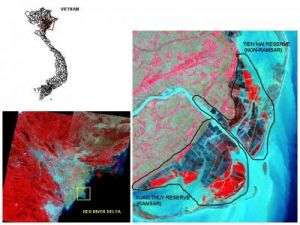
In the Global Environmental Change study, the researchers focused on Vietnam, a signatory of the Convention on Wetlands of International Importance Especially as Waterfowl Habitat, drafted in Ramsar, Iran, in 1971. The goal of the treaty was to protect wetlands by promoting sustainable use of resources found there. To date, more than 150 countries, including the United States, have signed the convention. The Florida Everglades and portions of the Ganges River in India and the Red River Delta in northern Vietnam are included on the convention's list of wetlands of international importance.
The growth of aquaculture in recent years has threatened coastal mangrove forest habitats in the Red River Delta. In response, the Vietnamese government has established protected areas, such as the Xuan Thuy Natural Wetland Reserve, which was designated a Ramsar site in 1988.
For the study, Seto and her colleagues concentrated on Xuan Thuy and a nearby reserve that is not included in the Ramsar treaty. The researchers analyzed a series of Landsat images taken between 1975 and 2002. Analysis revealed that both reserves experienced increased fragmentation of mangrove forest habitat with increased aquaculture. Contrary to expectations, the scientists found that aquaculture developed at a faster rate at the Xuan Thuy treaty site than at its non-Ramsar neighbor.
These findings mirrored statements by local residents in 2001, when Seto and her co-workers interviewed one-third of the households living and farming within the boundaries of both reserves. The researchers were told that aquaculture had been ongoing in the region since the early 1980s.
These results showed that satellite technology is a cost-effective means of assessing wetland health, Seto said, noting that the cost of acquiring the satellite images and conducting the interviews in the field totaled less than $5,000.
This technique could be used to verify compliance with other environmental agreements, added Ron Mitchell, professor of public policy at the University of Oregon and an expert on multi-national environmental treaties. ''Too often in the past policymakers have been at a loss as to how to evaluate progress,'' he said. ''Remote sensing could be used to evaluate many international environmental agreements, particularly habitat-based conventions, such as Ramsar or those dealing with deforestation, desertification and carbon sequestration projects under a climate change agreement.''
Source: Stanford University


