Teleportation method proposed by Australian scientists
July 3, 2007
Image credit: ARC Centre of Excellence for Quantum-Atom Optics
Teleportation, a concept popularised in the original Star Trek television series, is edging closer to reality through work being conducted by theorists from The University of Queensland and Australian National University.
Researchers from UQ's Australian Research Centre for Quantum Atom Optics (Dr Ashton Bradley, Dr Simon Haine and Dr Murray Olsen) and Australian National University (Joseph Hope) have proposed a new way of teleporting matter waves.
“We propose a scheme which allows an atom laser beam to disappear at one location and reappear at another,” Dr Bradley said.
“We feel that our scheme is closer in spirit to the original fictional concept,” Dr Haine said.
“What differentiates our scheme from what is usually termed quantum teleportation is that our scheme does not require the sender and receiver to share entangled states, as there is no measurement step involved in sending the information.
"In this scheme the sender and receiver require a reservoir of extremely cold atoms, known as a Bose-Einstein condensate (BEC).
"BEC is a state of matter that occurs when atoms become very cold, (about 100 billionths of a degree about absolute zero).
"Due to a phenomenon known as Bose-Enhancement, all the atoms like to act the same way. This causes the atoms to act as one macroscopic matterwave, rather than a collection of individual atoms.”
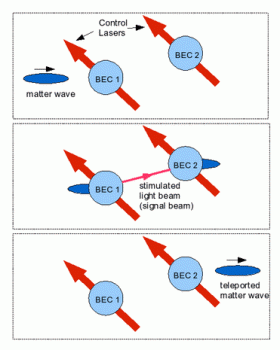
Dr Haine said that sending a pulse of atoms towards a trapped condensate (BEC) and illuminating them with a control laser beam, the atoms from the pulse were stimulated to act the same way as the atoms already trapped in the BEC.
This resulted in the emission of a photon. As all the atoms in the BEC had a very well-defined momentum, the photons being emitted would follow the same direction and form a signal beam.
"We can arrange the position and momentum of each atom (quantum information) to be encoded onto the signal beam by carefully adjusting the intensity and wavelength of the control beam,” Dr Haine said.
The signal beam is then sent to a second BEC, which is also illuminated with a control laser. The atoms trapped in the BEC absorb the photon from the signal beam, and in turn are forced to emit the photon into the control beam.
Due to the momentum of releasing the photons, the atoms are kicked out of the BEC. These atoms contain the quantum information of the original atomic pulse which has been transferred to the new pulse, effectively teleporting the original pulse of atoms.
"Our scheme is quite different from what is usually coined quantum teleportation because it gets around the need for the sender and receiver to share entanglement, as the quantum state to be teleported is never actually measured," Dr Bradley said.
"As our scheme doesn't rely on the quality of the entanglement, it may be possible to achieve more accurate teleportation via this method," he said.
Dr Bradley said the team would now embark on more detailed calculations, which took into account more complicated effects including the effects of the atoms colliding with each other, which could degrade the fidelity of the teleportation.
Dr John Close at ANU also has plans to implement these experiments and related ones in the next few years.
Links: Original paper -- http://arxiv.org/abs/0706.0062 ;
http://www.acqao.o … rticles.html
Source: University of Queensland
-
New light at the end of the tunnel
Oct 17, 2011 |
5 / 5 (3) |
7
-
A new scheme for photonic quantum computing
Oct 13, 2011 |
4.8 / 5 (5) |
2
-
Single magnesium ion brought to standstill by means of novel, simple laser cooling
Sep 29, 2011 |
4.3 / 5 (3) |
1
-
Post-silicon computing
Sep 19, 2011 |
5 / 5 (1) |
0
-
Measuring fundamental constants with methanol
Jun 14, 2011 |
4.7 / 5 (3) |
0
-
Engineers build first sub-10-nm carbon nanotube transistor
Feb 01, 2012 |
4.9 / 5 (29) |
30
-
Something old, something new: Evolution and the structural divergence of duplicate genes
Jan 31, 2012 |
4.6 / 5 (7) |
1
-
The hidden nanoworld of ice crystals: Revealing the dynamic behavior of quasi-liquid layers
Jan 30, 2012 |
5 / 5 (3) |
1
-
Stock market network reveals investor clustering
Jan 27, 2012 |
3.9 / 5 (23) |
8
-
Of microchemistry and molecules: Electronic microfluidic device synthesizes biocompatible probes
Jan 26, 2012 |
5 / 5 (1) |
0
-
Orbital Decay Question
1 hour ago
-
Pure energy
6 hours ago
-
How to remove the magnetic property for screw driver?
9 hours ago
-
How to magnetize a concrete wall?
13 hours ago
-
Upward speed of an object in water
14 hours ago
-
flipping quarks
15 hours ago
- More from Physics Forums - General Physics
More news stories
Physics research suggests new pathways for cancer progression
Observing that certain cancer cells may exhibit greater flexibility than normal cells, some scientists believe that this capability promotes rapid tumor growth. Now computer simulations developed by Boston University Biomedical ...
1 hour ago |
5 / 5 (1) |
0
Borexino Collaboration succeeds in spotting pep neutrinos emitted from the sun
(PhysOrg.com) -- To learn more about how the sun works, scientists study particles that are emitted from it into space due to thermonuclear reactions that occur inside; by applying known physics principles, ...
Transparent iron? For the first time, an experiment shows that atomic nuclei can become transparent
At the high-brilliance synchrotron light source PETRA III, a team of DESY scientists headed by Dr. Ralf Röhlsberger has succeeded in making atomic nuclei transparent with the help of X-ray light. At the ...
22 hours ago |
5 / 5 (9) |
3
|
Physicists build highly efficient 'no-waste' laser
A team of University of California, San Diego researchers has built the smallest room-temperature nanolaser to date, as well as an even more startling device: a highly efficient, "thresholdless" laser that ...
22 hours ago |
5 / 5 (17) |
4
|
Explained: Sigma
It's a question that arises with virtually every major new finding in science or medicine: What makes a result reliable enough to be taken seriously? The answer has to do with statistical significance -- but ...
3 hours ago |
5 / 5 (4) |
2
Apple to debut 'iPad 3' in March: report
Apple will unveil a new version of its market-ruling iPad table computer in March, according to a report in Dow Jones-owned technology blog All Things D.
Physically abused children report higher levels of psychosomatic symptoms
Children who display multiple psychosomatic symptoms, such as regular aches and pains and sleep and appetite problems, are more than twice as likely to be experiencing physical abuse at home than children who do not display ...
Facebook sees slowing growth
Few experts were surprised when Facebook disclosed in its recent IPO filing that its user growth had slowed in the U.S. and Canada. But a deeper look at Facebook's user numbers shows its growth is also slowing ...
New technology platform for molecule-based electronics
Researchers at the Nano-Science Center at the University of Copenhagen have developed a new nano-technology platform for the development of molecule-based electronic components using the wonder material graphene. At the same ...
60 percent of Spanish adolescents state they do not take drugs and rarely drink alcohol
Despite the clichés surrounding the habits of adolescents, the results of a study by the University of Seville show that most young people do not fit the risk profile of taking substances. Some 60% of ...
NFC aid for the visually and hearing impaired
As the proportion of senior citizens grows, their special needs are gaining momentum. Human eyesight, for example, weakens with age. VTT Technical Research Centre of Finland has been developing new NFC-based applications ...
Apr 08, 2009
Rank: 5 / 5 (1)
Apr 19, 2009
Rank: not rated yet