Domestic cat's 'five lives' could help save wild relatives
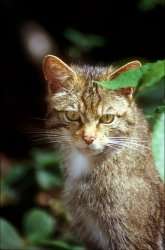
All domestic cats are descended from at least five common ancestors from the Near East, Oxford University scientists and their collaborators have discovered. The new research, published in this week’s Science, also suggests that the domestic cat’s ancestors diverged from the ancestors of other populations of today’s wildcats around 130,000 years ago, far earlier than previously suspected.
The scientists studied genetic material from 979 domestic cats and their wild relatives. Professor David Macdonald, Director of the Wildlife Conservation Research Unit, who led the work at Oxford University, said: ‘In our studies of mitochondrial DNA from these cats we found five distinct lineages dating back a hundred thousand years prior to any archaeological record of cat domestication.
These appear to come from at least five female cats from the Near East whose descendants have been transported across the world by humans.’ These five ‘matrilines’ (lines of descent from a female ancestor) were recruited at an unknown time during the last 130,000 years (possibly at different times and places in the Near East) as founders of the modern domestic cats.
Mitochondrial DNA is unusual in that, unlike chromosomes, it is held outside the nucleus of cells in specialised structures called mitochondria. In mammals mitochondrial DNA is inherited only though the mother, so it can be used to trace the female lineage.
The earliest archaeological evidence for cat domestication only stretches back to 9,500 years ago when they are thought to have lived alongside humans at sites in Cyprus. It seems that cats probably domesticated themselves, attracted by the food source of rodents that developed around human settlements when hunter-gatherers originally settled in agricultural villages in the Fertile Crescent of the Near East. The team obtained samples of contemporary wildcats carrying the ancestral genes from field studies or museums in Israel, Saudi Arabia, United Arab Emirates, Bahrain and Saudi Arabia.
Professor Macdonald, who has worked on cats around the world from barnyard cats to lions and cheetah, has devoted more than ten years to the conservation of the Scottish wildcat – Britain’s most endangered carnivore – which is blighted by cross-breeding with feral moggies. He said: ‘The most exciting thing about these genetic insights from the past is that they offer hope for the wildcat’s future. In Scotland we’ve been striving to find a genetic marker to identify Scottish wildcats, and now we have one. In terms of practical conservation our next move is to use this marker to find out how many wildcats are left in Scotland, work we are planning with Scottish Natural Heritage’.
The Wildlife Conservation Research Unit – known as the WildCRU – specialises in the science to underpin practical solutions to conservation problems. Carlos Driscoll, the molecular biologist who undertook the lab analyses, is a doctoral student at the WildCRU. He found that of 108 putative European wildcats, 28 carried mitochondrial DNA characteristic of the genotype shared by domestic cats and their Near Eastern ancestor – and the only way it could have got there was cross-breeding between domestic cats and their wild European relative.
The 21st-century problem is that such cross-breeding now threatens the existence of modern wildcats. Hopefully the team will be able to use the new genetic markers for wildcats in general, and Scottish wildcats in particular, to assist in their conservation. Professor Macdonald said: ‘this is the sort of result that excites us most: a fascinating biological insight that can be used to help solve a practical problem. And, whatever the future holds, the domestication of the cat to complement human civilisation stands out as one of the most successful ‘biological experiments’ ever undertaken by humans.’
Source: University of Oxford


