Simple Magnet Can Control Color of Liquid
July 3, 2007
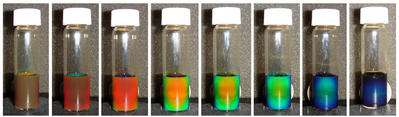
Image shows the solution of iron oxide in water changing color under a magnetic field, with increasing strength of the field from left to right. Photo credit: Yin laboratory, UCR
University of California, Riverside nanotechnologists have succeeded in controlling the color of very small particles of iron oxide suspended in water simply by applying an external magnetic field to the solution. The discovery has potential to greatly improve the quality and size of electronic display screens and to enable the manufacture of products such as erasable and rewritable electronic paper and ink that can change color eletromagnetically.
In their experiments, the researchers found that by changing the strength of the magnetic field they were able to change the color of the iron oxide solution – similar to adjusting the color of a television screen image.
When the strength of the magnetic field is changed, it alters the arrangement of the spherical iron oxide particles in solution, thereby modifying how light falling on the particles passes through or is deflected by the solution.
Study results appear in Angewandte Chemie International Edition’s online edition today. The research paper is scheduled to appear in print in issue 34 of the journal. Identified by Angewandte Chemie as a “very important paper,” the research will be featured on the inside cover of the print issue.
“The key is to design the structure of iron oxide nanoparticles through chemical synthesis so that these nanoparticles self-assemble into three-dimensionally ordered colloidal crystals in a magnetic field,” said Yadong Yin, an assistant professor of chemistry who led the research.
A nanoparticle is a microscopic particle whose size is measured in nanometers.
A colloid is a substance comprised of small particles uniformly distributed in another substance. Milk, paint and blood are examples of colloids.
“By reflecting light, these crystals – also called photonic crystals – show brilliant colors,” Yin said. “Ours is the first report of a photonic crystal that is fully tunable in the visible range of the electromagnetic spectrum, from violet light to red light.”
A photonic crystal controls the flow of light (photons) and works like a semiconductor for light. The nanoparticles’ spacing dictates the wavelength of light that a photonic crystal reflects.
Iron oxide (formula: Fe3O4) nanoparticles are “superparamagnetic,” meaning that they turn magnetic only in the presence of an external magnetic field. In contrast, “ferromagnetic” materials become magnetized in a magnetic field and retain their magnetism when the field is removed.
The researchers used the superparamagnetic property of iron oxide particles to tune the spacing between nanoparticles, and therefore the wavelength of the light reflection – or the color of the colloidal crystals – by changing the strength of the external magnetic field.
“Other reported photonic crystals can only reflect light with a fixed wavelength,” Yin said. “Our crystals, on the other hand, show a rapid, wide and fully reversible optical response to the external magnetic field.”
Photonic materials such as those used by Yin and his team could help in the fabrication of new optical microelectromechanical systems and reflective color display units. They also have applications in telecommunication (fiber optics), sensors and lasers.
“This is an elegant method that allows researchers in the field to assemble photonic crystals and control their spacing by using a magnetic field,” said Orlin Velev, an associate professor of chemical and biomolecular engineering at North Carolina State University, Raleigh, N.C., who was not involved in the research. “A simple magnet can be used to change the color of a suspension throughout the whole visible spectra. This has potential to result in usable precursors for various photonic devices.”
“What should make the technology commercially attractive is that iron oxide is cheap, non-toxic and available in plenty,” Yin said.
Yin explained that the new technology can be used to make an inexpensive color display by forming millions of small pixels using the photonic crystals. “A different color for each pixel can be assigned using a magnetic field,” he said. “The advantage is that you need just one material – for example, photonic crystals like iron oxide – for all the pixels. Moreover, you don’t need to generate light in each pixel. You would be using reflected light to create the images – a form of recycling.”
The UCR Office of Technology Commercialization has filed a patent application on the technology.
Source: University of California, Riverside
-
Nanorods could greatly improve visual display of information (w/ Video)
Mar 14, 2011 |
4 / 5 (11) |
1
-
New polymer that changes color instantly in response to external magnetic field (w/Video)
Jun 16, 2009 |
4.9 / 5 (19) |
2
-
Nanoscale zipper cavity responds to single photons of light
Jun 04, 2009 |
4 / 5 (2) |
0
-
Chameleon for Optoelectronics
Jul 13, 2007 |
4.4 / 5 (28) |
0
-
When worlds collide: Researchers harness supercomputers to understand solar storm, magnetosphere
Feb 07, 2012 |
3 / 5 (1) |
6
-
Engineers build first sub-10-nm carbon nanotube transistor
Feb 01, 2012 |
4.9 / 5 (33) |
30
-
Something old, something new: Evolution and the structural divergence of duplicate genes
Jan 31, 2012 |
4.6 / 5 (7) |
1
-
The hidden nanoworld of ice crystals: Revealing the dynamic behavior of quasi-liquid layers
Jan 30, 2012 |
5 / 5 (4) |
1
-
Stock market network reveals investor clustering
Jan 27, 2012 |
3.9 / 5 (23) |
8
-
Of microchemistry and molecules: Electronic microfluidic device synthesizes biocompatible probes
Jan 26, 2012 |
5 / 5 (2) |
0
-
Thermodynamics q
2 hours ago
-
what is electricity???
6 hours ago
-
Can Plasma Be Solid
7 hours ago
-
What is delta Δ ?
7 hours ago
-
Need some help understanding Hertz–Knudsen formula
8 hours ago
-
Anatomy of Fat man: implosion-critical bomb
10 hours ago
- More from Physics Forums - General Physics
More news stories
Lab study raises questions over nano-particle impact
Tests involving chickens have raised questions about the impact on health from engineered nano-particles, the ultra-fine grains commonly used in drugs and processed foods, scientists said on Sunday.
Nanotechnology / Bio & Medicine
12 hours ago |
5 / 5 (7) |
2
New kind of solar cell could capture significantly more energy than current cells
New solar cells could increase the maximum efficiency of solar panels by over 25%, according to scientists from the University of Cambridge.
Feb 08, 2012 |
4.5 / 5 (13) |
14
|
Nanoshell whispering galleries improve thin solar panels
Visitors to Statuary Hall in the U.S. Capitol Building may have experienced a curious acoustic feature that allows a person to whisper softly at one side of the cavernous, half-domed room and for another on ...
Nanotechnology / Nanomaterials
Feb 07, 2012 |
4.4 / 5 (7) |
6
|
'Dark plasmons' transmit energy
Microscopic channels of gold nanoparticles have the ability to transmit electromagnetic energy that starts as light and propagates via "dark plasmons," according to researchers at Rice University.
Feb 09, 2012 |
4.8 / 5 (10) |
1
|
Revealing how a battery material works
Since its discovery 15 years ago, lithium iron phosphate (LiFePO4) has become one of the most promising materials for rechargeable batteries because of its stability, durability, safety and ability to deliver ...
Nanotechnology / Nanomaterials
Feb 08, 2012 |
5 / 5 (6) |
0
|
Scientists discover molecular secrets of 2,000-year-old Chinese herbal remedy
For roughly two thousand years, Chinese herbalists have treated Malaria using a root extract, commonly known as Chang Shan, from a type of hydrangea that grows in Tibet and Nepal. More recent studies suggest that halofuginone, ...
New method to examine batteries -- MRI from the inside
There is an ever-increasing need for advanced batteries for portable electronics, such as phones, cameras, and music players, but also to power electric vehicles and to facilitate the distribution and storage of energy derived ...
A mitosis mystery solved: How chromosomes align perfectly in a dividing cell
Although the process of mitotic cell division has been studied intensely for more than 50 years, Whitehead Institute researchers have only now solved the mystery of how cells correctly align their chromosomes during symmetric ...
Google might launch Drive for cloud storage soon
(PhysOrg.com) -- Google's next big move, according to the Wall Street Journal, is a cloud storage service called Drive. Hardly first to the plate, Google is simply catching up to introducing its cloud reposi ...
Starve a virus, feed a cure? Findings show how some cells protect themselves against HIV
A protein that protects some of our immune cells from the most common and virulent form of HIV works by starving the virus of the molecular building blocks that it needs to replicate, according to research published online ...
Researchers find extensive RNA editing in human transcriptome
In a new study published online in Nature Biotechnology, researchers from BGI, the world's largest genomics organization, reported the evidence of extensive RNA editing in a human cell line by analysis of RNA-seq data, demons ...