Remotely Controlled Nanomachines
July 3, 2007 Remotely Controlled Nanomachines

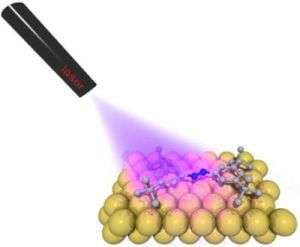
Adding legs to molecules of azobenzene adhered to a gold surface allows them to change shape when illuminated with a UV laser. Credit: M. J. Comstock et al. Physical Review Letters

Physicists at the University of California at Berkeley have produced images that show how light can control some of the smallest possible machines.

By shining ultraviolet laser light on tiny molecules of azobenzene adhered on a layer of gold, they could force the molecules to change shape at will. Potentially, the molecules could be incorporated into nanomachines in the form of remotely controlled switches, pistons or other movable components.

Scientists have experimented with shape-shifting azobenzene in previous studies, but the molecules only responded properly when suspended in liquids or incorporated into plastics, neither of which makes a very good foundation for complex nanomachines. In order to get the molecular machines to function while mounted on a gold surface, the physicists first had to add legs built of carbon and hydrogen atoms to hold the molecules slightly away from the metal.

Although the legs anchoring the molecules to the surface only provided a fraction of a nanometer of clearance (less than a billionth of a meter), it was enough to allow the molecules to move in response to the UV illumination.

The team confirmed their achievement with a series of scanning tunneling microscope images showing that they could switch the molecules' shapes from one configuration and back again.

Citation: M. J. Comstock et al., Physical Review Letters (forthcoming article)

Source: American Physical Society


print this article email this article download pdf blog this article bookmark this article     Stumble it Digg this share on Facebook retweet share on Reddit add to delicious
Rate this story - 4.6 /5 (14 votes)


July 3, 2007 all stories

Comments: 0

4.6 /5 (14 votes)
  • Stumble this up

  • Digg this

  • share this

  • hide
  • Related Stories

  • Big step in tiny technology
    created Aug 27, 2008 | popularity not rated yet | comments 0
  • Scientists overcome nanotech hurdle
    created Aug 13, 2008 | popularity not rated yet | comments 0
  • Forces out of nothing
    created Jan 10, 2008 | popularity not rated yet | comments 0
  • Pioneering research to assist in creation of nanomachines
    created Nov 14, 2007 | popularity not rated yet | comments 0
  • Light-powered micro-machines to advance telecommunications
    created Nov 02, 2007 | popularity not rated yet | comments 0


  • hide
  • Relevant PhysicsForums posts

Other News

carbon fiber

Ultra-Long Carbon Nanotubes Could Serve as Future Transmission Lines

Nanotechnology / Nanomaterials

created Nov 10, 2009 | popularity 4.9 / 5 (20) | comments 13

(PhysOrg.com) -- When it comes to carbon nanotubes, the majority of research so far has focused on small-scale applications. But now, a team of researchers from Rice University has created carbon nanotubes ...


Researchers turn algae into high-temperature hydrogen source

Researchers turn algae into high-temperature hydrogen source

Nanotechnology / Nanophysics

created Nov 12, 2009 | popularity 3.6 / 5 (7) | comments 5

In the quest to make hydrogen as a clean alternative fuel source, researchers have been stymied about how to create usable hydrogen that is clean and sustainable without relying on an intensive, high-energy ...


Argonne 'homegrown' hybrid solar cell aims for low-cost power

Argonne 'homegrown' hybrid solar cell aims for low-cost power

Nanotechnology / Nanomaterials

created Nov 10, 2009 | popularity 4.2 / 5 (11) | comments 3

(PhysOrg.com) -- Scientists at the U.S. Department of Energy’s (DOE) Argonne National Laboratory have refined a technique to manufacture solar cells by creating tubes of semiconducting material and then "growing" ...


Nanoparticles for gene therapy improve

Nanoparticles for gene therapy improve

Nanotechnology / Bio & Medicine

created Nov 06, 2009 | popularity 5 / 5 (5) | comments 3

(PhysOrg.com) -- About five years ago, Professor Janet Sawicki at the Lankenau Institute in Pennsylvania read an article about nanoparticles developed by MIT's Robert Langer for gene therapy, the insertion ...


Engineers image nanostructure of a solid acid catalyst and boost its catalytic activity

Nanotechnology / Nanomaterials

created Nov 09, 2009 | popularity 5 / 5 (3) | comments 2

The catalytic processes that facilitate the production of many chemicals and fuels could become much more environmentally friendly thanks to a breakthrough achieved by researchers from Lehigh and Rice Universities.