Air pressure matters when landing on sandy planets
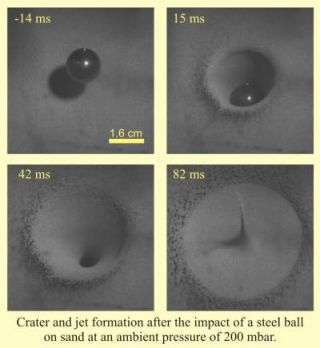
A steel ball dropped into loose, fine sand makes an impressive splash, according to physicists of the Physics of Fluids group investigating the fluid-like properties of sand at the University of Twente in the Netherlands. Such considerations factor into designing a rover to land on and move about Martian dunes or other dusty surfaces.
Just as a cannon-ball dive into a pool will send a plume of water into the air, the researchers led by Detlef Lohse found that the steel ball was instantly engulfed by the fine sand, sending up a dust plume with a height that depended on the air pressure. When they decreased the air pressure in the experiment, they found that the ball penetrated less deeply into the sand and sent up a shorter plume.
It's natural that the plume height varies with the depth of the ball's penetration into the dust because the plume is caused by the sudden collapse of the cavity formed by the steel ball's impact. Higher air pressure causes greater air-sand mixing near the surface of the ball which leads to reduced friction and more fluid-like behavior. Reduced friction means deeper penetration thus a higher plume.
Most astrophysics researchers prefer that their rovers are not buried on impact, which makes low-pressure atmospheres more favorable for landing robots on dusty planets. Luckily, the atmospheric pressure on Mars is only about 1% of the pressure here on Earth.
Citation: Gabriel Caballero et al., Physical Review Letters (forthcoming article)
Source: American Physical Society


