Researchers Hope to Unlock Capabilities of Carbon Nanotubes
July 3rd, 2007 Researchers Hope to Unlock Capabilities of Carbon Nanotubes

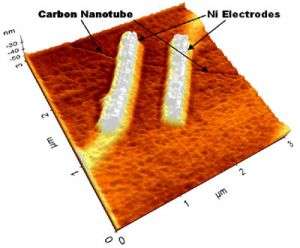
UT Dallas researchers are using nickel electrodes to explore making electrical contact with a carbon nanotube that is about one-100,000th the width of a human hair. Credit: University of Texas at Dallas

In a three-year project that researchers say could revolutionize the electronics industry, engineers at The University of Texas at Dallas are attempting to establish a standard means for tapping the potential of carbon nanotubes.

Ever since they emerged in the early 1990s, nanotubes have promised to enable a whole new wave of technology, including ultra-fast computers that leave today’s machines in their dust. But despite advances in manufacturing the tiny graphite cylinders, there’s still no standard approach for making electrical contact with them.

“We think carbon nanotubes are ideal candidates to be the building blocks of electronic devices of the future, but to exploit their unique properties you have to be able to connect them to the outside world,” said Dr. Moon Kim, a professor of electrical engineering in the Erik Jonsson School of Engineering and Computer Science at UT Dallas and the project’s principal investigator. “This will be the first time anyone has determined the extensive metal contacts that need to be established with nanotubes in order to incorporate them into new technology.”

Carbon nanotubes are particularly attractive because of their ability to carry electrical current without dissipating much heat, and heat loss is one of the semiconductor industry’s chief enemies as silicon chips’ physical features become ever smaller.

Nanotubes themselves bring new meaning to the word “small.” Their walls can be just one atom thick, forcing researchers to find a way to make an electrical connection between our big clunky world and nanotubes’ almost impossibly small one.

The $225,000 grant that’s funding the research is one of eight awarded through the new Nano-Bio-Information Technology Symbiosis program, or NBIT, jointly operated by the South Korean Ministry of Science and Technology and the U.S. Air Force Office of Scientific Research. The other U.S. universities receiving grants through the program are Harvard, Caltech, UC Berkeley, UCLA, UC San Diego, the University of Michigan and the University of Cincinnati.

“Not only is this research grant itself important, but it’s part of a trend in which we’ve been successfully competing and collaborating with some of the most prestigious engineering schools in the country,” said Dr. Bob Helms, dean of the Jonsson School. “And international collaborations like this are clearly going to be an increasingly important part of the way universities conduct research.”

The eight grant winners emerged from a field of more than 50 research proposals submitted to NBIT. Each grant involves collaborative research between U.S. and Korean researchers. The UT Dallas researchers are collaborating with a team from South Korea’s Sungkyunkwan University as well as a team from the University of Pittsburgh.

Source: University of Texas at Dallas


print this article email this article download pdf blog this article bookmark this article     Digg this Stumble it share on Facebook share on Reddit add to delicious save to Yahoo! bookmarks
4.6/5 after 12 votes


July 3rd, 2007 all stories
Nanotechnology / Nanomaterials

Comments: 0
Rank: 4.6/5 after 12 votes

  • Stumble this up

  • Digg this

  • Share it:
  • share on Facebook
  • share on MySpace
  • share on Slashdot
  • rss-newsfeed
  • share on Google
  • share on Reddit
  • add to delicious
  • save to Yahoo! bookmarks
  • share on Windows Live
  • Add to Mixx!
Rating: 4.6/5 after 12 votes


Tags


  • Physicists Demonstrate Quantum Memory with Matter Qubits
    Physicists Demonstrate Quantum Memory with Matter Qubits
    Physics / General Physics
    created Jul 03, 2009 | popularity 4.4 / 5 (17) | comments 1
  • 'Holey' Nanosheets for Wastewater Dye Removal
    Nanotechnology / Nanomaterials
    created Jul 01, 2009 | popularity 5 / 5 (5) | comments 1
  • Jellyfish Robot Swims Like its Biological Counterpart
    Jellyfish Robot Swims Like its Biological Counterpart
    Electronics / Robotics
    created Jun 26, 2009 | popularity 4.4 / 5 (8) | comments 1
  • Could Maxwell's Demon Exist in Nanoscale Systems?
    Could Maxwell's Demon Exist in Nanoscale Systems?
    Physics / General Physics
    created Jun 24, 2009 | popularity 4.4 / 5 (18) | comments 29
  • Living Safely with Robots, Beyond Asimov's Laws
    Living Safely with Robots, Beyond Asimov's Laws
    Electronics / Robotics
    created Jun 22, 2009 | popularity 4.6 / 5 (54) | comments 40
  • Other News

    Physics research with atomic force microscope could lead to better health care

    Atomic force microscope research could lead to better health care

    Nanotechnology / Nanophysics

    created 1hour ago | popularity 5 / 5 (1) | comments 0

    Where biology, chemistry and physics intersect, a Kansas State University professor expects to find applications to improve human health.


    Canadian researchers set to study impact of nanomaterials on aquatic ecosystems

    Nanotechnology / Bio & Medicine

    created 3 hours ago | popularity 5 / 5 (1) | comments 0

    A team of Canadian scientists and engineers, led by the University of Alberta and the National Research Council of Canada, will collaborate on a $3.39 million, three-year study to assess the potential effects of nanoparticles ...


    Nano Measurement in the 3rd Dimension

    Nano Measurement in the 3rd Dimension

    Nanotechnology / Nanophysics

    created 4 hours ago | popularity 3 / 5 (1) | comments 0

    From the motion sensor to the computer chip - in many products of daily life components are used whose functioning is based on smallest structures of the size of thousandths - or even millionths - of millimetres. ...


    A 'quantum of sol' -- how nanotechnology could hold the key to a solar-powered future

    A 'quantum of sol' -- how nanotechnology could hold the key to a solar-powered future

    Nanotechnology / Nanomaterials

    created Jun 30, 2009 | popularity 3.9 / 5 (16) | comments 17

    (PhysOrg.com) -- A new generation of 'nano-structured' millimetre-sized solar cells that could convert the sun's energy to electricity more than twice as efficiently as current technology, is the subject of ...


    Australian researchers are set to begin human trials of a tiny nano-cell that acts as a "Trojan horse" against cancer

    Hi-tech 'Trojan horse' can kill cancer cells: researchers

    Nanotechnology / Bio & Medicine

    created Jun 29, 2009 | popularity 4.7 / 5 (12) | comments 7

    Australian researchers are set to begin human trials of a tiny nano-cell that acts as a "Trojan horse" against cancer cells, a breakthrough they say may curb the need for debilitating chemotherapy.