Blood clotting protein may inhibit spinal cord regeneration
July 3rd, 2007 Blood clotting protein may inhibit spinal cord regeneration

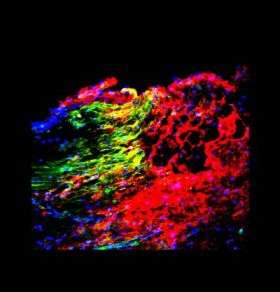
Fibrinogen (red) and activated EFGR (green) in the spinal cord after injury.

Fibrinogen, a blood-clotting protein found in circulating blood, has been found to inhibit the growth of central nervous system neuronal cells, a process that is necessary for the regeneration of the spinal cord after traumatic injury. The findings by researchers at the University of California, San Diego (UCSD) School of Medicine, may explain why the human body is unable to repair itself after most spinal cord injuries.

The study, led by Katerina Akassoglou, Ph.D., assistant professor in UCSD’s Department of Pharmacology, is the first evidence that when blood leaks into the nervous system, the blood protein contributes to the neurons’ inability to repair themselves. The findings, which show the molecular link between vascular and neuronal damage during injury to the central nervous system, was published in the online issue of the Proceedings of the National Academy of Sciences on July 2.

The research team studied three types of spinal cord injuries in mice and rats which resulted in cellular and vascular damage, and leakage of fibrinogen from the blood vessels. Once injured, neurons cannot be repaired because of various inhibitors that are present in the brain and the spinal cord after damage, which results in a patient’s paralysis. The researchers were surprised at the massive deposits of fibrinogen found at the sites of injury. That discovery led them to investigate the protein’s effect on neuronal cells’ ability to regenerate.

“Our study shows that fibrinogen directly affects neurons by inhibiting their ability for repair,” said Akassoglou. Fibrinogen – contained in the blood which leaks at the site of injury – begins the process of inhibiting axonal growth by binding to the beta 3 integrin receptor. This binding, in turn, induces the activation of another receptor on the neuronal cells, called the epidermal growth factor receptor. When the second receptor is activated, it inhibits the axonal growth. Other inhibitors have been identified that use the same epidermal growth factor receptor, but this is the first blood-derived inhibitor that has been found.

The discovery may open the door to a possible strategy to improving recovery after spinal cord injury by discovering a way to block activation of neuronal receptors by fibrinogen.
Identifying the specific inhibitors that impede the repair process could provide ways to regenerate and connect the damaged nerves and initiate recovery from paralysis after spinal cord injury.

“Inhibiting the damaging effects of fibrinogen on neurons may potentially facilitate repair in the nervous system after injury” said Akassoglou. A similar mechanism could be at work in other neurological diseases that result in paralysis, such as multiple sclerosis or hemorrhagic stroke, where blood vessels break and bleed into the brain. She added that such a therapeutic approach wouldn’t interfere with fibrinogen’s essential role in coagulation, because its blood-clotting mechanism depends on binding with a different receptor.

Source: University of California - San Diego


print this article email this article download pdf blog this article bookmark this article     Digg this Stumble it share on Facebook share on Reddit add to delicious save to Yahoo! bookmarks
4/5 after 5 votes


July 3rd, 2007 all stories
Medicine & Health / Research

Comments: 0
Rank: 4/5 after 5 votes

  • Stumble this up

  • Digg this

  • Share it:
  • share on Facebook
  • share on MySpace
  • share on Slashdot
  • rss-newsfeed
  • share on Google
  • share on Reddit
  • add to delicious
  • save to Yahoo! bookmarks
  • share on Windows Live
  • Add to Mixx!
Rating: 4/5 after 5 votes

  • Related Stories

  • Advanced nerve cell system could help cure diabetic neuropathy, related diseases
    created Jun 23, 2009 | popularity not rated yet | comments 0
  • Key found to how tumor cells invade the brain in childhood cancer
    created Jun 17, 2009 | popularity not rated yet | comments 0
  • Gray matter under attack in multiple sclerosis
    created Apr 30, 2009 | popularity not rated yet | comments 0
  • Limping rat provides sciatica insights
    created Apr 29, 2009 | popularity not rated yet | comments 0
  • Families flying toddlers to China for stem-cell treatments
    created Apr 29, 2009 | popularity not rated yet | comments 0

Tags


  • Physicists Demonstrate Quantum Memory with Matter Qubits
    Physicists Demonstrate Quantum Memory with Matter Qubits
    Physics / General Physics
    created Jul 03, 2009 | popularity 4.4 / 5 (17) | comments 1
  • 'Holey' Nanosheets for Wastewater Dye Removal
    Nanotechnology / Nanomaterials
    created Jul 01, 2009 | popularity 5 / 5 (5) | comments 1
  • Jellyfish Robot Swims Like its Biological Counterpart
    Jellyfish Robot Swims Like its Biological Counterpart
    Electronics / Robotics
    created Jun 26, 2009 | popularity 4.4 / 5 (8) | comments 1
  • Could Maxwell's Demon Exist in Nanoscale Systems?
    Could Maxwell's Demon Exist in Nanoscale Systems?
    Physics / General Physics
    created Jun 24, 2009 | popularity 4.4 / 5 (18) | comments 29
  • Living Safely with Robots, Beyond Asimov's Laws
    Living Safely with Robots, Beyond Asimov's Laws
    Electronics / Robotics
    created Jun 22, 2009 | popularity 4.6 / 5 (52) | comments 40
  • Other News

    Variations in 5 genes raise risk for most common brain tumors

    Medicine & Health / Genetics

    created 11 hours ago | popularity not rated yet | comments 1

    Common genetic variations spread across five genes raise a person's risk of developing the most frequent type of brain tumor, an international research team reports online in Nature Genetics.


    Researchers highlight new direction for drug discovery

    Medicine & Health / Research

    created 9 hours ago | popularity not rated yet | comments 0

    In a discovery that rebuffs conventional scientific thinking, researchers at Georgetown University Medical Center (GUMC) have discovered a novel way to block the activity of the fusion protein responsible for Ewing's sarcoma, ...


    MicroRNAs hold promise for treating diseases in blood vessels

    Medicine & Health / Research

    created 11 hours ago | popularity not rated yet | comments 0

    A newly discovered mechanism controls whether muscle cells in blood vessels hasten the development of both atherosclerosis and Alzheimer's disease, according to an article published online today in the journal Nature.


    Wind power may have its own environmental problems

    Medicine & Health / Health

    created 10 hours ago | popularity 3.8 / 5 (5) | comments 3

    Wind power generation is expected to be a clean and environmentally friendly natural energy source, but a new kind of environmental problem has surfaced as infrasonic waves caused by windmills are suspected of causing health ...


    Malaysian authorities seize 'Viagra coffee' : report

    Medicine & Health / Health

    created 14 hours ago | popularity not rated yet | comments 1

    Malaysia's health authorities have seized over 20,000 dollars worth of coffee mixed with sildenafil, the main ingredient in erectile dysfunction drug Viagra, a report said Sunday.