ILC's High-Energy Collisions Require Accurate Energy Measurements
The International Linear Collider (ILC) collaboration proposes to crash electron and positron beams together with a total energy of 500 GeV (billion electron volts). The actual energy of each beam will vary slightly from one bunch of particles to the next, so just before the collision point, energy spectrometers will measure each bunch's exact energy.
"We need to be able to measure the beam energy with an accuracy of one part in 10,000 to establish the masses of the new particles we'll hopefully see," said Yury Kolomensky, associate professor of physics at the University of California-Berkeley.
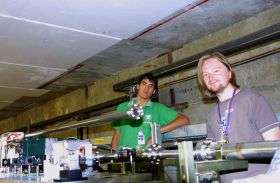
Kolomensky and his collaborators (from SLAC, the University of California, Berkeley, and the University of Notre Dame in the U.S.; University College London, Royal Holloway College, and Cambridge University in the U.K.; DESY in Germany; and Dubna in Russia) have installed their prototype energy spectrometer on the beam line in End Station A. For most of July, a test beam of electrons will whiz down the beam line, letting Kolomensky and others test equipment under ILC-like conditions. The energy of the test beam is about ten times less than that of an ILC beam, but has the same bunch length and charge.
Existing spectrometers can't provide the required accuracy for a single bunch at a time. The prototype starts where most energy spectrometers do, with a set of magnets that deflect the beam. Beam position monitors, provided by SLAC and a group from University College London, measure the amount of deflection. The higher the beam's energy, the less the beam gets deflected. In End Station A, four magnets bend the beam about 5 millimeters horizontally over the course of the 20-meter-long energy spectrometer set-up.
In addition, the prototype has a way to very precisely and very accurately measure the magnetic field over the entire spectrometer during each pulse of the beam. 'Precisely' is like throwing darts that all land very close to one another; 'accurately' is all those darts hitting the bull's-eye. Collaborators from DESY and Dubna worked with the Magnetic Measurement Group at SLAC this past fall and winter to determine the magnetic fields at all positions along the beam trajectory through the spectrometer magnets.
After testing the components in March, researchers are now ready to run. "The goal is to have a demonstration of the technology that will ultimately go into the ILC design," Kolomensky said.
Source: by Heather Rock Woods, SLAC Today


