Logitech Unveils the World´s First Laser Mouse
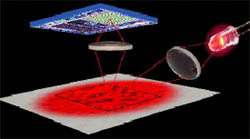
Logitech the leading manufacturer of computer mice, today announced the Logitech® MX™1000 Laser Cordless Mouse, the world´s first mouse to use laser illumination and tracking. Combining laser with Logitech´s powerful MX processing engine and Fast RF™ wireless technology, the Logitech MX 1000 Laser Cordless Mouse sets a new performance benchmark for responsiveness and accuracy.
Laser is the latest in a long list of mouse firsts for Logitech, a roster that includes the first commercially available mouse in 1982, the first cordless mouse in 1984, and the first cordless optical mouse in 2001. Now, Logitech introduces the first mouse with laser tracking technology.
Logitech has taken the first step beyond LED illumination with the unveiling of a true, next-generation engineering breakthrough: laser illumination and tracking with the MX1000 Cordless Laser Mouse. For gamers, graphic artists, CAD engineers, medical technicians, and business users alike, laser technology is an innovation that delivers a new benchmark in mouse performance.
The laser tracking technology is the result of an alliance between Logitech, the world´s No. 1 manufacturer of mice, and Agilent Technologies, the leader in mouse tracking technology.The culmination of years of research has produced laser technology that delivers astonishingly precise tracking. The nearly singular wavelength of laser light is capable of revealing much greater surface detail than the red light-emitting diode (LED) found in today´s optical mice. In tests conducted at Agilent, the laser mouse was found to have 20 times more sensitivity to surface detail than LED optical mice. Hence, the laser can track reliably even on tricky polished or wood-grain surfaces.
Laser tracking responds to the slightest hand movement with extraordinary accuracy. And it does so on virtually any surface, white or black, solid or pattern, shiny or matte. Laser illumination tracks flawlessly on the high-gloss surfaces that LED-based mice simply can’t negotiate. These surfaces include lacquered tabletops, glazed ceramic tile, untextured plastic, metal surfaces, photo paper, laminate countertops, opaque glass, and more.
In a recent Logitech survey of more than 2,000 LED-based optical mice users, more than two-thirds of respondents were interested in the ability to use a mouse on more surfaces. Because of their ability to illuminate the surface in greater detail, laser mice will track on surfaces on which LED-based optical mice tend to falter. Mouse pads, those dustcatching relics from the era of rolling-ball mice, are, at last, no longer necessary for smooth operation.
The laser light of the Logitech MX 1000 Laser Cordless Mouse is nearly invisible to the human eye — and very safe. The laser beam emanates through a polished silver ring on the base, illuminates the surface beneath the mouse, and then reflects back up through the same ring where the surface detail is captured by the sensor. The sensor has the ability to capture 5.8 megapixels of detail each second. As the laser mouse is moved, the sensor sees minute changes in the surface detail, which then translates into cursor motion on screen.
“Our team of engineers has once again raised the bar with the invention of the laser illumination and tracking engine,” said Jason Hartlove, vice president and general manager of Agilent´s Sensor Solutions Division. “We are pleased to be working with Logitech again to introduce a cutting edge technology, as together we have a long and successful history of collaboration. The first laser mouse is bound to set a new standard for performance.”
“Lasers are a natural evolution of the optical mouse, as their illumination enhances surface textures invisible under LED illumination,” said Martin Reynolds, vice president of research firm Gartner, Inc. “This is physics in action, and will become one of the top volume applications for lasers.”
While the laser is the key technological innovation that powers the Logitech MX 1000 Laser Cordless Mouse, there are several other features that set it apart from other mice:
Optimized Navigation and Supreme Control
The Logitech MX 1000 Laser Cordless Mouse empowers people with new levels of navigation control. It features Logitech´s new Tilt Wheel Plus Zoom, enabling the ability to scroll in three dimensions: up and down, left and right, and in and out. When working with applications such as PowerPoint or Word, it´s easy to quickly zoom in to tweak the fine points of a slide or report, and then zoom out to see the entire document layout. When people apply pressure to the left or right of the wheel, they can efficiently scroll horizontally through wide documents in applications such as Excel, or easily browse left and right through images in the Windows® XP Filmstrip mode. The MX 1000 also incorporates Logitech´s proprietary Cruise Control™ speed scrolling system, providing rapid scrolling through large Web pages and long documents when the user holds down the buttons above and below the scroll wheel. Also, a small chrome assembly atop the thumb rest includes Internet Forward and Back buttons and the Application Switch button, which allows one-click switching between open windows.
Sophisticated Design
The Logitech MX 1000 Laser Cordless Mouse has a sophisticated look and feel. Its contour shape is accentuated by a concave thumb-rest on one side, which is opposed by a sculpted side-grip for a pinkie and fourth finger. The chrome island that encircles the scroll wheel contrasts with its rubberized, black grips and steel grey keyplates. A polished metal ring on the base of the mouse encircles the laser exit. And the exterior is solid — it´s void of any loose panels, and absent of any battery door because the mouse is rechargeable. The mouse has the kind of style, subtle detail, personality and comfort that are renowned traits of Logitech´s award-winning product designs.
State-of-the-Art Fast RF Wireless
The Logitech MX 1000 Laser Cordless Mouse includes Logitech´s proprietary Fast RF technology. Fast RF enables the same rate of wireless data transfer as that of corded mice operating through a USB port. Fast RF, which uses the 27 MHz band, allows mice to deliver up to 125 reports per second, approximately 2.5 times more than other RF-based cordless mice. As the number of reports per second increases, the motion of the cursor on the screen becomes more fluid. Likewise, as the number of reports per second increases, the motion of the cursor mimics the movement of the mouse with increased precision.
Advanced Power System
The Logitech MX 1000 Laser Cordless Mouse brings power management to new heights. It is the first mouse with a four-level integrated battery indicator. The four bars illuminate, allowing easy monitoring of the battery level. It´s rechargeable — the mouse includes a docking cradle that is both a wireless receiver and recharger. The mouse is also maintenance free. The nuisance of battery replacement is non-existent in that the Logitech MX 1000 Laser Cordless Mouse ships with an integrated lithium ion battery. A complete charge for the mouse takes 3-4 hours, which typically lasts 21 days. In addition, with rapid recharge after 10 minutes in the cradle, the mouse is charged for a full day´s worth of use.
Pricing and Availability
The Logitech MX 1000 Laser Cordless Mouse will be available on retail shelves in the U.S. and in Europe and at www.logitech.com beginning this month. Its suggested retail price is $79.95 in the U.S.


