Two new lakes found beneath Antarctic ice sheet
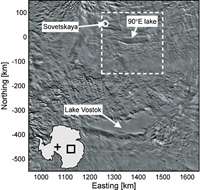
The Earth Institute at Columbia University--Lying beneath more than two miles of Antarctic ice, Lake Vostok may be the best-known and largest subglacial lake in the world, but it is not alone down there. Scientists have identified more than 145 other lakes trapped under the ice. Until now, however, none have approached Vostok's size or depth.
In the February 2006 issue of Geophysical Research Letters, scientists from the Lamont-Doherty Earth Observatory, a member of The Earth Institute at Columbia University, describe for the first time the size, depth and origin of Vostok's two largest neighbors. The two ice-bound lakes are referred to as 90╨E and Sovetskaya for the longitude of one and the Russian research station coincidentally built above the other. The scientists' findings also indicate that, as suspected with Lake Vostok, an exotic ecosystem may still be thriving in the icy waters 35 million years after being sealed off from the surface.
Geophysicists Robin Bell and Michael Studinger of Lamont-Doherty combined data from ice-penetrating radar, gravity surveys, satellite images, laser altimetry and records of a Soviet Antarctic Expedition that unknowingly traversed the lakes in 1958-1959. The shorelines of the lakes appeared in satellite images of the region as perturbations in the surface of the East Antarctic ice sheet. In addition, because the ice is effectively floating on the surface of the lakes, the ice sheet exhibits slight depressions over the lakes that appear in radar and laser elevations.

Bell and Studinger, along with colleagues from the University of New Hampshire and NASA, report that the 90╨E Lake has a surface area of 2,000km2, which is about the size of Rhode Island, and is second only to Lake Vostok's 14,000km2 surface area. Sovetskaya Lake was calculated to be about 1,600 km2. Both are sealed beneath more than two miles of ice.
The lake depths, estimated to be at least 900 meters, were calculated from gravity data taken during aerial surveys in 2000 and 2001. Because gravitational force is directly related to mass, a decrease in gravitational pull over the ice sheet corresponds to a decrease in mass beneath the ice. "Over the lakes, the pull of gravity is much weaker, so we know there must be a big hole down there," said Bell.
Their depth, along with the fact that they are parallel to each other and Lake Vostok, indicate that the lake system is tectonic in origin, the authors conclude.
Shallow lakes scooped out by glaciers or a meteorite impact can quickly fill with sediment, and thus are short lived. Lakes created by faulted blocks of the Earth's crust, however, are deeper and don't fill in as rapidly. Many of the smaller sub-glacial lakes scientists have identified so far are believed to be shallow "ephemeral" lakes that were suddenly sealed off by the ice.
The combination of heat from below and a thick layer of insulating ice above keeps the water temperature at the top of 90ºE and Sovetskaya at a balmy √2 degrees Celsius, despite temperatures on the surface that can drop to √80 degrees Celsius in winter. Since the lakes are bounded by faults, Bell said it is likely the lakes receive flows of nutrients that could support unique ecosystems. Moreover, laser mapping of the ice sheet surface by NASA's Ice Cloud and Land Elevation Satellite (ICESat) revealed that this water-ice boundary, or ceiling, is tilted.
"Since the surface is tilted, we know that the ice sheet changes thickness over the lake and that will drive circulation in the lake," said Bell. "This will provide mixing and distribute whatever nutrients are in the lake, which is an important component of subglacial ecosystems."
This, along with the tectonic origin of the lakes, supports the idea that despite climate changes on the surface over the last 10 million to 35 million years, the volume of the lakes have remained remarkably constant, providing a stable, if inhospitable, environment that may harbor an ancient and alien ecosystem adapted to life beneath the ice sheet. However, just how, when or even whether scientists will risk the possibility of contaminating the lakes to confirm their suspicions remains the subject of an ongoing international debate.
Source: The Earth Institute at Columbia University


