DNA-wrapped carbon nanotubes serve as sensors in living cells
January 26, 2006 DNA-wrapped carbon nanotubes serve as sensors in living cells

Michael Strano, a professor of chemical and biomolecular engineering, and his research team´s discovery opens the door to new types of optical sensors and biomarkers that exploit the unique properties of nanoparticles in living systems.

Single-walled carbon nanotubes wrapped with DNA can be placed inside living cells and detect trace amounts of harmful contaminants using near infrared light, report researchers at the University of Illinois at Urbana-Champaign. Their discovery opens the door to new types of optical sensors and biomarkers that exploit the unique properties of nanoparticles in living systems.

"This is the first nanotube-based sensor that can detect analytes at the subcellular level," said Michael Strano, a professor of chemical and biomolecular engineering at Illinois and corresponding author of a paper to appear in the Jan. 27 issue of the journal Science. "We also show for the first time that a subtle rearrangement of an adsorbed biomolecule can be directly detected by a carbon nanotube."

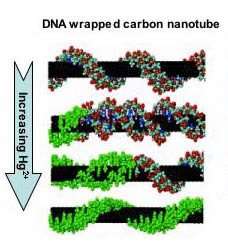
At the heart of the new detection system is the transition of DNA secondary structure from the native, right-handed "B" form to the alternate, left-handed "Z" form.
DNA-wrapped carbon nanotubes serve as sensors in living cells
Enlarge


"We found that the thermodynamics that drive the switching back and forth between these two forms of DNA structure would modulate the electronic structure and optical emission of the carbon nanotube," said Strano, who is also a researcher at the Beckman Institute for Advanced Science and Technology and at the university's Micro and Nanotechnology Laboratory.

To make their sensors, the researchers begin by wrapping a piece of double-stranded DNA around the surface of a single-walled carbon nanotube, in much the same fashion as a telephone cord wraps around a pencil. The DNA starts out wrapping around the nanotube with a certain shape that is defined by the negative charges along its backbone.

When the DNA is exposed to ions of certain atoms -- such as calcium, mercury and sodium -- the negative charges become neutralized and the DNA changes shape in a similar manner to its natural shape-shift from the B form to Z form. This reduces the surface area covered by the DNA, perturbing the electronic structure and shifting the nanotube's natural, near infrared fluorescence to a lower energy.

"The change in emission energy indicates how many ions bind to the DNA," said graduate student Daniel Heller, lead author of the Science paper. "Removing the ions will return the emission energy to its initial value and flip the DNA back to the starting form, making the process reversible and reusable."

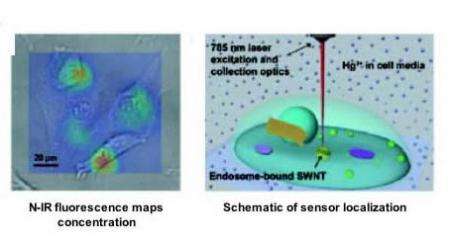
The researchers demonstrated the viability of their measurement technique by detecting low concentrations of mercury ions in whole blood, opaque solutions, and living mammalian cells and tissues -- examples where optical sensing is usually poor or ineffective. Because the signal is in the near infrared, a property unique to only a handful of materials, it is not obscured by the natural fluorescence of polymers and living tissues.

"The nanotube surface acts as the sensor by detecting the shape change of the DNA as it responds to the presence of target ions," Heller said.

Source: University of Illinois at Urbana-Champaign


print this article email this article download pdf blog this article bookmark this article     Stumble it Digg this share on Facebook retweet share on Reddit add to delicious
Rate this story - 3.9 /5 (15 votes)


January 26, 2006 all stories

Comments: 0

3.9 /5 (15 votes)
  • Stumble this up

  • Digg this

  • share this

  • hide
  • Related Stories

  • With help of DNA, nanotubes may become a bigger force
    created Aug 04, 2009 | popularity not rated yet | comments 0
  • Proton radiation more dangerous than once thought
    created Feb 20, 2006 | popularity not rated yet | comments 0
  • Military experiment seeks to predict PTSD
    created Nov 20, 2009 | popularity not rated yet | comments 0
  • Beyond genomics, biologists and engineers decode the next frontier
    created Nov 18, 2009 | popularity not rated yet | comments 0
  • Sponges recycle carbon to give life to coral reefs
    created Nov 13, 2009 | popularity not rated yet | comments 0


Other News

Peptides control crystal growth with 'switches, throttles and brakes'

Peptides control crystal growth with 'switches, throttles and brakes'

Nanotechnology / Bio & Medicine

created 14 hours ago | popularity 5 / 5 (3) | comments 0

(PhysOrg.com) -- By producing some of the highest resolution images of peptides attaching to mineral surfaces, scientists have a deeper understanding how biomolecules manipulate the growth crystals. This research ...


Water droplets direct self-assembly process in thin-film materials

Nanotechnology / Nanomaterials

created 13 hours ago | popularity 5 / 5 (4) | comments 2

You can think of it as origami - very high-tech origami. Researchers at the University of Illinois have developed a technique for fabricating three-dimensional, single-crystalline silicon structures from thin films by coupling ...


Nanoparticles used in common household items caused genetic damage in mice

Nanotechnology / Bio & Medicine

created Nov 16, 2009 | popularity 4.8 / 5 (24) | comments 11

Titanium dioxide (TiO2) nanoparticles, found in everything from cosmetics to sunscreen to paint to vitamins, caused systemic genetic damage in mice, according to a comprehensive study conducted by researchers at UCLA's Jonsson ...


Nanotube defects equal better energy and storage systems

Nanotube defects equal better energy and storage systems

Nanotechnology / Nanomaterials

created Nov 19, 2009 | popularity 4.4 / 5 (10) | comments 2

(PhysOrg.com) -- Most people would like to be able to charge their cell phones and other personal electronics quickly and not too often. A recent discovery made by UC San Diego engineers could lead to carbon ...


Using superconducting probes to get a picture of what it's like inside CNTs

Nanotechnology / Nanophysics

created Nov 20, 2009 | popularity 4.4 / 5 (9) | comments 0

(PhysOrg.com) -- "Carbon nanotubes are exciting for fundamental physics, and for potential technological applications," Nadya Mason tells PhysOrg.com. "However, we are generally limited in the way that we can study them. ...