Link between immune system and mammary gland could shed new light on breast cancer
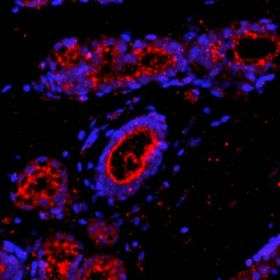
Scientists at the University of Cambridge have published new research today (5 July) in the journal Development showing an unexpected link between a fundamental part of the immune system and the cells that produce milk in the breast during lactation.
The researchers, funded by the Biotechnology and Biological Sciences Research Council (BBSRC), found that cytokines, which have a central role in immune response, are used in the breast to promote the production of milk producing cells. The finding has implications for understanding breast cancer as cells that respond incorrectly to cytokine signalling can grow out of control and become cancerous.
When the body needs to fight infection it makes specific cells that respond to the invading organism. These cells are either T helper Type 1 to fight a virus or T helper Type 2 to attack a parasite. Once made each type of T cell releases cytokine molecules to promote more of its own kind to help the body’s immune response. The Cambridge researchers have shown that during pregnancy the mammary gland uses this system to enhance the growth of milk producing cells.
The breast uses Type 2 T helper cytokines as a signal to get resting mammary duct cells to begin dividing and differentiating to produce large numbers of milk-producing cells. These cells then release more cytokine molecules to get the body to make yet more milk producing cells. Using a mouse model, the scientists were able to conclusively demonstrate the role of the Type 2 cytokines. When the signalling molecules were not present, production of milk producing cells was vastly reduced.
Dr Walid Khaled from the University’s Department of Pathology conducted the research. He explains: “This really was an unexpected discovery. Up until now we thought that breast development was controlled by just steroid and peptide hormones. The discovery of this role played by aspects of the immune system will open up new avenues for examining the development of breast cancer, particularly in women who have just had a baby, a time when there is a greater risk of breast cancer.”
Dr Khaled’s research demonstrates the importance of investigating basic biology in order to better understand disease. Dr Christine Watson leads the research group at the University of Cambridge. She comments: “The breast undergoes tremendous and amazing changes during and after pregnancy. The body generates milk producing cells using signalling mechanisms adopted from the immune system and once a child is weaned these cells die and the mammary gland returns to its pre-pregnant state. It is vital that we understand the processes involved as it is when these normal developmental events go wrong that we are at risk of cancer developing.”
Source: Biotechnology and Biological Sciences Research Council


