Research ends debate over benefits of butterfly defenses
July 5, 2007 Research ends debate over benefits of butterfly defenses

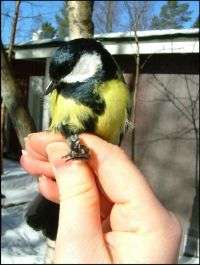
Researchers observed how a butterfly evolves to protect themselves from predators, such as the Great-tit.

Researchers observed the behaviour of Great-tits foraging for artificial prey to understand more clearly how a species evolves to protect themselves from predators.

Insects, such as butterflies, have bright contrasting colour patterns that indicate to predators that they are not likely to be palatable. In order to gain greater protection from predators, however, some butterflies evolve to imitate the warning signals of a more highly defended species – a phenomenon known as mimicry. Scientists at Liverpool, in collaboration with the University of Jyväskylä in Finland, tested which species of butterfly benefits the most from this technique.

Hannah Rowlands explains: “Previous studies have suggested that the relationship between two look-alike species is parasitic, whereby a ‘tastier’ insect reaps all the benefits of resembling a more unpalatable species. Scientists have argued that predators may get confused as to which species is most edible and which is not, resulting in them eating more of the unpalatable species than they normally would have done.

“We found that the two species of butterfly we used in our research do not undermine each other and benefit mutually from looking like each other. Copying in this sense is the highest form of flattery!”

In order to understand how this technique benefited both species of butterfly the team devised an experiment in an indoor aviary and observed the behaviour of Great-tits as they attacked artificial prey made from almond filled paper parcels.

Hannah added: “We coated some of the almonds in a non-toxic chemical which gave them a nasty taste, while others were moderately distasteful and some were left to taste simply of almonds. The birds in our aviary learnt to avoid the highly distasteful species quicker than the moderately distasteful ones. The ‘tastier’ species still benefited, however, in that the birds eventually learnt that in order to stop mistakenly eating the distasteful prey, they must stop eating both species altogether.

“We can now apply this model to other insects that use mimicking techniques, giving us greater insight into why particular species evolve to resemble one another and change their behaviour.”

Source: University of Liverpool


print this article email this article download pdf blog this article bookmark this article     Stumble it Digg this share on Facebook retweet share on Reddit add to delicious
Rate this story - 4.7 /5 (3 votes)


July 5, 2007 all stories

Comments: 0

4.7 /5 (3 votes)
  • Stumble this up

  • Digg this

  • share this

  • hide
  • Related Stories

  • Gulf fritillary is back
    created Sep 24, 2009 | popularity not rated yet | comments 0
  • Hind wings help butterflies make swift turns to evade predators, study finds
    created Jan 07, 2009 | popularity not rated yet | comments 0
  • Painting by numbers
    created Sep 29, 2006 | popularity not rated yet | comments 0
  • Tree-eating bugs threaten Monarch butterfly in Mexico
    created Nov 21, 2009 | popularity not rated yet | comments 0
  • Can biodiversity persist in the face of climate change?
    created Nov 06, 2009 | popularity not rated yet | comments 0


Other News

Golden Oldie: Key Role for Ancient Protein in Algae Photosynthesis

Golden Oldie: Key Role for Ancient Protein in Algae Photosynthesis

Biology / Biotechnology

created 4 hours ago | popularity not rated yet | comments 1

The discovery that an ancient light harvesting protein plays a pivotal role in the photosynthesis of green algae should help the effort to develop algae as a biofuels feedstock. Researchers with the Lawrence ...


Hammerhead shark

Wide heads give hammerheads exceptional stereo view

Biology / Plants & Animals

created 13 hours ago | popularity 4.4 / 5 (5) | comments 4

Hammerhead sharks are some of the Ocean's most distinctive residents. 'Everyone wants to understand why they have this strange head shape,' says Michelle McComb from Florida Atlantic University. One possible ...


Indonesia rejects Bali plan for turtle sacrifices (AP)

Indonesia rejects Bali plan for turtle sacrifices

Biology / Ecology

created 11 hours ago | popularity not rated yet | comments 0

(AP) -- Indonesia has rejected a push by the resort island of Bali for rare turtles to be legally slain in Hindu ceremonies, siding with conservationists of the protected reptiles against religious advocates, ...


Tough yet stiff deer antler is materials scientist's dream

Biology / Plants & Animals

created 13 hours ago | popularity 3 / 5 (1) | comments 2

Prized for their impressive antlers, red deer have been caught in the hunters' sights for generations. But a deer's antlers are much more than decorative. They are lethal weapons that stags crash together when duelling. John ...


Ecologists sound out new solution for monitoring cryptic species

Biology / Ecology

created 13 hours ago | popularity not rated yet | comments 0

Ecologists have at last worked out a way of using recordings of birdsong to accurately measure the size of bird populations. This is the first time sound recordings from a microphone array have been translated into accurate ...