Oldest DNA Ever Recovered Suggests Earth Was Warmer
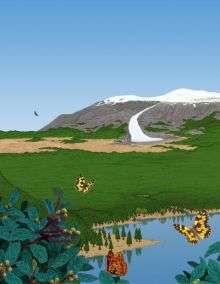
Ancient Greenland was green. New Danish research has shown that it was covered in conifer forest and, like southern Sweden today, had a relatively mild climate. Eske Willerslev, a professor at Copenhagen University, has analysed the world’s oldest DNA, preserved under the kilometre-thick icecap. The DNA is likely close to half a million years old, and the research is painting a picture which is overturning all previous assumptions about biological life and the climate in Greenland.
The results have just been published in the prestigious scientific journal Science.
Ten percent of the Earth’s surface has been covered with ice for thousands of years. No one knows what lies beneath the kilometre-deep icecaps. These are the earth’s unknown and unexplored regions. But some have begun the exploration. Several projects under Danish leadership have been drilling through the icecap on Greenland, and collected complete columns of ice all the way from the top to the bottom. The ice has annual layers and is a frozen archive of the world’s climate.
“I wonder, if there could also be DNA down there”, thought Eske Willerslev, who is the world’s leading expert in extracting DNA from organisms buried in permafrost. His thinking was that perhaps he could reconstruct the environment of the past.
Ice-core samples of ancient sediment
The icecap itself is comprised of pure ice, but the lower sections are mixed with mud from the bottom, and it was this mud that Eske Willerslev wanted to research. He got base layer samples from three drillings; DYE-3 drilling in the southern part of Greenland, the GRIP drilling in the middle of the Greenlandic ice sheet, and for the third core base layer sample he used the John Evans glacier in Canada.
The Canadian glacier is only a few thousand years old, and samples from it were used to test the method. From the base layer samples of the ice he found DNA from three of the four most common plants which grow in the area. “That means that, what one finds under the ice, represents the local environment” explains Eske Willerslev.
In the base layer sample from the GRIP drilling, from the middle of the Greenlandic ice sheet, there were no DNA remains at all- not from plants, mammals or insects. “The explanation,” he says, “is that the ice in the middle of the ice sheet is very thick- over three kilometres, and the greater pressure produces a higher temperature at the base, and so the DNA material, which cannot tolerate warmth, disintegrates”.
Ancient Flora and Fauna
At the DYE-3 drilling-site, the ice is ‘only’ two kilometres thick, and here the DNA-material was so well preserved that Eske Willerslev could extract genetic traces of a long list of plants and insects and thereby reconstruct ancient plant and animal life.
“This genetic material presents a biological environment, which is completely different to what we see today.” he says. “We have found grain, pine, yew and alder. These correspond to the landscapes we find in Eastern Canada and in the Swedish forests today. The trees provide a backdrop from which we can also ascertain the climate since each species has its own temperature requirements. The yew trees reveal that the temperature during the winter could not have been lower than minus 17 degrees Celsius, and the presence of other trees shows that summer temperatures were at least 10 degrees”.
Climate theories over-turned
The research results are the first direct proof that there was forest in southern Greenland. Furthermore Willerslev found genetic traces of insects such as butterflies, moths, flies and beetles. But when was that" According to most scientific theories to date, all of southern Greenland and most of the northern part were ice-free during the last interglacial period 125,000 years ago, when the climate was 5 degrees warmer than the interglacial period we currently live in.
This theory however, was not confirmed by Willerslev and co-workers subsequent datings. He analysed the insects’ mitochondria, which are special genomes that change with time and like a clock can be used to date the DNA. He also analysed their amino acids which also change over time. Both datings showed that the insects were at least 450,000 years old.
The ice-core researchers are experts at analysing the fine dust which blows onto the ice and is preserved year by year. They advocate two further datings. One is dating by optically stimulated luminescence. It is a method where the examined minerals can be affected to give off a type of light, which depends on how long it has been since the minerals were last exposed to sunlight.
The other method is radioactive dating. “We can fix when the ice was last in contact with the atmosphere,” says Jørgen Peder Steffensen who is a researcher in the Ice and Climate group at the Niles Bohr Institute at Copenhagen University. He explains that the special isotopes, Beryllium-10 and Chlorine-36 both have a particular half-life of radioactive decay (just like Carbon-14). The relation between them can date when the ice and dust were buried and no longer came in contact with the atmosphere.
The dating of dust particles also showed that it has been at least 450,000 years ago since the area of the DYE-3 drilling, in the southern part of Greenland, was ice-free.
That signifies that there was ice there during the Eemian interglacial period 125,000 years ago. It means that although we are now confronted with global warming, the whole ice sheet will not melt and bring about the tremendous sea-level rises which have been the subject of so much discussion.
Source: University of Copenhagen


