The Earth is smaller than assumed: German researchers
July 5, 2007 Earth

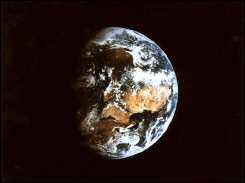
German researchers at the University of Bonn said that the world is smaller than first thought.

Although the discrepancy is not large, it is significant: Geodesists from the University of Bonn have remeasured the size of the Earth in a long lasting international cooperation project. The blue planet is accordingly some millimeters smaller than previously assumed.

The results are important, for example, to be able to demonstrate a climate contingent rise in sea level. The results have now appeared in the renowned Journal of Geodesy.

The system of measurement used by the Bonn Geodesists is invisible. It consists of radiowaves that are transmitted into space from punctiform sources, the so-called Quasars. A network of more than 70 radio telescopes worldwide receives these waves. Because the gaging stations are so far apart from each other, the radio signals are received with a slight time-lag.

"From this difference we can measure the distance betwen the radio telescopes—and to the preciseness of two millimeters per 1,000 kilometers ", explained Dr. Axel Nothnagel, reasearch group leader for the Geodesy Institute of the University of Bonn.

The procedure is called VLBI, which stands for "Very Long Baseline Interferometry". The technique can be used, for example, to demonstrate that Europe and North America are distancing from each other at a rate of about 18 millimeters annually. The distance of the gaging stations from each other allows the the size of the Earth or the exact location of the center of the Earth to be determined.

"We have analyzed the measurements and calculations from 34 partners in 17 countries",explained Nothnagel. "A combination of GPS and satellite laser measurements will enable the availability of the coordinates from almost 400 points on the surface of the Earth with unparalleled exactness."

The results are the basis for a new coordinate system for the planet. With this system it would be possible, for example, to determine the track of so-called Altimeter-Satellites within a few millimeters precision. Altimeter-Satellites measure their altitude over the Earth’s surface and can, for example, register a rise in sea level. Deviations from the flight path, however, falsify the result. If the satellite flies higher than expected, the distance to the surface of the Earth differentiates from what is recorded—the sea level appears lower than it really is.

Source: University of Bonn


print this article email this article download pdf blog this article bookmark this article     Stumble it Digg this share on Facebook retweet share on Reddit add to delicious
Rate this story - 4.3 /5 (38 votes)


July 5, 2007 all stories

Comments: 0

4.3 /5 (38 votes)
  • Stumble this up

  • Digg this

  • share this

  • hide
  • Related Stories

  • Oases for Life on the Mid-Caymen Rise
    created Oct 21, 2009 | popularity not rated yet | comments 0
  • Diverting Sediment-rich Water Below New Orleans Could Lead to Extensive New Land
    created Oct 20, 2009 | popularity not rated yet | comments 0
  • 3 questions: Ben Weiss discusses what a wet moon might mean
    created Sep 30, 2009 | popularity not rated yet | comments 0
  • Honey, I Blew up the Tokamak
    created Aug 31, 2009 | popularity not rated yet | comments 0
  • Shuttle to carry 'Constrained Vapor Bubble' experiment to International Space Station
    created Aug 25, 2009 | popularity not rated yet | comments 0


  • hide
  • Relevant PhysicsForums posts

  • Himalayan glaciers
    created 2 hours ago
  • upcoming GRL paper shows CO2 fraction is constant
    created 8 hours ago
  • Is there a point to buying organic?
    created 11 hours ago
  • cycles
    created Nov 08, 2009
  • More from Physics Forums - Earth

Other News

Earth

Early life on Earth may have developed more quickly than thought

Space & Earth / Earth Sciences

created 46 minutes ago | popularity not rated yet | comments 0

The Earth's climate was far cooler -- perhaps more than 50 degrees -- billions of years ago, which could mean conditions for life all over the planet were more conducive than previously believed, according ...


sky, sun

A lightning strike in Africa helps take the pulse of the sun

Space & Earth / Space Exploration

created 56 minutes ago | popularity not rated yet | comments 0

Sunspots, which rotate around the sun's surface, tell us a great deal about our own planet. Scientists rely on them, for instance, to measure the sun's rotation or to prepare long-range forecasts of the Earth's ...


Earth's early ocean cooled more than a billion years earlier than thought: Stanford study

Earth's early ocean cooled more than a billion years earlier than thought (w/ Video)

Space & Earth / Earth Sciences

created 1hour ago | popularity 5 / 5 (1) | comments 0

(PhysOrg.com) -- The scalding-hot sea that supposedly covered the early Earth may in fact never have existed, according to a new study by Stanford University researchers who analyzed isotope ratios in 3.4 ...


Exoplanets Clue to Sun's Curious Chemistry

Exoplanets Clue to Sun's Curious Chemistry

Space & Earth / Astronomy

created 2 hours ago | popularity 4.7 / 5 (3) | comments 3

(PhysOrg.com) -- A ground-breaking census of 500 stars, 70 of which are known to host planets, has successfully linked the long-standing "lithium mystery" observed in the Sun to the presence of planetary systems. ...


A bubbling ball of gas

A bubbling ball of gas (w/ Video)

Space & Earth / Space Exploration

created 3 hours ago | popularity 5 / 5 (4) | comments 2

The Sun is a bubbling mass. Packages of gas rise and sink, lending the sun its grainy surface structure, its granulation. Dark spots appear and disappear, clouds of matter dart up - and behind the whole thing ...