Engineered Blood Vessels Function like Native Tissue

July 5, 2007

Blood vessels that have been tissue-engineered from bone marrow adult stem cells may in the future serve as a patient's own source of new blood vessels following a coronary bypass or other procedures that require vessel replacement, according to new research from the University at Buffalo Department of Chemical and Biological Engineering.

"Our results show that bone marrow is an excellent source of adult stem cells containing smooth muscle and endothelial cells, and that these stem cells can be used in regenerative medicine for cardiovascular applications," said Stelios T. Andreadis, Ph.D., associate professor in the UB Department of Chemical and Biological Engineering in the School of Engineering and Applied Sciences.

Andreadis co-authored the paper, published recently in Cardiovascular Research, with Jin Yu Liu, Ph.D., lead author and a post doctoral researcher in Andreadis' lab.
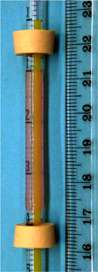
Engineered Blood Vessels Function like Native Tissue

UB researchers have developed a method to produce blood vessels tissue-engineered from bone marrow adult stem cells.

The research demonstrates the potential for eventually growing tissue-engineered vessels out of stem cells harvested from the patients who need them, providing a desirable alternative to the venous grafts now routinely done in patients undergoing coronary bypass operations.

Disadvantages with venous grafts include limited availability of vessels, pain and discomfort at the donor site and a high 10-year failure rate.

The UB researchers developed a novel method for isolating functional smooth muscle cells from bone marrow by using a fluorescent marker protein and a tissue-specific promoter for alpha-actin, a protein found in muscles that is responsible for their ability to contract and relax.

Although not yet strong enough for coronary applications, the UB group's tissue-engineered vessels (TEVs) performed similarly to native tissue in critical ways, including their morphology, their expression of several smooth muscle cell proteins, the ability to proliferate and the ability to contract in response to vasoconstrictors, one of the most important properties of blood vessels.

The TEVs also produced both collagen and elastin, which give connective tissue their strength and elasticity and are critical to the functioning of artificial blood vessels.

"These are the first tissue-engineered vessels to demonstrate the ability to make elastin in vivo," said Andreadis.

In addition, the smooth muscle cells isolated from the bone marrow are mesenchymal cells, that is, stem cells that can differentiate into several cell types.

Several studies have shown that mesenchymal stem cells may be immunoprivileged, which means they will not trigger an immune reaction when transplanted into another individual, Andreadis said.

"If true, this means that you may be able to develop a universal cell source for smooth muscle cells, so that you could potentially make these vessels into an 'off-the-shelf' product, available to any patient," Andreadis said.

The TEVs were implanted into sheep and functioned normally for five weeks.

Andreadis' group now is working on ways to make the TEVs stronger. It also is studying the differences between stem cells taken from older versus younger individuals, work that is being funded by the John R. Oishei Foundation.

Co-authors on the paper with Andreadis and J.Y. Liu include Daniel D. Swartz, Ph.D., research assistant professor at Women and Children's Hospital of Buffalo; Sylvia F. Gugino, UB senior research support specialist; James A. Russell, Ph.D., in the UB Department of Physiology and Biophysics; and Hao Fan Peng, graduate student in the Department of Chemical and Biological Engineering.

Source: University at Buffalo

4.2 /5 (5 votes)  

Rank 4.2 /5 (5 votes)
Tags

Relevant PhysicsForums posts

More news stories

How early breast tumors become deadly: A small group of molecules might hold the answer

Researchers have discovered a restricted pattern of molecules that differentiate early-stage breast tumors from invasive, life-threatening cancer. They also found a similar molecular signature that correlated with the aggressiveness ...

Medicine & Health / Cancer

created 10 hours ago | popularity 5 / 5 (2) | comments 0 | with audio podcast

Scientists use an old theory to discover new targets in the fight against breast cancer

Reviving a theory first proposed in the late 1800s that the development of organs in the normal embryo and the development of cancers are related, scientists at the Salk Institute for Biological Studies have ...

Medicine & Health / Cancer

created 10 hours ago | popularity 5 / 5 (2) | comments 0 | with audio podcast

Green tea found to reduce disability in the elderly

(Medical Xpress) -- A lot of research has been done over the past several years looking into the health benefits of green tea. As a result, scientists have found that regular consumption of the beverage leads ...

Medicine & Health / Health

created 17 hours ago | popularity 4.9 / 5 (8) | comments 7 | with audio podcast report

Parkinson's disease: Study of live human neurons reveals the disease's genetic origins

Parkinson's disease researchers at the University at Buffalo have discovered how mutations in the parkin gene cause the disease, which afflicts at least 500,000 Americans and for which there is no cure.

Medicine & Health / Genetics

created 15 hours ago | popularity 5 / 5 (3) | comments 0 | with audio podcast

Warning! Collision imminent! The brain's quick interceptions help you navigate the world

Researchers at The Neuro and the University of Maryland have figured out the mathematical calculations that specific neurons employ in order to inform us of our distance from an object and the 3-D velocities of moving objects ...

Medicine & Health / Neuroscience

created 16 hours ago | popularity 5 / 5 (5) | comments 1 | with audio podcast


Scientists develop biological computer to encrypt and decipher images

Scientists at The Scripps Research Institute in California and the Technion–Israel Institute of Technology have developed a "biological computer" made entirely from biomolecules that is capable of deciphering ...

Mars-bound NASA rover carries coin for camera checkup

(PhysOrg.com) -- The camera at the end of the robotic arm on NASA's Mars rover Curiosity has its own calibration target, a smartphone-size plaque that looks like an eye chart supplemented with color chips ...

Entire genome of extinct human decoded from fossil

(PhysOrg.com) -- In 2010, Svante Pääbo and his colleagues presented a draft version of the genome from a small fragment of a human finger bone discovered in Denisova Cave in southern Siberia. The ...

Physicists 'record' magnetic breakthrough

An international team of scientists has demonstrated a revolutionary new way of magnetic recording which will allow information to be processed hundreds of times faster than by current hard drive technology.

Haptic cube lets you feel tomorrow's temps

(PhysOrg.com) -- Will it be an invention joining a storage room of other inventions? Or kicked further up to gadget boutiques for the very rich? Or a popular gadget for many worldwide? Whatever its destiny, ...

Computer security firm Symantec extorted by hackers

Computer security firm Symantec on Tuesday confirmed it tried to turn the tables on hackers who threatened to release stolen source code if a demand for $50,000 was not met.