When is a worm not a worm? When it’s a jellyfish...
July 6th, 2007 When is a worm not a worm? When it’s a jellyfish...

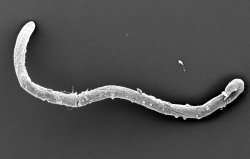
The rare worm Buddenbrockia only merits a footnote in most biology textbooks. Now genetic research has shown it is a relative of anemones and jellyfish. Credit: University of Oxford

One of the world’s strangest creatures has found its long-lost kin. Oxford University scientists have discovered that an extremely rare gutless worm is related to sea anemones and jellyfish, rather than similar-looking animals, reports this week’s Science. The finding could cause an evolutionary rethink.

The worm, Buddenbrockia, has been seen only a handful of times since its discovery in 1851 and exactly where it fits in the animal kingdom has long puzzled scientists. ‘It has no mouth, no gut, no brain and no nerve cord,’ said Professor Peter Holland of Oxford University’s Department of Zoology who led the study. ‘It doesn’t have a left or right side or a top or bottom – we can’t even tell which end is the front!’

Its bizarre body-plan is quite unlike other worms, such as nematodes, that despite their simplicity have different ‘organs’ on different sides – and at different ends – of their bodies in the same way that fish and mammals do. Professor Holland said: ‘Buddenbrockia is very unusual in not displaying this kind of body asymmetry. Seen in cross section it is completely symmetrical so no way is ‘up’ and no direction is ‘forward’.

To find out what in the animal kingdom the worm is related to, Professor Holland, Dr Eva Jimenez and colleagues analysed 50 genes from Buddenbrockia and compared them to the genes of other animals. They found that despite its worm-like body shape Buddenbrockia is actually related to animals it looks nothing like, such as sea anemones and jellyfish. ‘This means that the worm-like body shape evolved at least twice from two completely different kinds of animal,’ said Professor Holland. ‘It is one of the most striking examples of convergent evolution you will ever see – we are not talking about the convergent evolution of individual organs or body parts, such as eyes or wings, but of the whole body shape.’

The new study is also good news for salmon farmers as it may help them to tackle a devastating parasite. Buddenbrockia is closely related to the parasite Tetracapsula bryosalmonae that infects the kidneys and spleens of salmon causing immune cells to multiply out of control destroying these organs and killing the fish. Parasites such as Tetracapsula bryosalmonae are notoriously hard to study because of the difficulty of separating the parasite’s DNA from the host’s DNA. But because Buddenbrockia sometimes swims free from its host (a moss animal or bryozoan) its DNA can be isolated and analysed: opening up a genetic window onto the mysterious world of such parasites.

Professor Peter Holland said: ‘This sort of genetic detective work has only become possible in the wake of the Human Genome Project, which has helped to drive down the costs of large-scale DNA sequencing. In the future these techniques could shed fresh light on the relationships between many other animals that, up until now, have been grouped together according to what they looked like rather than what genetic information they share.’

Source: University of Oxford


print this article email this article download pdf blog this article bookmark this article     Digg this Stumble it share on Facebook share on Reddit add to delicious save to Yahoo! bookmarks
4.7/5 after 26 votes


July 6th, 2007 all stories
Biology /

Comments: 0
Rank: 4.7/5 after 26 votes

  • Stumble this up

  • Digg this

  • Share it:
  • share on Facebook
  • share on MySpace
  • share on Slashdot
  • rss-newsfeed
  • share on Google
  • share on Reddit
  • add to delicious
  • save to Yahoo! bookmarks
  • share on Windows Live
  • Add to Mixx!
Rating: 4.7/5 after 26 votes

  • Related Stories

  • Worm-like marine animal providing
    created Jun 18, 2008 | popularity not rated yet | comments 0
  • Increasing age of mothers in Spain leads to rise in mortality rates
    created Jul 01, 2009 | popularity not rated yet | comments 0
  • High court won't block remote storage DVR system
    created Jun 29, 2009 | popularity not rated yet | comments 0
  • Pesticide susceptibility in children lasts longer than expected
    created Jun 23, 2009 | popularity not rated yet | comments 0
  • Study highlights massive imbalances in global fertilizer use
    created Jun 22, 2009 | popularity not rated yet | comments 0

Tags


  • Physicists Demonstrate Quantum Memory with Matter Qubits
    Physicists Demonstrate Quantum Memory with Matter Qubits
    Physics / General Physics
    created Jul 03, 2009 | popularity 4.4 / 5 (17) | comments 1
  • 'Holey' Nanosheets for Wastewater Dye Removal
    Nanotechnology / Nanomaterials
    created Jul 01, 2009 | popularity 5 / 5 (5) | comments 1
  • Jellyfish Robot Swims Like its Biological Counterpart
    Jellyfish Robot Swims Like its Biological Counterpart
    Electronics / Robotics
    created Jun 26, 2009 | popularity 4.4 / 5 (8) | comments 1
  • Could Maxwell's Demon Exist in Nanoscale Systems?
    Could Maxwell's Demon Exist in Nanoscale Systems?
    Physics / General Physics
    created Jun 24, 2009 | popularity 4.4 / 5 (18) | comments 29
  • Living Safely with Robots, Beyond Asimov's Laws
    Living Safely with Robots, Beyond Asimov's Laws
    Electronics / Robotics
    created Jun 22, 2009 | popularity 4.6 / 5 (52) | comments 40
  • Other News

    California water plan aims to save Puget Sound orcas

    Biology / Ecology

    created 13 hours ago | popularity not rated yet | comments 0

    A plan to restore salmon runs on California's Sacramento River also could help revive killer whale populations 700 miles to the north in Puget Sound, as federal scientists struggle to protect endangered species in a complex ...


    Scientists 'rebuild' giant moa using ancient DNA

    Biology / Plants & Animals

    created Jul 01, 2009 | popularity 5 / 5 (10) | comments 12

    (PhysOrg.com) -- Scientists have performed the first DNA-based reconstruction of the giant extinct moa bird, using prehistoric feathers recovered from caves and rock shelters in New Zealand.


    Pacific Giant Salamander (Dicamptodon tenebrosus)

    Salamanders, regenerative wonders, heal like mammals, people

    Biology / Microbiology

    created Jul 01, 2009 | popularity 5 / 5 (20) | comments 11

    The salamander is a superhero of regeneration, able to replace lost limbs, damaged lungs, sliced spinal cord -- even bits of lopped-off brain. But it turns out that remarkable ability isn't so mysterious after ...


    Genetically modified trees

    Anti-biotech groups obstruct forest biotechnology

    Biology / Biotechnology

    created Jun 30, 2009 | popularity 3.7 / 5 (7) | comments 5

    The potential of forest biotechnology to help address significant social and environmental issues is being "strangled at birth" by the rigid opposition of some groups and regulations that effectively preclude ...


    Super-sleepers could help super-sizers!

    Super-sleepers could help super-sizers!

    Biology / Plants & Animals

    created Jun 29, 2009 | popularity 5 / 5 (2) | comments 4

    Burrowing frogs can survive buried for several years without food or water. Scientists have discovered that the metabolism of their cells changes radically during the dormancy period allowing the frogs to ...