Electronic 'crowd behavior' revealed in semiconductors
July 7, 2007
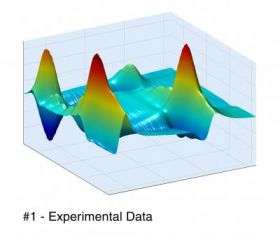
Physicists at JILA have confirmed subtle "collective behavior" among electronic structures in semiconductors, research that may help improve the design of optoelectronic devices. In the first image (#1, showing new experimental data), matching large peaks in the foreground, showing energy intensity ranging from low in blue to high in red, indicate that pairs of large electronic particles called excitons are oscillating in concert as they absorb ultrafast laser light and emit energy at various frequencies. The data match new theoretical models accounting for all electronic properties of semiconductors (image #2) much better than older theoretical models. Credit: JILA and University of Marburg
Like crowds of people, microscopic particles can act in concert under the right conditions. By exposing crowd behavior at the atomic scale, scientists discover new states and properties of matter.
Now, ultrafast lasers have revealed a previously unseen type of collective electronic behavior in semiconductors, which may help in the design of optoelectronic devices. The work at JILA, a joint venture of the National Institute of Standards and Technology (NIST) and the University of Colorado at Boulder, is described in a new paper in the Proceedings of the National Academy of Sciences.

Physicists at JILA have confirmed subtle "collective behavior" among electronic structures in semiconductors, research that may help improve the design of optoelectronic devices. Credit: JILA and University of Marburg
Design of optoelectronic devices, like the semiconductor diode lasers used in telecommunications, currently involves a lot of trial and error. A designer trying to use basic theory to calculate the characteristics of a new diode laser will be off by a significant amount because of subtle interactions in the semiconductor that could not be detected until recently.To shed light on these interactions, the JILA team used a highly sensitive and increasingly popular method of manipulating laser light energy and phase (the point in time when a single light wave begins) to reveal the collective behavior of electronic particles that shift the phase of any deflected light. Their work is an adaptation of a technique that was developed years ago by other researchers to probe correlations between spinning nuclei as an indicator of molecular structure (and led to a Nobel prize).
In the latest JILA experiments, a sample made of thin layers of gallium arsenide was hit with a continuous series of three near-infrared laser pulses lasting just 100 femtoseconds each. Trillions of electronic structures called excitons were formed. Excitons are large, fluffy particles consisting of excited electrons and the “holes” they left behind as they jumped to higher-energy vibration patterns.
By tinkering with the laser tuning—the frequency and orientation of the electric field—and analyzing how the semiconductor altered the intensity and phase of the light, the researchers identified a subtle coupling between pairs of excitons with different energy levels, or electron masses. The experimental data matched advanced theoretical calculations of the electronic properties of semiconductors, confirming the importance of the collective exciton behavior—and dramatically demonstrated the superiority of those calculations over simpler models of semiconductor behavior (see graphic).
Citation: T. Zhang, I. Kuznetsova, T. Meier, X. Li, R.P. Mirin, P. Thomas and S.T. Cundiff. Polarization-dependent optical two-dimensional Fourier transform spectroscopy of semiconductors. Proceedings of the National Academy of Sciences. Scheduled to be posted on-line July 6.
Source: National Institute of Standards and Technology
-
An eye for the tsetse fly
13 hours ago |
not rated yet |
0
-
Measurements from high-energy collisions lead to better understanding of why meson particles disappear
12 hours ago |
5 / 5 (1) |
0
-
SLAC, Stanford team focuses on high-energy electrons to treat cancer
11 hours ago |
5 / 5 (1) |
0
-
Domestic consumption main contributor to Africa's growing e-waste
11 hours ago |
not rated yet |
0
-
Barriers fall between TV, Internet
Feb 09, 2012 |
not rated yet |
0
-
Fast photon control brings quantum photonic technologies closer
1 minute ago |
not rated yet |
0
-
Engineers build first sub-10-nm carbon nanotube transistor
Feb 01, 2012 |
4.9 / 5 (33) |
30
-
Something old, something new: Evolution and the structural divergence of duplicate genes
Jan 31, 2012 |
4.6 / 5 (7) |
1
-
The hidden nanoworld of ice crystals: Revealing the dynamic behavior of quasi-liquid layers
Jan 30, 2012 |
5 / 5 (5) |
1
-
Stock market network reveals investor clustering
Jan 27, 2012 |
3.9 / 5 (23) |
8
-
What are the chemical reaction happen indise lamp in tungsten
4 hours ago
-
What is the number of significant digits in a integer with trailing 0's ?
5 hours ago
-
Forces of Magnets Attraction>Repulsion?
6 hours ago
-
Underwater projectile affected by Coriolis Effect
6 hours ago
-
Thermodynamics q
10 hours ago
-
what is electricity???
13 hours ago
- More from Physics Forums - General Physics
More news stories
Fast photon control brings quantum photonic technologies closer
(PhysOrg.com) -- Using photons instead of electrons to transmit information could lead to faster and more secure ways to communicate, among other advantages. Now a team of physicists has taken another step toward realizing ...
Rapunzel, Leonardo and the physics of the ponytail
(PhysOrg.com) -- New research provides the first mathematical understanding of the shape of a ponytail and could have implications for the textile industry, computer animation and personal care products.
4 hours ago |
4.7 / 5 (3) |
0
|
Researchers make better heat sensor based on butterfly wings
(PhysOrg.com) -- Scientists have long known that butterfly wings produce their iridescent colors by bouncing light around and between tiny ridges in structures made of chitin. More recently they’ve discovered ...
Explained: Sigma
It's a question that arises with virtually every major new finding in science or medicine: What makes a result reliable enough to be taken seriously? The answer has to do with statistical significance -- but ...
Feb 09, 2012 |
5 / 5 (21) |
87
Quantum physicist explains $100K offer for proof scaled-up quantum computing is impossible
(PhysOrg.com) -- MIT researcher Scott Aaronson has certainly riled the physics community with his offer this past Friday, of $100,000 to anyone who can prove that scaled-up quantum computing is impossible. ...
Transforming galaxies
(PhysOrg.com) -- Many of the Universe's galaxies are like our own, displaying beautiful spiral arms wrapping around a bright nucleus. Examples in this stunning image, taken with the Wide Field Camera 3 on ...
'Smart' microcapsules in a single step
(PhysOrg.com) -- A new, single-step method of fabricating microcapsules, which have potential commercial applications in industries including medicine, agriculture and diagnostics, has been developed by researchers ...
New ability to regrow blood vessels holds promise for treatment of heart disease
(Medical Xpress) -- University of Texas at Austin researchers have demonstrated a new and more effective method for regrowing blood vessels in the heart and limbs a research advancement that could have ...
A continent ablaze in auroral and manmade light
The North American continent is literally set ablaze in a confluence of Auroral and Manmade light captured in spectacular new videos snapped by the astronauts serving aboard the International Space Station ...
Nanostructured electrodes for rechargeable sodium-Ion batteries
Highly efficient 3V cathodes for rechargeable sodium-ion batteries have been developed by users from Argonne National Laboratory's Materials Science, Chemical Sciences & Engineering, and X-ray Sciences Divisions, ...
New tumor suppressor gene identified
A recent study published in Clinical Cancer Research suggests that the protein hVps37A suppresses tumor growth in ovarian cancer. The work, which was funded by the Austrian Science Fund FWF, shows, for th ...