Researchers collaborate to understand phenomena controlling PEM fuel cell performance, durability
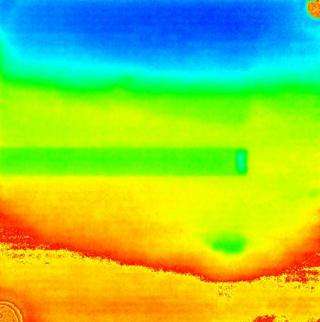
Two researchers at Sandia National Laboratories are working to understand several key phenomena that control hydrogen-fueled PEM (proton exchange membrane or polymer electrolyte membrane) fuel cells. One, Ken S. Chen, is developing computational models to describe the phenomena while the other, Mike Hickner, is performing physical experimentation.
Proper water management and performance degradation, or durability, must be addressed before PEM fuel cells can be used to routinely power automobiles and homes.
"A natural byproduct of using hydrogen and oxygen to produce electricity in a PEM fuel cell is water [with waste heat being the other]," Chen, project principal investigator, says. "One challenge is maintaining the proper amount of water in a PEM fuel cell. Sufficient water in the membrane is needed to maintain its conductivity, whereas too much liquid water can result in flooding the cathode gas diffusion layer, which prevents reactant oxygen from reaching catalytic sites and causes performance deterioration."
The work is leading to better understandings in a couple of important areas, including how liquid water is produced, transported, and removed efficiently in PEM fuel cells and how PEM fuel cell performance degrades. Such understandings are key in finding ways to maintain the cells' long-term performance during normal and harsh (e.g. freezing) conditions and improving their durability.
The close teaming between Chen's modeling and Hickner's experimental efforts has been quite helpful in meeting project objectives.
"Our approach in combining computational modeling with experiments is unique," Chen says. "Typically, Mike would perform discovery experiments to gain physical insights. I would then develop a model to describe the observation or data that Mike has obtained. Mike would perform further experiments so I can validate the model I have developed."
Hickner says they've obtained some nice feedback between the experiments and analyses. The intent is to build a computational tool that can be used in designing fuel cells, eliminating the need to do experiments on every single part of them.
"We want to have all the small pieces worked out in the modeling process so we can concentrate on the larger issues with experiments," he says.
Chen has been using GOMA, a Sandia-developed multidimensional and multi-physics finite-element computer code, as the basic platform to develop 2-D performance models for PEM fuel cells. With the assistance of Nathan Siegel, a postdoctoral researcher with the Solar Technologies Department at Sandia, he is also exploring the development of quasi-3D PEM fuel cell models using FLUENT, a commercial computational fluid dynamic computer code. Chen emphasizes that the focus of this LDRD project is on understanding the key phenomena using experimental means and computational models, both simplified and multi-dimensional.
Joel Lash, manager of Sandia's Multiphase Transport Processes Department, concurs. "Sandia's state-of-the-art multi-physics codes, like GOMA, form the backbone from which simplified phenomena-centric models can be developed to explore complex behavior, such as occurs in operating PEM fuel cells," he says.
For the past couple of years Chen and Hickner have focused mainly on liquid water transport, developing a PEM fuel cell model that can be employed to simulate a fuel cell's performance, and performing diagnostic tests on fuel cells for phenomena discovery and model validation. Next, Chen says, they will tackle the key technical issues of performance degradation or durability, including performance degradation under normal operating conditions and under freezing operating conditions.
To date, the team has reported portions of its work in three refereed publications, four proceedings papers, and half a dozen technical presentations.
"Our validation method is new and exciting and leading us to learn some things not well known previously," Hickner says.
Bruce Kelley, project manager for the PEM Fuel Cell LDRD and manager of Sandia's Chemical Biological Systems Department, says the project was developed specifically to leverage Sandia's capabilities in multi-physics modeling and membrane materials to develop broader capabilities with applicability to fuel cells and other related technology areas.
In doing so, Kelley says, "We have attracted significant industrial interest in the work."
The work is internally funded through a three-year Laboratory Directed Research and Development (LDRD) grant to tackle key technical challenges. Sandia is a National Nuclear Security Administration laboratory.
Source: Sandia National Laboratories


