What's in your microcapsule? Tattoo ink -- and more
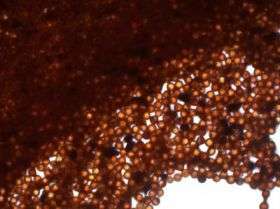
In her Brown University laboratory, Edith Mathiowitz makes tiny particles coated in polymers. These microcapsules, some as small as the point of a pin, can carry medicines, genes, paints, pesticides – any molecule that needs protection or controlled release.
Mathiowitz developed her technique as a drug delivery system, but her microcapsules are now being put to a very different use – to make ink for the first permanent removable tattoo. Under a new intellectual property licensing agreement signed by Brown University and Freedom-2 Holdings Inc., the company has the right to make and sell their ink based on research Freedom-2 has funded in the Mathiowitz lab.
With Freedom-2 funding, Mathiowitz and her team have made microencapsulated beads filled with dyes. These beads are mixed with a solution to make Freedom-2 tattoo inks. The inks are safer than conventional products, free of heavy metals and other toxins. The inks can also be easily removed. A single laser treatment breaks the polymer beads, allowing the body to naturally expel the dye trapped inside. Currently, it takes about six or seven laser treatments to remove a tattoo using traditional inks.
“It’s terrific that my technology has such a cool consumer application,” Mathiowitz said. “My microencapsulation technique has other potential uses, particularly for making new medicines. Any fragile, bioactive molecule – proteins, hormones, DNA – can be coated so that it can be safely delivered to where it is needed in the body and still do its job once it gets there. There are enormous possibilities for drug delivery with this technology.”
Microencapsulation, or suspending particles in biodegradable coatings, is widely used in manufacturing. The process is used to make products such as aspirin, plant food, stain remover, and cake mix. It’s even used to make scratch-and-sniff perfume advertisements found in magazines: Scratch the treated paper and microbeads burst to release the scent.
Mathiowitz, a Brown professor of medical science and engineering, is known in the field for coming up with innovative coatings for molecules. The trick, she says, is understanding the substance that you’re trying to protect. Knowing how a particular solid, liquid or gas behaves when exposed to heat, light, water or enzymes is critical to developing the correct coating method that will properly protect a substance until it can be released.
Microencapsulation requires a smorgasbord of scientific knowledge. Expertise in physics, physiology, biology and pharmacology is needed to do the work. Most of all, the work demands expertise in chemistry – and the Mathiowitz lab reveals its chemistry roots. The room is filled with beakers and vats bubbling with solvents, polymers and dyes used to make Freedom-2 inks.
“Microencapsulation is a real science,” she said, “and a real art.”
It can also be big business. Microcapsules can be made to carry vaccines or human growth factors that can help the body regenerate bone, nerves or cartilage. Microcapsules can also carry controlled release drugs. Of the top 200 best-selling drugs in 2004, 11 compounds used oral controlled or extended release technologies and comprised sales of about $9 billion.
In 1997, Mathiowitz founded Spherics Inc., a pharmaceutical company that now makes drugs to treat nervous system disorders, gastrointestinal diseases and cancer.
“Encapsulation is a wonderful tool that can be used to benefit human health,” Mathiowitz said. “We’re just beginning to see the possibilities.”
Source: Brown University


