Significant new method developed for characterizing density wave features
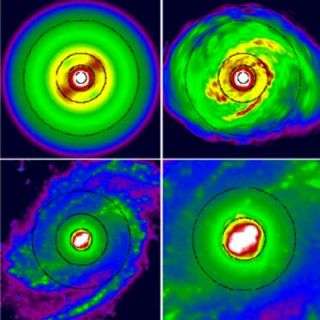
In a paper published in The Astronomical Journal (133:2584-2606, June 2007) Dr. Xiaolei Zhang, of the Naval Research Laboratory, and Dr. Ronald J. Buta, of the University of Alabama, report that they have developed an accurate and widely-applicable method for characterizing density wave features in galaxies.
These density waves appear as high-density regions in galaxies in the forms of spirals, bars, and rings. Orbiting stars and gas stream in and out of these features much like in a traffic jam. Density wave in galaxies has been an active area of study among astronomers and mathematicians since the early 1960s. A popular account of the history of the development of density wave theory can be found in the September 2002 issue of Sky and Telescope magazine.
The density waves in the different regions of a galaxy's disk often appear as intricately nested segments of patterns (bars within bars, or bars within spirals, see the figure at the end of this article), each segment rotating rigidly with a fixed pattern speed. Using near-infrared light as a mass-density tracer, the new method allows the pattern speeds of the different nested density wave patterns to be determined empirically by calculating the gravitational potential field produced by these density patterns.
Using a related approach, Drs. Zhang and Buta have also confirmed that a previously proposed internal physical process termed "secular dynamical evolution,” which is driven by these density waves, can transform the shapes of galaxies over their lifetime. This provides an important link to our understanding of how galaxies in the universe were formed and how they evolve.
Observed galaxies can be roughly grouped into two kinds: highly flattened disk-shaped galaxies, such as the Milky Way, and ellipsoidal galaxies. More accurately however, there are an infinite number of shades in between, characterized by a galaxy's "bulge-to-disk ratio" (the bulge is the central, ellipsoidal part of the disk, since the disk generally thickens toward the central region). This trend of gradually varying galaxy morphology is reflected in the famous morphological classification scheme developed by American astronomer Edwin Hubble in the early part of the twentieth century.
Observations in recent decades have shown that there are gradually larger numbers of disky galaxies and smaller numbers of bulgy galaxies the farther away astronomers look (in astronomy, the farther away we look in space is the same thing as the farther back we look in time, because it takes the light more time from a distant location to reach us). So the hypothesis has been that an increasingly larger fraction of the disky galaxies are transformed into the bulgy galaxies. But scientists have not settled on how the actual transformation process occurs.
In the past, mergers between galaxies were proposed as a major mechanism for a galaxy "morphing" from disks to ellipsoids. But the merging rate has been observed to be very low for much of the recent history of the universe, and mergers are known not to preserve the outer disks of galaxies, whereas the morphological change of galaxies (i.e. the increasing bulge-to-disk ratio) is known to change gradually, with the outer disks well preserved in the process. Many of the nearby galaxy disks, such as the disk of the Milky Way, are found to have been around since the galaxy was first born. Despite these and other known inconsistencies between the merger paradigm predictions and the observed properties of galaxies, merging remains one of the most popular mechanisms in accounting for the morphological evolution of galaxies.
By contrast, the secular evolution paradigm has been a more recent proposal. Secular evolution is described as a slow, steady evolution occurring in individual galaxies. Similar to the effect of the gentle action of water over a long time span in carving out deep gorges and canyons, the instantaneously almost-imperceptible secular evolution process in galaxies can have a powerful impact on the morphological transformation of galaxies over the lifetime of a galaxy. Since the late 1970s, several astronomers, notably John Kormendy of the University of Texas at Austin, had speculated about the existence of secular evolution from mostly phenomenological grounds. These early secular evolution proposals, however, stressed mostly the accretion of the gas component, and thus were limited to the evolution of the more-flattened types of galaxies which have smaller bulges, since the bulk of a galaxy's luminous mass, in particular its bulge mass, is made of stars. A dynamical mechanism by which the stars can also gradually lose their energy and angular momentum and thus sink inward toward the center was not known at that time.
Dr. Zhang carried out the first systematic exploration of the dynamical foundations of the secular evolution process in the late 1980s and throughout the 1990s, the results of which were published in a series of articles in The Astrophysical Journal. These earlier theoretical works showed that the rate of secular evolution is greatly enhanced by the presence of density wave patterns in galaxies, with the strength of these density waves often enhanced by the gravitational tidal interactions between a galaxy and its environment. As a result of the interplay between the density wave and the disk matter, the matter in the inner disk region (including both stars and gas) gradually loses its rotational energy and spirals inward toward the central region, as well as flaring up in the vertical direction, so the galaxy's bulge increases in size with time and eventually looks more and more like an elliptical galaxy. There is also a fraction of the matter in the outer disk that drifts further outward with time.
A new dynamical mechanism that allows the secular exchange of energy and angular momentum between the disk matter and the density wave is found to underlie both the stellar and gaseous accretion processes, thus there is now a unified foundation for the secular evolution paradigm. Understanding the role that stars play in secular evolution helps resolve one of the early objections to the secular evolution proposal, namely that most of the stars in the more-massive type of bulges look old, and do not appear to be formed recently from newly-accreted gas. In the new secular dynamical evolution paradigm, with its allowance of stellar accretion, the shape of a galaxy's central region could be built up later than the birth of the stellar population constituting it. Thus, the accretion process can be alternatively viewed as a contracting and building-up process of the inner region of a galaxy with time. The accretion process can operate as long as the density wave pattern is skewed, which means that secular evolution can just as effectively be driven by the somewhat less-organized density wave patterns observed in more distant galaxies.
The predictions of Zhang's theoretical studies, however, had not been quantitatively compared with the observed properties of galaxies until the recent work of Drs. Zhang and Buta. By calculating radial mass accretion rates directly using near-infrared images of disk galaxies obtained by both ground-based telescopes and the Spitzer Space Telescope, Drs. Zhang and Buta confirm for the first time the magnitude and thus the significance of the internal secular evolution process in transforming galaxy morphologies. The new results show that for most of the observed galaxies, the level of internal secular evolution is adequate to build up the observed bulge component in their lifetime. For those galaxies possessing large-amplitude density waves it is possible for their morphologies to change from a disk-dominated system to a bulge-dominated system during the time span of a fraction of the age of the universe, thus producing the observed evolution in number counts among the disky and bulgy galaxies.
This research also provides a practical means to estimate many of the kinematic features of the density wave patterns (i.e., how fast a given segment of the pattern rotates as a whole, where are the resonances between the wave pattern and the orbiting stars, etc.). Accurate characterization of these features has traditionally been a very difficult problem. In the new method, the gravitational potential field of a density wave mode, calculated from the weighted global summation of the surface density as traced by near-infrared light, is found to either lag or lead in phase in azimuthal angle with respect to the surface density. The radial locations where the two are equal in phase, coincide with the radial locations where the wave pattern-speed is identical to the circular speed of the underlying matter, as demonstrated in the new method. These so-called wave/disk-matter corotation radii, determined from the zero-crossings of the potential-density phase-shift versus galactic radius plot, coupled with the knowledge of the matter rotation-speed distribution in the galaxy, further allow the pattern speeds of the wave modes in a radial range to be determined.
Drs. Zhang and Buta have tested the new potential-density phase shift method for more than 100 galaxies, and have confirmed that the corotation resonance features are predominant and can be accurately determined by the new method. The demonstrated validity of the new approach, when applied to most of the bright disk galaxies in the nearby universe, is also an independent confirmation that the spiral and bar patterns present in galaxies are, in fact, density wave modes that are long-lived. Without the longevity or the quasi-stationary nature of these modes, it would not have been possible for the partially kinematic features of density waves, such as corotation radii, to be obtained from purely morphological features in the near-infrared images of galaxies. This issue, whether the waves are transient or long lasting, has also been persistently debated in the astronomical community for several decades.
Source: Naval Research Laboratory


