Rocket Tests Move NASA Closer to the Lunar Vision
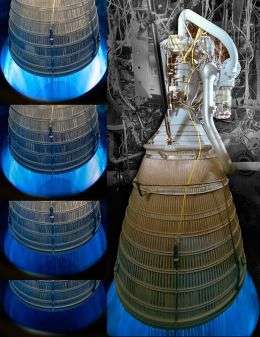
A liquid oxygen-hydrogen pump fed engine developed to demonstrate advanced rocket technologies for future space vehicles achieved a major technical milestone in throttling capability.
The engine was designed to demonstrate successful throttling from full power down to 10 percent of its thrust. This flexibility to control the flow of fuel through an engine is necessary for a lunar lander, allowing the spacecraft ample propulsion, yet enough control to land gently on the moon’s surface.
The Common Extensible Cryogenic Engine, CECE for short, was built off the design of the Pratt & Whitney Rocketdyne RL10 engine which has a proven history of performance. CECE is fueled by a mixture of liquid oxygen and liquid hydrogen and generates 13,800 pounds of thrust. Cryogenic means "ice cold" in Greek, referring to the extremely low temperatures needed to keep the hydrogen and oxygen in a liquid phase.
Using liquid hydrogen and oxygen in rockets will provide major advantages for landing astronauts on the moon. Hydrogen is very light but has about 40 percent more performance (force on the rocket per pound of propellant) than other rocket fuels, enabling lower vehicle mass and a larger payload than with the same amount of conventional propellants.
"This technology has the potential to be the backbone of a deep-throttling, reliable, reusable engine for use across most human and robotic missions," said Tony Kim, NASA’s Deep Throttling Engine Project Manager. "Through two rounds of testing, the CECE team has accomplished quite a bit, but we still have a long way to go before this technology will be ready for full scale development."
Engineers have added throttling ability by using a bypass valve to direct hydrogen around the turbopump that drives propellant into the combustion chamber. Through two rounds of hot-fire testing, the CECE team has demonstrated throttling operability to 9.5 percent power, but operation with stable combustion to 20 percent power, or a 5-to-1 throttling ratio. Engine performance data collected during 2098 seconds of hot run time will be analyzed to support future development decisions.
Looking forward, the team will push CECE to lower throttle levels. Currently, at lower throttle levels, oxygen vapor forms on the inner injector plate and causes the oxygen flow to fluctuate. This triggers pressure oscillations in the engine called "chugging." Chugging may not be a problem for the engine itself, but the vibrations it causes has the potential to resonate with the structure of the rocket and could cause damage. The next tests will determine whether, with modifications to the injector and valves, CECE can demonstrate stable combustion down to 10 percent power, a 10-to-1 throttle ratio.
The CECE collaboration includes engineers from Marshall Space Flight Center and Glenn Research Center joined with Pratt & Whitney Rocketdyne. The CECE effort is part of the Propulsion and Cryogenics Advanced Development (PCAD) project at Glenn, which is developing cryogenic propulsion and propellant management systems for the Lunar Lander. The PCAD project is funded by the Exploration Technology Development Program in NASA's Exploration Systems Mission Directorate.
NASA has invested in CECE technology since 2005. The aim is to achieve a more reliable, robust and less expensive rocket engine ready in 2018 for America’s next moon landing. "This CECE testing has moved us another step closer in providing risk mitigation for designing and building a future lunar lander," said Mark Klem, NASA's PCAD Project Manager.
Source: NASA


