Scientists study how to make humanoid robots more graceful
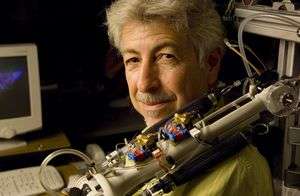
Infants learn how to move by recognizing which movements and positions cause them physical discomfort and learning to avoid them. Computer science Professor Oussama Khatib and his research group at the Stanford Artificial Intelligence Laboratory are using the same principle to endow robots with the ability to perform multiple tasks simultaneously and smoothly.
"Humanoid robots today can walk and wave, but they cannot interact with the world," Khatib said. "We are developing robots with the capability to physically touch, push and move objects."
Khatib's project is one aspect of the Honda Humanoid Robot Project, which aims to build human-friendly robots that can perform useful tasks in a complex, changing environment. Honda recruited Khatib to work on its project after he impressed company officials in 1995 with his twin robots Romeo and Juliet, mobile robot arms that can cooperate to perform complicated tasks, such as lifting a long length of pipe.
His inspiration for this new generation of robots came from humans themselves. In pondering the challenge of robotic movement, Khatib noticed that humans perform physical tasks in ways that minimize effort and discomfort. For example, while taking a sip from a hot cup of coffee, most people naturally hold their forearm at about a 45-degree angle, not up near their ear or down by their side. "They use the mechanical advantage of their bodies to perform the task while assuming postures that minimize muscular effort," he said.
To be useful, robots must be able to manipulate objects as they move through their environments—just like the Jetsons' robotic maid Rosie gracefully slid through rooms as she dusted tables, cleaned windows and vacuumed the floor in the animated TV series. Khatib wondered if robots could be taught such multitasking by employing the same energy-minimization strategy humans learn during infancy.
What tai chi masters can teach robots
A member of Stanford's Bio-X program, which aims to spur interdisciplinary scientific research, Khatib teamed up with another Bio-X member, bioengineering and mechanical engineering Professor Scott Delp, to investigate how humans move. The researchers used sensors to track human subjects performing movements such as bending, walking and jumping. Test subjects included Khatib's own students and a tai chi master visiting from China.
Based on these observations, Khatib and his team came up with a multivariable model that minimizes human muscular effort for every position and produces a smooth path by which a robot simulated on a computer can move to perform its assigned task.
Using this energy-minimization strategy, the robot produces the movements without explicitly computing its trajectories in advance (as done in conventional methods, which can be computationally intense). Khatib likens the robot's thought process to a ball rolling down a hill. Based on the laws of physics, the ball will automatically seek out the lowest energy path to reach the bottom of the hill. The energy-optimization model allows the robot to accomplish the task while minimizing physical effort—just like humans do.
"We found that you just minimize the energy associated with effort," Khatib said. "That is basically what is guiding the motion."
So far, the team has developed a computer prototype called StanBot. While not an actual robot, StanBot lives on Khatib's computer screen as a simulation. StanBot has all the attributes of a physical robot and responds to external conditions like gravity and other forces as a physical robot would. In about a year, Khatib hopes to see his ideas embodied in one of Honda's humanoid robots, ASIMO. Though this seven-year-old robot can walk, run and greet passers-by, it cannot yet perform useful tasks in a complex, real-time world. With Khatib's new software, ASIMO eventually will be able to perform chores such as ironing and clearing tables.
"The goal is to provide these robots with human-like manipulation skills," he said. "All of this is going to give ASIMO new capabilities to have advanced behavior like a human and to interact with the world."
Safety first
In addition to being able to sweep and vacuum, robots like ASIMO also must be safe and human-friendly to achieve popularity in a human environment. For example, to safely shake a person's hand, a robot must understand the proper pressure to apply.
Workers in Khatib's lab have designed innovations to ensure safety—including robot arms that use multiple motors instead of just one, allowing for increased softness of touch. Khatib said that the generation of robots after ASIMO will be one order of magnitude safer than today's typical robots.
Khatib envisions a not-so-distant future in which robots will perform boring chores such as washing dishes or filing office papers with little or no human involvement.
"At this stage we are looking at physical capability," he said. "We want to move to a higher level where the supervision of the human could be almost by voice alone."
Source: by Chelsea Anne Young, Stanford University


