World’s largest telescope to make first observations Friday
July 9, 2007
World’s largest telescope to make first observations Friday

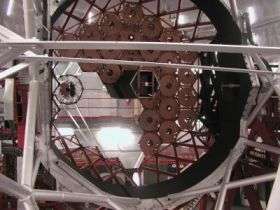
This is a view of the unfinished primary mirror of the Gran Telescopio Canarias in Spain’s Canary Islands. The telescope, the world’s largest, is set to make its first observations at a “first light” ceremony July 13, 2007. Under construction since 1990, the telescope and its 34.1 foot mirror is set to be completed next year. The University of Florida contributed $5 million to the $175 million project and owns a 5 percent share of the telescope, the only U.S. institution with such an ownership share. Credit: University of Florida

The world’s largest telescope will take its first peek into the heavens this week, ushering the University of Florida into the top ranks of the “big observers,” as one astronomy professor put it.

The Gran Telescopio Canarias, or GTC, under construction in Spain’s Canary Islands for the past seven years, will hold its “first light” opening ceremony Friday. UF, which contributed $5 million to the project and owns a 5 percent share, is the only U.S. institution with a stake in the massive telescope.

“This is one of the largest international projects that the university is involved in, and first light is certainly a big step for a small department,” said Stan Dermott, astronomy department chairman and one of four UF astronomy faculty members who will attend Friday’s ceremony.

The roughly $175 million GTC is not yet complete. Only 12 of the 36 mirrors that together will compose its 34.1-foot primary mirror have been installed, Dermott said. The rest are expected to be mounted this year, with the telescope’s grand opening — to be presided over by King Juan Carlos I of Spain — set for next summer. Only after that date will scientific-quality observations begin.

All that said, enough of the mirror is assembled to allow telescope operators to make initial test runs, he said. So at 10 p.m. Greenwich Mean Time Friday (6 p.m. EDT), Prince Felipe, heir to the Spanish throne, will train the telescope on Polaris, the North Star, for a ceremonial observation to be attended by about 300 people.

Besides Dermott, the UF contingent will be astronomers Charlie Telesco, Rafael Guzman and Anthony Gonzalez, as well as Tom Walsh, UF director of sponsored research. “This will be the first demonstration that the telescope can produce a focused image of a star,” Dermott said.

The Spanish government is the main owner of the GTC, with UF and two institutes in Mexico as partners. As a result of its participation, UF astronomers will be allotted 20 nights of telescope time annually for observations. A UF-designed and built infrared imager and spectrometer, meanwhile, will be one of the first instruments mounted on the telescope when it opens for scientific observation next year.

“We are not just passive partners in this project,” Dermott said. “We are the world’s leader in developing astronomical instruments, and our instrument, CanariCam, will be one of the first instruments used on the GTC.”

Dermott said UF’s participation in the GTC effectively makes it one of a handful of institutions with guaranteed access to the world’s most powerful telescopes. That will open the door to a wide range of research not only at the GTC but elsewhere as well.

”Already we are forming scientific teams that will involve other telescopes to take part in surveys of the distant universe,” he said. “For example, Rafael Guzman is leading a team that will investigate the origin of galaxies. In a sense, we have joined the club of big observers now.”

Funded in part by the Spanish government with a $6.5 million grant, Guzman’s team of 40 astronomers from the U.S., Spain, France and England is conducting a survey called GOYA, or Galaxy Origins and Young Assembly.

Source: University of Florida

3.9 /5 (15 votes)  

Rank 3.9 /5 (15 votes)
Tags

Relevant PhysicsForums posts
  • Never ending outer space.....
    created17 hours ago
  • Neutron Star fragments?
    created19 hours ago
  • stationary or not?
    created23 hours ago
  • Scale of the Universe
    createdFeb 10, 2012
  • Titan's lack of impact craters
    createdFeb 09, 2012
  • Real pictures of black hole eating a star?
    createdFeb 08, 2012
  • More from Physics Forums - General Astronomy

More news stories

Latin America mining boom clashes with conservation

Latin America is experiencing a mining boom as prices rise fuelled by a hike in global demand, but the region is also being hit by a wave of violent protests, strikes and rallies by environmentalists.

Space & Earth / Environment

created 10 hours ago | popularity 5 / 5 (1) | comments 1

Salvage workers begin pumping fuel from Italian shipwreck

Salvage workers Sunday began pumping fuel from the shipwrecked Italian cruise liner Costa Concordia, a day ahead of schedule, officials said.

Space & Earth / Environment

created 2 hours ago | popularity not rated yet | comments 0

Political leaders play key role in how worried Americans are by climate change: study

More than extreme weather events and the work of scientists, it is national political leaders who influence how much Americans worry about the threat of climate change, new research finds.

Space & Earth / Environment

created Feb 06, 2012 | popularity 5 / 5 (6) | comments 73

NASA budget will axe Mars deal with Europe: scientists

US President Barack Obama's budget proposal to be submitted next week for 2013 will cut NASA's budget by 20 percent and eliminate a major partnership with Europe on Mars exploration, scientists said Thursday.

Space & Earth / Space Exploration

created Feb 10, 2012 | popularity 5 / 5 (3) | comments 58

Humans may have helped the decline of African rainforests 3000 years ago

(PhysOrg.com) -- Large areas of rainforests in Central Africa mysteriously disappeared over three thousand years ago, to be replaced by savannas. The prevailing theory has been that the cause was a change ...

Space & Earth / Environment

created Feb 10, 2012 | popularity 4.1 / 5 (14) | comments 20 | with audio podcast report


Scientists discover molecular secrets of 2,000-year-old Chinese herbal remedy

For roughly two thousand years, Chinese herbalists have treated Malaria using a root extract, commonly known as Chang Shan, from a type of hydrangea that grows in Tibet and Nepal. More recent studies suggest that halofuginone, ...

New method to examine batteries -- MRI from the inside

There is an ever-increasing need for advanced batteries for portable electronics, such as phones, cameras, and music players, but also to power electric vehicles and to facilitate the distribution and storage of energy derived ...

Google might launch Drive for cloud storage soon

(PhysOrg.com) -- Google's next big move, according to the Wall Street Journal, is a cloud storage service called Drive. Hardly first to the plate, Google is simply catching up to introducing its cloud reposi ...

Lab study raises questions over nano-particle impact

Tests involving chickens have raised questions about the impact on health from engineered nano-particles, the ultra-fine grains commonly used in drugs and processed foods, scientists said on Sunday.

A mitosis mystery solved: How chromosomes align perfectly in a dividing cell

Although the process of mitotic cell division has been studied intensely for more than 50 years, Whitehead Institute researchers have only now solved the mystery of how cells correctly align their chromosomes during symmetric ...

Starve a virus, feed a cure? Findings show how some cells protect themselves against HIV

A protein that protects some of our immune cells from the most common and virulent form of HIV works by starving the virus of the molecular building blocks that it needs to replicate, according to research published online ...