The brain predicts our perception of the outside world
July 10, 2007
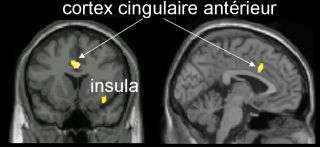
Activity measured in the anterior cingular cortex and the insula predict three seconds in advance whether we will perceive laser stimulation as more or less painful. © ULg-CRC
The human brain anticipates our perception of the outside world. For example, it is capable of predicting if we are going to perceive tactile stimulation of weak intensity or, on the contrary, if a more intense stimulation will be perceived more or less painfully.
If people can make these observations empirically, a team of researchers at the Coma Science Group of University of Liege (Cyclotron Research Centre) and Neurology Department at the University Hospital of Liege (Belgium) is today demonstrating it scientifically through measuring the spontaneous activity of the brain and the relationships between the different cerebral regions involved
In a study published this week in the Proceedings of the National Academy of Sciences (PNAS), the team of scientists led by Dr Mélanie Boly and Dr Steven Laureys shows that the spontaneous activity measured in certain parts of the brain have a direct influence over our conscious perception and our perception of the intensity of pain. ‘Our brain is never really at rest, but science does not have a good understanding of how the spontaneous and continuous activity of our neurons influences our perception of the world. Our study contributes to lifting a corner of the veil over these mechanisms’, the researchers state.
Using functional magnetic resonance imaging (fMRI) and laser stimulation of the skin’s nervous structures (stimulation in a thousandth of a second), the researchers brought to light the regions more specifically involved in this spontaneous brain activity. Thus, the awareness of self and of our internal world is increasingly connected to the activity in a network that includes the precuneus and posterior cingular cortex and the temporoparietal junction. However, awareness of our external world is linked to the activity measured in the thalamus and the frontoparietal lateral cortical zones. As regards the anterior cingular cortex and the insular cortex, they predict whether the laser stimulation will be perceived as more or less painful.
These results improve our knowledge of the mechanisms involved in human consciousness and allow for a better understanding of why we are at times more "sensitive" to pain than we are at other times. "Awareness has two components: awakening, on the one hand, and awareness of the environment (the external world) of self (the internal world), on the other. We knew the regions involved in awakening. With this study, we will demonstrate now that awareness of our internal and external world has different neuronal correlates and how they interact", the ULg researchers conclude.
Article: http://www.pnas.or … 0611404104v1
Source: University of Liège
-
Research links 'brain waves' to cognition, attention and diagnosing disorders
Feb 07, 2012 |
4 / 5 (1) |
0
-
Discovery of extremely long-lived proteins may provide insight into cell aging
Feb 03, 2012 |
4.9 / 5 (13) |
0
-
Researcher studies hockey and football concussions: Is it time for major changes?
Jan 30, 2012 |
5 / 5 (1) |
0
-
Groundbreaking portable PET scanner moves closer to market, medical applications
Jan 27, 2012 |
5 / 5 (4) |
0
-
fMRI brain imaging illuminates magic mushrooms' psychedelic effects
Jan 23, 2012 |
4.8 / 5 (16) |
6
-
Engineers build first sub-10-nm carbon nanotube transistor
Feb 01, 2012 |
4.9 / 5 (31) |
30
-
Something old, something new: Evolution and the structural divergence of duplicate genes
Jan 31, 2012 |
4.6 / 5 (7) |
1
-
The hidden nanoworld of ice crystals: Revealing the dynamic behavior of quasi-liquid layers
Jan 30, 2012 |
5 / 5 (3) |
1
-
Stock market network reveals investor clustering
Jan 27, 2012 |
3.9 / 5 (23) |
8
-
Of microchemistry and molecules: Electronic microfluidic device synthesizes biocompatible probes
Jan 26, 2012 |
5 / 5 (1) |
0
-
Is Everyday Technology Killing Us?
Feb 08, 2012
-
Exercise and weight loss
Feb 08, 2012
-
Why do we have head aches? Our brains can't feel anything.
Feb 07, 2012
-
"The end of diseases" by David Agus, interview from Daily Show with Jon Stewart
Feb 04, 2012
-
Oncolytic adenovirus
Feb 04, 2012
-
Nutrition label stuffs and diets
Feb 02, 2012
- More from Physics Forums - Medical Sciences
More news stories
Complex wiring of the nervous system may rely on a just a handful of genes and proteins
Researchers at the Salk Institute have discovered a startling feature of early brain development that helps to explain how complex neuron wiring patterns are programmed using just a handful of critical genes. ...
3 hours ago |
5 / 5 (5) |
0
|
Both maternal and paternal age linked to autism
Older maternal and paternal age are jointly associated with having a child with autism, according to a recently published study led by researchers at The University of Texas Health Science Center at Houston (UTHealth).
Medicine & Health / Psychology & Psychiatry
7 hours ago |
5 / 5 (1) |
0
|
New understanding of DNA repair could eventually lead to cancer therapy
A research group in the Faculty of Medicine & Dentistry at the University of Alberta is hoping its latest discovery could one day be used to develop new therapies that target certain types of cancers.
7 hours ago |
4.8 / 5 (4) |
0
|
Human cognitive performance suffers following natural disasters, researchers find
Not surprisingly, victims of a natural disaster can experience stress and anxiety, but a new study indicates that it might also cause them to make more errors - some serious - in their daily lives. In their upcoming Human Fa ...
Medicine & Health / Psychology & Psychiatry
4 hours ago |
4 / 5 (1) |
0
Curry spice component may help slow prostate tumor growth
Curcumin, an active component of the Indian curry spice turmeric, may help slow down tumor growth in castration-resistant prostate cancer patients on androgen deprivation therapy (ADT), a study from researchers ...
8 hours ago |
4.6 / 5 (5) |
0
|
Google users warned of threat to smartphone wallets
Users of Google smartphone wallets were being warned on Friday that there is a way to crack pass codes intended to thwart thieves from going on illicit shopping sprees.
Anonymous knocks CIA website offline (Update)
The website of the Central Intelligence Agency was inaccessible on Friday after the hacker group Anonymous claimed to have knocked it offline.
NASA sees wide-eyed cyclone Jasmine
Cyclone Jasmine's eye has opened wider on NASA satellite imagery, as it moves through the Southern Pacific Ocean.
NASA sees Giovanna reach cyclone strength, threaten Madagascar
Tropical Storm 12S built up steam and became a cyclone on February 10, 2012 as NASA's Terra satellite passed overhead. Residents of east-central Madagascar should prepare for this cyclone to make landfall ...
Putting the squeeze on planets outside our solar system
(PhysOrg.com) -- Using high-powered lasers, scientists at Lawrence Livermore National Laboratory and collaborators discovered that molten magnesium silicate undergoes a phase change in the liquid state, abruptly ...
The power of estrogen -- male snakes attract other males
A new study has shown that boosting the estrogen levels of male garter snakes causes them to secrete the same pheromones that females use to attract suitors, and turned the males into just about the sexiest ...