Self-assembled nanostructures function better than bone as porosity increases
July 10, 2007 Self-assembled nanostructures function better than bone as porosity increases

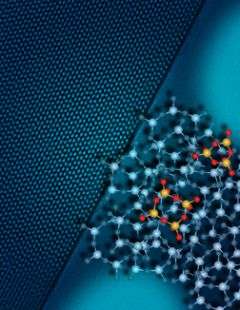
On the left is a TEM micrograph of a porous, cube-like nanostructure. On the right is a blow-up of the silica framework (the dark <2-nm thick regions on the left side figure) based on modeling. The highlighted structures represent the small rings referred to in the story. Credit: Sandia National Laboratory

Naturally occurring structures like birds’ bones or tree trunks are thought to have evolved over eons to reach the best possible balance between stiffness and density.

But in a June paper in Nature Materials, researchers at Sandia National Laboratories and the University of New Mexico (UNM), in conjunction with researchers at Case Western Reserve and Princeton Universities, show that nanoscale materials self-assembled in artificially determined patterns can improve upon nature’s designs.

“Using self-assembly we can construct silica materials at a finer scale than those found in nature,” says principal investigator Jeff Brinker. “Because, at very small dimensions, the structure and mechanical properties of the materials change, facile fabrication of stiff, porous materials needed for microelectronics and membrane applications may be possible.”

Nuclear magnetic resonance and Raman spectroscopic studies performed by Sandia researchers Roger Assink (ret.) and Dave Tallant, along with molecular modeling studies performed by Dan Lacks at Case Western Reserve University, showed that, as the ordered porous films became more porous, the silica pore walls thinned below 2 nm, re-arranging the silica framework to become denser and stiffer.

Whereas the stiffness of evolved optimized bone declines proportional to the square of its density, mechanical studies performed by Sandia researcher Thomas Buchheit working with UNM student Christopher Hartshorn showed that the stiffness/modulus of self-assembled materials was much less sensitive to increasing porosity: For a material synthesized with a cubic arrangement of pores, the modulus declined only as the square root of its density.

The silica nanostructures — basically a synthetic analogue of bone-like cellular structures, replicated at the nanoscale using silica compounds — thus may improve performance where increased pore volume is important. These include modern thin-film applications such as membrane barriers, molecular recognition sensors, and low-dielectric-constant insulators needed for future generation of microelectronic devices.

“Bone, closely examined, is a structured cellular material,” says Brinker, a Sandia Fellow and chemical engineering professor at UNM. “Because, using self-assembly, we had demonstrated the fabrication of a variety of ordered cellular materials at the nanoscale with worm-like (curving cylinders), hexagonal (soda straw packing) and cubic sphere arrangements of pores, we wondered whether the modulus-density scaling relationships of these nanoscale materials would be similar to the optimized evolved materials [like bone]. We found that both material structure and pore sizes matter. At all densities we observed that the cubic arrangement was stiffer than the hexagonal arrangement, which was stiffer than the worm-like. For each of these structures, increasing porosity caused a reduction in modulus, but the reduction was less than for theoretically optimized or naturally evolved materials due to the attendant stiffening of the thinning nanoscale silica walls resulting from the formation of small stiff silica rings.

“This change in ring structure only happens at the nanoscale,” says Brinker.

Sandia researcher Hongyou Fan created cubic, cylindrical, and worm-like (or disordered) pores to evaluate differences in stiffness resulting from these differently shaped internal spaces.

Other paper authors include Dave Kissel of UNM, Regina Simpson at Sandia, and Salvatore Torquato of Princeton.

Source: Sandia National Laboratory


print this article email this article download pdf blog this article bookmark this article     Stumble it Digg this share on Facebook retweet share on Reddit add to delicious
Rate this story - 4.5 /5 (33 votes)


July 10, 2007 all stories

Comments: 0

4.5 /5 (33 votes)
  • Stumble this up

  • Digg this

  • share this

  • hide
  • Related Stories

  • FBI unveils science of anthrax investigation
    created Aug 22, 2008 | popularity not rated yet | comments 0
  • Researchers solve mystery of attractive surfaces
    created Aug 02, 2006 | popularity not rated yet | comments 0
  • Nano World: Nano helps keep cells alive
    created Jul 26, 2006 | popularity not rated yet | comments 0
  • Sandia work shows live cells influence growth of nanostructures
    created Jul 20, 2006 | popularity not rated yet | comments 0
  • Materials scientists find better model for glass creation
    created Nov 04, 2009 | popularity not rated yet | comments 0


  • hide
  • Relevant PhysicsForums posts

  • Polymer Properties Question
    created 11 hours ago
  • Fatigue Properties of Chinese steel
    created Nov 04, 2009
  • Finding Hardness values
    created Nov 04, 2009
  • Fluid flow, pressure drop simulation in Comsol
    created Nov 04, 2009
  • More from Physics Forums - Materials & Chemical Engineering

Other News

Findings show nanomedicine promising for treating spinal cord injuries

Findings show nanomedicine promising for treating spinal cord injuries

Nanotechnology / Bio & Medicine

created 20 hours ago | popularity 4.5 / 5 (4) | comments 0

(PhysOrg.com) -- Researchers at Purdue University have discovered a new approach for repairing damaged nerve fibers in spinal cord injuries using nano-spheres that could be injected into the blood shortly ...


New Digital 'Electronics' Concept May Continue Moore's Law

New Digital 'Electronics' Concept May Continue Moore's Law

Nanotechnology / Nanophysics

created Nov 05, 2009 | popularity 4.6 / 5 (55) | comments 9

(PhysOrg.com) -- Computers of the future could be operating not on electrons, but on tiny waves traveling through an electron "fluid," if a new proposal is successful. The new circuit design, recently introduced ...


Nanoparticles for gene therapy improve

Nanoparticles for gene therapy improve

Nanotechnology / Bio & Medicine

created Nov 06, 2009 | popularity 5 / 5 (4) | comments 3

(PhysOrg.com) -- About five years ago, Professor Janet Sawicki at the Lankenau Institute in Pennsylvania read an article about nanoparticles developed by MIT's Robert Langer for gene therapy, the insertion ...


Breakthrough in industrial-scale nanotube processing

Breakthrough in industrial-scale nanotube processing

Nanotechnology / Nanomaterials

created Nov 02, 2009 | popularity 4.9 / 5 (20) | comments 3

(PhysOrg.com) -- Rice University scientists today unveiled a method for the industrial-scale processing of pure carbon-nanotube fibers that could lead to revolutionary advances in materials science, power ...


Nanoparticles may cause DNA damage across a cellular barrier

Nanoparticles may cause DNA damage across a cellular barrier

Nanotechnology / Bio & Medicine

created Nov 05, 2009 | popularity 4.3 / 5 (9) | comments 1

(PhysOrg.com) -- Scientists have shown in the laboratory that metal nanoparticles damaged the DNA in cells on the other side of a cellular barrier. The research, by the University of Bristol, is published ...