Astronomers find the most distant known galaxies
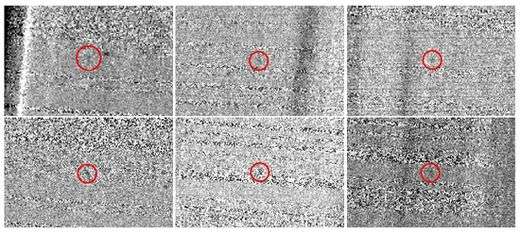
Using natural ‘gravitational lenses’, an international team of astronomers claim to have found a hint of a population of the most distant galaxies yet seen - the light we see from them today left more than 13 thousand million years ago, when the Universe was just 500 million years old.
Team leader Professor Richard Ellis, Steele Professor of Astronomy at Caltech, will present images of these faint and distant objects in his talk on Wednesday 11 July at the ‘From IRAS to Herschel and Planck’ conference at the Geological Society in London. The meeting is being held to celebrate the 65th birthday of Royal Astronomical Society President Professor Michael Rowan-Robinson.
When light from very distant bodies passes through the gravitational field of much nearer massive objects, it bends in an effect known as ‘gravitational lensing’. In a pioneering technique, the Caltech-led group used massive clusters of galaxies – the best example of natural gravitational lenses - in a series of campaigns to locate progressively more distant systems that would not be detected in normal surveys. The team found the galaxies using one of the most powerful telescopes in the world, the Keck II, which has a 10 m diameter mirror and is sited on Mauna Kea, Hawaii.
Richard Ellis explains, "Gravitational lensing is the magnification of distant sources by foreground structures. By looking through carefully-selected clusters, we have located 6 star forming galaxies seen at unprecedented distances, corresponding to a time when the Universe was only 500 million years old, or less than 4% of its present age."
When the Universe was 300,000 years old it is thought to have entered a period when no stars were shining. Cosmologists refer to this phase of cosmic history as the `Dark Ages'. Pinpointing the moment of `cosmic dawn' when the first stars and galaxies began to shine and the dark ages ended is a major observational quest and provides the motivation for building future powerful telescopes such as the European Southern Observatory’s Extremely Large Telescope, the US/Canadian Thirty Meter Telescope and the space-borne James Webb Telescope.
The new survey represents 3 years' painstaking observations summarised in the thesis of graduate student, Mr Dan Stark. "Using Keck II, we have detected 6 faint star-forming galaxies whose signal has been boosted about 20 times by the magnifying effect of a foreground cluster. That we should find so many distant galaxies in our small survey area suggests they are very numerous indeed. We estimate the combined radiation output of this population could be sufficient to break apart (ionize) the hydrogen atoms in space at that time, thereby ending the Dark Ages" said Mr Stark.
Proving definitively that each of the 6 objects is unambiguously at these enormous distances (and hence being viewed at such early times) is hard, even with the most powerful facilities. "As with all work at the frontiers, skeptics may wish to see further proof that the objects we are detecting with Keck are really so distant", confessed Ellis. However, in addition to numerous checks the team has made following their initial discovery a year ago, Ellis and Stark point to supporting evidence from galaxies containing old stars that are seen when the Universe was just a bit older.
"We can infer the Universe had a lot of star formation at these early times from Spitzer Space Telescope measurements of larger galaxies seen when the Universe was about 300-500 million years older", explains Mr Stark. "These galaxies show the tell-tale sign of old stars (and were described in earlier work by University of Exeter scientist Dr Andrew Bunker). To produce these old stars requires significant earlier activity, most likely in the fainter star-forming galaxies we have now seen."
Also associated with the programme is Caltech postdoctoral scholar, Dr Johan Richard, who is leading a similar, but independent, survey of magnified galaxies detected with the Hubble and Spitzer Space Telescopes. Although that work is not yet complete, preliminary findings support the conclusions of the Keck II survey. European collaborators include Professor Jean-Paul Kneib of the Laboratory of Astrophysics at Marseilles, and Dr Graham Smith at the University of Birmingham.
Source: Royal Astronomical Society


