Arizona State scientists keep an eye on Martian dust storm
July 11th, 2007 Arizona State scientists keep an eye on Martian dust storm

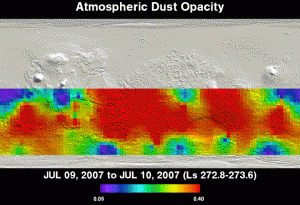
The map shows the atmosphere's opacity at an infrared wavelength of 9 micrometers. The scale bar's values run from nearly clear (0.05) to roughly a two-thirds reduction in sunlight (0.40).Image credit: NASA/JPL/Arizona State University

Scientists at Arizona State University's Mars Space Flight Center are using the Thermal Emission Imaging System (THEMIS) on NASA's Mars Odyssey orbiter to monitor a large dust storm on the Red Planet. The instrument, a multi-wavelength camera sensitive to five visible wavelengths and 10 infrared ones, is providing Mars scientists and spacecraft controllers with global maps that track how much atmospheric dust is obscuring the planet.

The dust storm, which erupted during the last week of June 2007, is affecting operations for all five spacecraft operating at Mars. The fleet includes two NASA rovers on the ground (Spirit and Opportunity), plus three orbiters, two of which belong to NASA (Mars Odyssey and Mars Reconnaissance Orbiter) and one to the European Space Agency (Mars Express).

Beginning in Mars' heavily cratered southern highlands, the dust storm took roughly a week to grow large enough to encircle the planet. Dust has now drifted into the northern hemisphere as well.

"This is the favorable time of the Martian year for dust storms," says Joshua Bandfield, research associate at the Mars Space Flight Facility. The facility is part of the School of Earth and Space Exploration in ASU's College of Liberal Arts and Sciences.

"It's summer in the southern hemisphere," he says, "That's when Mars lies closest to the sun and solar heating is greatest."

Bandfield adds, "We can watch weather fronts spreading and kicking up dust in a big way." He explains that as winds sweep dust into the atmosphere, the atmosphere becomes warmer. This adds to the storm's power, helping it to pick up more dust. But the process has a built-in limitation, he says. "When the dust becomes thick enough, it reflects more sunlight from the atmosphere, allowing the air near the surface to cool."

As seen from orbit, the dust storm has the effect of veiling surface features – or even concealing them completely, which hasn't happened yet in this event. "This storm isn't as big or severe as the one in 2001," Bandfield says. "THEMIS and other orbiters can still see the surface, despite the continuing dust activity."

From the ground, the dust in the air has cut the amount of sunlight reaching the rovers' solar panels and reducing their electrical power. "If you were standing there, you'd see the sky looking tawny with haze," explains Bandfield. "The sun would appear as a sharp-edged disk, but the light level would be noticeably lower than what you would see under a totally clear sky."

Luckily, say scientists, summer is a time when the rovers can best survive under reduced power. If the storm had struck during local winter, the rovers might not get enough power during the day to stay alive through the cold Martian night.

How long will this storm last" No one knows for sure, but Bandfield notes its effects won't disappear as quickly as the storm erupted. "Mars," he says, "will remain dusty for at least a couple months more."

Source: Arizona State University


print this article email this article download pdf blog this article bookmark this article     Digg this Stumble it share on Facebook share on Reddit add to delicious save to Yahoo! bookmarks
4.8/5 after 6 votes


July 11th, 2007 all stories
Space & Earth / Space Exploration

Comments: 0
Rank: 4.8/5 after 6 votes

  • Stumble this up

  • Digg this

  • Share it:
  • share on Facebook
  • share on MySpace
  • share on Slashdot
  • rss-newsfeed
  • share on Google
  • share on Reddit
  • add to delicious
  • save to Yahoo! bookmarks
  • share on Windows Live
  • Add to Mixx!
Rating: 4.8/5 after 6 votes

  • Related Stories

  • Not space junk yet: Mars rovers carry on despite age, ailments
    created Jun 28, 2009 | popularity not rated yet | comments 0
  • First direct evidence of lightning on Mars detected
    created Jun 17, 2009 | popularity not rated yet | comments 0
  • Wake up and smell the coffee -- on the Moon!
    created May 18, 2009 | popularity not rated yet | comments 0
  • Scientists monitor developing Mars dust storm
    created Apr 20, 2009 | popularity not rated yet | comments 0
  • Lunar Reconnaissance Orbiter to Help Astronauts Survive in Infinity
    created Apr 17, 2009 | popularity not rated yet | comments 0

Tags


  • Physicists Demonstrate Quantum Memory with Matter Qubits
    Physicists Demonstrate Quantum Memory with Matter Qubits
    Physics / General Physics
    created Jul 03, 2009 | popularity 4.4 / 5 (16) | comments 1
  • 'Holey' Nanosheets for Wastewater Dye Removal
    Nanotechnology / Nanomaterials
    created Jul 01, 2009 | popularity 5 / 5 (5) | comments 1
  • Jellyfish Robot Swims Like its Biological Counterpart
    Jellyfish Robot Swims Like its Biological Counterpart
    Electronics / Robotics
    created Jun 26, 2009 | popularity 4.4 / 5 (7) | comments 1
  • Could Maxwell's Demon Exist in Nanoscale Systems?
    Could Maxwell's Demon Exist in Nanoscale Systems?
    Physics / General Physics
    created Jun 24, 2009 | popularity 4.4 / 5 (18) | comments 29
  • Living Safely with Robots, Beyond Asimov's Laws
    Living Safely with Robots, Beyond Asimov's Laws
    Electronics / Robotics
    created Jun 22, 2009 | popularity 4.6 / 5 (52) | comments 40
  • Other News

    Forty years ago man first walked on the moon

    Space & Earth / Space Exploration

    created 3 hours ago | popularity 5 / 5 (2) | comments 0

    Forty years ago on July 20, 1969, American astronaut Neil Armstrong realized the oldest dream of human civilizations when he became the first man to walk on the moon.


    The least sea ice in 800 years

    The least sea ice in 800 years

    Space & Earth / Earth Sciences

    created Jul 01, 2009 | popularity 4.3 / 5 (59) | comments 52

    New research, which reconstructs the extent of ice in the sea between Greenland and Svalbard from the 13th century to the present indicates that there has never been so little sea ice as there is now. The ...


    Gas around young galaxy

    Intense heat killed the Universe's would-be galaxies, researchers say

    Space & Earth / Astronomy

    created Jul 01, 2009 | popularity 3.2 / 5 (19) | comments 25

    (PhysOrg.com) -- Our Milky Way galaxy only survived because it was already immersed in a large clump of dark matter which trapped gases inside it, scientists led by Durham University's Institute for Computational ...


    Scientists' Drill Hits Magma: Only Third Time on Record

    Scientists' Drill Hits Magma: Only Third Time on Record

    Space & Earth / Earth Sciences

    created Jun 29, 2009 | popularity 4.7 / 5 (20) | comments 19

    (PhysOrg.com) -- Scientists drilling a borehole deep into Iceland’s rocky crust to explore new methods of using geothermal energy hit a major roadblock on Thursday: Their drill ran into molten rock at a depth ...


    NASA manager pitches a cheaper return-to-moon plan

    Space & Earth / Space Exploration

    created Jun 30, 2009 | popularity 4 / 5 (7) | comments 18

    (AP) -- Like a car salesman pushing a luxury vehicle that the customer no longer can afford, NASA has pulled out of its back pocket a deal for a cheaper ride to the moon.