Search for the water of life -- Astronomers find water on extra-solar planet
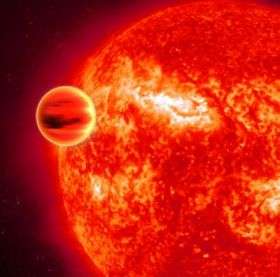
July 11th, 2007 An Artist's Impression of HD 189733b and its Star as Though Viewed Using Infrared

An artist's impression of HD 189733b and its star as though viewed using infrared. Credit: ESA - C. Carreau

Researchers at UCL (University College London) are part of an international team which has discovered water on an extra-solar planet for the first time. Findings will be published in this week’s Nature.

‘Extra-solar’ planets are those outside our Solar System and more than 200 have been discovered orbiting stars close to our own Sun. The planet with water in its atmosphere is known as HD 189733b, and orbits a star in the constellation of Vulpecula the Fox, which is 64 light years from the Sun. HD 189733b is known as a “transiting planet” because it passes directly in front of its star, as viewed from the Earth.

The researchers, led by Dr Giovanna Tinetti of the European Space Agency and UCL’s Department of Physics & Astronomy, found that as HD 189733b passes in front of its ‘sun’, it absorbs starlight in a way that can only be explained by the presence of water vapour in its atmosphere. This is the first time that astronomers have been able to confirm that water is present on an extra-solar planet.

Dr Tinetti, who has recently taken up a prestigious Aurora Fellowship at UCL, said: “Although HD 189733b is far from being habitable, and actually provides a rather hostile environment, our discovery shows that water might be more common out there than previously thought, and our method can be used in the future to study more ‘life-friendly’ environments.”

The discovery was made using NASA’s Spitzer Earth-orbiting telescope, taking measurements at a number of key wavelengths in the infrared region of the spectrum that pick out the crucial signature of water. The water detection relied not only on Dr Tinetti’s painstaking analysis, but also on the calculation of highly accurate water absorption parameters by Dr Bob Barber and Professor Jonathan Tennyson, both of UCL’s Department of Physics & Astronomy.

Dr Barber said: “The absorption parameters were calculated from our Barber-Tennyson list of water vapour spectral lines. This includes over 500 million individual absorption features, each like fingerprints, giving us vital clues to the amount of water present and the temperature of the atmosphere.”

Professor Tennyson, who heads UCL’s Physics & Astronomy Department, explained: “Parts of the atmosphere of HD 189733b are very hot – around 2,000 degrees. You need the millions of lines we calculated to simulate this, putting in absorption accurately where it should be and – just as accurately – giving gaps for the light to get through the atmosphere, where it can.”

HD 189733 is a star very much like our own Sun, although a little cooler. Its planet is not like Earth, however. HD 189733b is a gas giant planet, about 15 per cent bigger than Jupiter. However, while Jupiter is over five times as far away from the Sun as our Earth is, HD 189733b is more than 30 times closer to its star than the Earth is to the Sun – explaining why it’s so hot.

Dr Tinetti added: “The ‘holy grail’ for today’s planet hunters is to find an Earth-like planet that also has water in its atmosphere. When it happens, that discovery will provide real evidence that planets outside our Solar System might harbour life. Finding the existence of water on an extra-solar gas giant is a vital milestone along that road of discovery.”

Source: University College London


print this article email this article download pdf blog this article bookmark this article     Digg this Stumble it share on Facebook share on Reddit add to delicious save to Yahoo! bookmarks
4.6/5 after 50 votes


July 11th, 2007 all stories
Space & Earth / Astronomy

Comments: 0
Rank: 4.6/5 after 50 votes

  • Stumble this up

  • Digg this

  • Share it:
  • share on Facebook
  • share on MySpace
  • share on Slashdot
  • rss-newsfeed
  • share on Google
  • share on Reddit
  • add to delicious
  • save to Yahoo! bookmarks
  • share on Windows Live
  • Add to Mixx!
Rating: 4.6/5 after 50 votes

  • Related Stories

  • Hubble Finds Carbon Dioxide on an Extrasolar Planet
    created Dec 09, 2008 | popularity not rated yet | comments 0
  • Hubble Finds First Organic Molecule on an Exoplanet
    created Mar 19, 2008 | popularity not rated yet | comments 0
  • Hazy red sunset on extrasolar planet
    created Dec 11, 2007 | popularity not rated yet | comments 0
  • Absence of Water in Distant Planet's Atmosphere Surprises Astronomers
    created Feb 21, 2007 | popularity not rated yet | comments 0
  • Global warming tactic cools climate but won’t help corals, say researchers
    created Jul 03, 2009 | popularity not rated yet | comments 0

Tags


  • Physicists Demonstrate Quantum Memory with Matter Qubits
    Physicists Demonstrate Quantum Memory with Matter Qubits
    Physics / General Physics
    created Jul 03, 2009 | popularity 4.4 / 5 (16) | comments 1
  • 'Holey' Nanosheets for Wastewater Dye Removal
    Nanotechnology / Nanomaterials
    created Jul 01, 2009 | popularity 5 / 5 (5) | comments 1
  • Jellyfish Robot Swims Like its Biological Counterpart
    Jellyfish Robot Swims Like its Biological Counterpart
    Electronics / Robotics
    created Jun 26, 2009 | popularity 4.4 / 5 (8) | comments 1
  • Could Maxwell's Demon Exist in Nanoscale Systems?
    Could Maxwell's Demon Exist in Nanoscale Systems?
    Physics / General Physics
    created Jun 24, 2009 | popularity 4.4 / 5 (18) | comments 29
  • Living Safely with Robots, Beyond Asimov's Laws
    Living Safely with Robots, Beyond Asimov's Laws
    Electronics / Robotics
    created Jun 22, 2009 | popularity 4.6 / 5 (52) | comments 40
  • Other News

    Forty years ago man first walked on the moon

    Space & Earth / Space Exploration

    created 4 hours ago | popularity 5 / 5 (2) | comments 0

    Forty years ago on July 20, 1969, American astronaut Neil Armstrong realized the oldest dream of human civilizations when he became the first man to walk on the moon.


    The least sea ice in 800 years

    The least sea ice in 800 years

    Space & Earth / Earth Sciences

    created Jul 01, 2009 | popularity 4.3 / 5 (59) | comments 52

    New research, which reconstructs the extent of ice in the sea between Greenland and Svalbard from the 13th century to the present indicates that there has never been so little sea ice as there is now. The ...


    Gas around young galaxy

    Intense heat killed the Universe's would-be galaxies, researchers say

    Space & Earth / Astronomy

    created Jul 01, 2009 | popularity 3.2 / 5 (19) | comments 25

    (PhysOrg.com) -- Our Milky Way galaxy only survived because it was already immersed in a large clump of dark matter which trapped gases inside it, scientists led by Durham University's Institute for Computational ...


    Scientists' Drill Hits Magma: Only Third Time on Record

    Scientists' Drill Hits Magma: Only Third Time on Record

    Space & Earth / Earth Sciences

    created Jun 29, 2009 | popularity 4.7 / 5 (20) | comments 19

    (PhysOrg.com) -- Scientists drilling a borehole deep into Iceland’s rocky crust to explore new methods of using geothermal energy hit a major roadblock on Thursday: Their drill ran into molten rock at a depth ...


    NASA manager pitches a cheaper return-to-moon plan

    Space & Earth / Space Exploration

    created Jun 30, 2009 | popularity 4 / 5 (7) | comments 18

    (AP) -- Like a car salesman pushing a luxury vehicle that the customer no longer can afford, NASA has pulled out of its back pocket a deal for a cheaper ride to the moon.