A Game of Tolerances
July 11, 2007
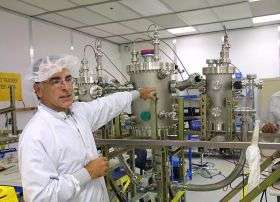
Rafe Schindler in the LSST clean room.
Contamination is the enemy for Large Synoptic Survey Telescope collaborators Rafe Schindler and a team of SLAC scientists and technicians working in Light Assembly Building 33. The clean room, which requires shoe covers, hair nets and immaculately cleaned nylon lab coats, will house the construction of the camera for the Large Synoptic Survey Telescope (LSST). But before work begins on the three-ton camera, Schindler's team is building a suite of high vacuum chambers to test materials for use in its construction.
"We're starting early because this research on potential materials impacts the entire downstream design and construction of every other component in proximity to the optical elements of the camera," said Schindler.
The LSST will scan the entire southern hemisphere every other night. Its camera will comprise 21 sub-cameras, each comparable to the largest camera on a telescope today. Delicately placed side-by-side, no more than a few hundred microns apart, the cameras' minute separations will minimize dead space. The result will be one large camera with an imaging surface nearly three-quarters of a meter wide and almost perfectly flat.
"This is a game of tolerances," says Schindler. "This part of the project pushes the limits of modern manufacturing and metrology."
But before parts can be manufactured, materials must be tested to ensure they will not create contaminants in the focal plane's environment that could interfere with picture taking. If dirt, dust or a thin film—like a fingerprint—contaminates an average digital camera, it would take a few minutes to take apart, clean and reassemble. If the LSST's camera is contaminated, it could take 6 to 12 months to repair, and possibly damage the delicate sensors of the focal plane.
Because of the long repair time, it is imperative that the camera be made out of materials that won't contaminate its imaging surfaces over the expected 10-year lifetime. Schindler’s team is building a contamination chamber that will test camera components and their preparation for vacuum use to find which materials are acceptable.
"Our test facility should create a new standard for preparation and qualification of materials for all future optical instruments of the same scale," says Schindler.
The contamination chamber will be ready for material testing in a couple of months, after it is transferred to new laboratory space on Stanford's main campus. The clean room and Building 33 will eventually be used for the camera's assembly. When completed, the camera will take four images a minute, with each image file containing about 10,000 times more data than a good digital camera in today's market.
"For the field of particle astrophysics the LSST project as a whole will herald a revolution akin to that which took place in accelerator–based particle physics in the early 70's, with the emergence of single dedicated experiments based on large solid angle spectrometers," said Schindler.
Source: by Ken Kingery, SLAC Today
-
Engineers build first sub-10-nm carbon nanotube transistor
Feb 01, 2012 |
4.9 / 5 (31) |
30
-
Something old, something new: Evolution and the structural divergence of duplicate genes
Jan 31, 2012 |
4.6 / 5 (7) |
1
-
The hidden nanoworld of ice crystals: Revealing the dynamic behavior of quasi-liquid layers
Jan 30, 2012 |
5 / 5 (3) |
1
-
Stock market network reveals investor clustering
Jan 27, 2012 |
3.9 / 5 (23) |
8
-
Of microchemistry and molecules: Electronic microfluidic device synthesizes biocompatible probes
Jan 26, 2012 |
5 / 5 (1) |
0
-
gas leaks in space
3 hours ago
-
Weight required to balance a boom stand?
5 hours ago
-
Questions about Equivalence principle & Einstein Elevator?
6 hours ago
-
Kinetic energy of gas
8 hours ago
-
Understanding induced emfs
10 hours ago
-
What is the precise definition of a year?
11 hours ago
- More from Physics Forums - General Physics
More news stories
Explained: Sigma
It's a question that arises with virtually every major new finding in science or medicine: What makes a result reliable enough to be taken seriously? The answer has to do with statistical significance -- but ...
Feb 09, 2012 |
5 / 5 (19) |
66
Quantum physicist explains $100K offer for proof scaled-up quantum computing is impossible
(PhysOrg.com) -- MIT researcher Scott Aaronson has certainly riled the physics community with his offer this past Friday, of $100,000 to anyone who can prove that scaled-up quantum computing is impossible. ...
Diamond light, brighter than the sun
Its the size of five football pitches and generates light 10 billion times brighter than the sun. As the Diamond Light Source celebrates its tenth anniversary this year, Penny Bailey visits one of the ...
Feb 07, 2012 |
4.3 / 5 (7) |
18
|
Physicists 'record' magnetic breakthrough
An international team of scientists has demonstrated a revolutionary new way of magnetic recording which will allow information to be processed hundreds of times faster than by current hard drive technology.
Feb 07, 2012 |
4.5 / 5 (41) |
14
|
Hints of the Higgs - papers are submitted
Back in December 2011, the ATLAS and CMS experiments at CERN presented some exciting results that provided tantalising hints of the Higgs boson.
Feb 08, 2012 |
4.1 / 5 (7) |
10
Google might launch Drive for cloud storage soon
(PhysOrg.com) -- Google's next big move, according to the Wall Street Journal, is a cloud storage service called Drive. Hardly first to the plate, Google is simply catching up to introducing its cloud reposi ...
Latin America mining boom clashes with conservation
Latin America is experiencing a mining boom as prices rise fuelled by a hike in global demand, but the region is also being hit by a wave of violent protests, strikes and rallies by environmentalists.
Love a click away in Indonesia's Twitter Republic
He was a geeky kid from Yogyakarta, she a glamorous city girl in Jakarta. In a country with one of the world's most vibrant social networking scenes they fell in love on Twitter.
Walney offshore wind farm is world's biggest (for now)
(PhysOrg.com) -- The Walney wind farm on the Irish Sea--characterized by high tides, waves and windy weather--officially opened this week. The farm is treated in the press as a very big deal as the Walney ...
GPS court ruling leaves US phone tracking unclear
A US Supreme Court decision requiring a warrant to place a GPS device on the car of a criminal suspect leaves unresolved the bigger issue of police tracking using mobile phones, legal experts say.
Europeans protest controversial Internet pact
Tens of thousands of people marched in protests in more than a dozen European cities Saturday against a controversial anti-online piracy pact that critics say could curtail Internet freedom.