Longest study finds reef fish need longer break
July 11, 2007
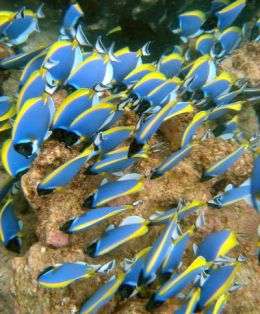
A study on the recovery rates of fishes in exploited reef systems on the coast of Kenya found that some species, such as the powder blue tang, may need decades to recover to pre-fishing levels. Credit: Tim McClanahan/Wildlife Conservation Society
In the longest running study on how fish populations in coral reef systems recover from heavy exploitation, researchers from the Wildlife Conservation Society (WCS) and others have found that the fish can recover, but they need lots of time – decades in some cases. The study appears in a recent edition of the journal Ecological Applications.
With nearly continuous data spanning some 37 years from four national marine parks off the coast of Kenya which were closed to fishing at different times, the study found that commercially important species such as parrotfish, wrasses, and surgeonfish can take a quarter of a century to recover fully. More importantly, the ecological equilibrium needed for a healthy reef system, which relies on the interplay of many fish, invertebrate, and plant species, take even longer to achieve, and certainly longer than the length of the study. Most fish recovery studies are conducted with small data sets in short durations of time.
“There’s a pressing need for long-term studies on how fish communities in reef ecosystems rebuild when fishing is banned,” said WCS researcher Dr. Tim McClanahan, the lead author of the study. “This study gives us some important insights in how the different fish species recover and how these communities affect the health of the reef as a whole.”
Specifically, the study examined the recovery rates of eight dominant fish families in Kenya’s marine national parks between 1987 and 2005 using counts that measured fish diversity, size, and density. What the researchers found is that species diversity peaked and stabilized 10 years after a marine park was closed to fishing. The recovery rates of different families and species, however, occurred at different rates, partly as a result of competition for resources among different species. For instance, most parrotfish took some 10-20 years to recover, but then declined, perhaps as a result of competition from a variety of surgeonfish.
A group of fish known as wrasses increased and then peaked in diversity and numbers after 10 years and then their abundance declined, perhaps as a result of competition with triggerfish for the same invertebrate prey. One species of triggerfish—the orange-lined triggerfish—became dominant in the parks with the longest fishing bans, actively excluding other competitors from territories.
Triggerfish are important in another respect; they feed on sea urchins, which in turn feed on the reef-building algae on which the entire reef system depends. When fishing eliminates species that prey on sea urchins, the invertebrates can severely impact the entire system, so keeping sea urchins in check is vital to coral reefs.
Overall, the time frame needed by surgeonfish and tangs, triggerfish, rabbitfish, and the coral-building algae to completely rebuild their populations to pre-fishing levels may exceed the length of the study.
“Decisions made by managers to close areas to fishing in an effort to save fish populations can be unpopular but necessary,” added McClanahan. “What this study has shown us is that many fish populations take long periods of time to recover fully, and that permanent bans on fishing in some parks are necessary if we’re to conserve healthy coral reef systems.”
Source: Wildlife Conservation Society
-
Moreton Bay ecosystem still at risk
Jan 31, 2012 |
4.5 / 5 (2) |
0
-
Rich Asians threaten high-value fish: experts
Jan 24, 2012 |
not rated yet |
0
-
Lessons in coral reef survival from deep time
Jan 23, 2012 |
not rated yet |
0
-
Cliffhanging corals avoid trawler damage
Jan 20, 2012 |
4.8 / 5 (4) |
0
-
Cruise ship threatens marine paradise
Jan 20, 2012 |
5 / 5 (1) |
0
-
Fast photon control brings quantum photonic technologies closer
10 hours ago |
5 / 5 (4) |
0
-
Engineers build first sub-10-nm carbon nanotube transistor
Feb 01, 2012 |
4.9 / 5 (33) |
30
-
Something old, something new: Evolution and the structural divergence of duplicate genes
Jan 31, 2012 |
4.6 / 5 (7) |
1
-
The hidden nanoworld of ice crystals: Revealing the dynamic behavior of quasi-liquid layers
Jan 30, 2012 |
5 / 5 (5) |
1
-
Stock market network reveals investor clustering
Jan 27, 2012 |
3.9 / 5 (23) |
8
More news stories
Plants use circadian rhythms to prepare for battle with insects
In a study of the molecular underpinnings of plants' pest resistance, Rice University biologists have shown that plants both anticipate daytime raids by hungry insects and make sophisticated preparations to ...
1 hour ago |
5 / 5 (2) |
0
|
Study finds fish of Antarctica threatened by climate change
A Yale-led study of the evolutionary history of Antarctic fish and their "anti-freeze" proteins illustrates how tens of millions of years ago a lineage of fish adapted to newly formed polar conditions ...
4 hours ago |
5 / 5 (2) |
0
|
Explosive evolution need not follow mass extinctions, says study of ancient zooplankton
Following one of Earth's five greatest mass extinctions, tiny marine organisms called graptoloids did not begin to rapidly develop new physical traits until about 2 million years after competing species became ...
4 hours ago |
5 / 5 (1) |
1
|
Writing a new code for life?
On "Star Trek, the aliens often look so human that crew members fall in love with them. But in real life, scientists in the field known as astrobiology can't be sure alien life would even be carbon-based like us, or use DNA ...
6 hours ago |
5 / 5 (5) |
1
Lens produces hours of scientific work in seconds
A new form of microscope which can produce results in seconds rather than hours dramatically speeding up the process of drug development - is being developed by researchers at the University of Strathclyde ...
8 hours ago |
4.4 / 5 (7) |
1
|
First-of-its-kind stem cell study re-grows healthy heart muscle in heart attack patients
Results from a Cedars-Sinai Heart Institute clinical trial show that treating heart attack patients with an infusion of their own heart-derived cells helps damaged hearts re-grow healthy muscle.
Scientists discover reason for Mt. Hood's non-explosive nature
(PhysOrg.com) -- For a half-million years, Mount Hood has towered over the landscape, but unlike some of its cousins in Oregons Cascade Mountains and many other volcanoes around the Pacific Rim ...
Discovery paves way for salmonella vaccine
(Medical Xpress) -- An international research team led by a University of California, Davis, immunologist has taken an important step toward an effective vaccine against salmonella, a group of increasingly antibiotic-resistant ...
Time of year important in projections of climate change effects on ecosystems
(PhysOrg.com) -- Does it matter whether long periods of hot weather, such as last year's heat wave that gripped the U.S. Midwest, happen in June or July, August or September?
Smoking bans lead to less, not more, smoking at home: study
Smoking bans in public/workplaces don't drive smokers to light up more at home, suggests a study of four European countries with smoke free legislation, published online in Tobacco Control.
Ovarian cancer arises in fallopian tube of knockout mice
(Medical Xpress) -- The most deadly form of "ovarian" cancer arises in the fallopian tubes not the ovaries of knockout mice that lack two genes associated with the disease, said researchers led by Baylor College ...