Bak protein sets stressed cells on suicide path, researchers show
July 12, 2007
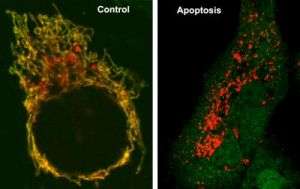
Cell image: The control cell has normal, filamentous mitochondria while the stressed, dying cell has numerous mitochondrial fragments. Credit: Medical College of Georgia
When a cell is seriously stressed, say by a heart attack, stroke or cancer, a protein called Bak just may set it up for suicide, researchers have found.
In a deadly double whammy, Bak helps chop the finger-like filament shape of the cell’s powerhouse, or mitochondrion, into vulnerable little spheres. Another protein Bax then pokes countless holes in those spheres, spilling their pro-death contents into the cell.
“We found out Bak has a distinct function in regulation of the mitochondrial morphology,” says Dr. Zheng Dong, cell biologist at the Medical College of Georgia and the Veterans Affairs Medical Center in Augusta and corresponding author on a paper published this week in Proceedings of the National Academy of Sciences. “Bax, on the other hand, is not involved in morphological regulation but needs to be there to puncture holes.”
“One has to break up, kind of soften, the mitochondria for injury, and the other one actually punches the holes to kill it,” says Craig Brooks, MCG graduate student and the paper’s first author.
Bak and Bax have similar structures and scientists have long suspected they play major, similar roles in programmed cell death, or apoptosis. “These two proteins are very important for mitochondrial injury and subsequent apoptosis,” says Dr. Dong.
To stress cells, they blocked oxygen supplies and used the common chemotherapeutic agent cisplatin, then documented that filamentous mitochondria became fragmented very early and quickly in apoptosis. Ironically they also found the deadly fragmentation results from Bak’s interaction with mitochondria-shaping proteins called mitofusins, which help mitochondria keep their filamentous shape in non-stressed cells. Dr. Dong suspects Bak may also play a role in mitofusin regulation in normal, non-stressful conditions.
In fact, the researchers suspect Bak, Bax and the contents they spill into the cell all have roles in keeping a cell functioning until a stressor kicks in.
“They probably are both kept in check normally in the cell by other proteins, and when something happens that overwhelms the cell, it activates Bak and Bax to start cell death,” says Mr. Brooks. “Some of the same proteins, cytochrome c is the big one, are needed for daily mitochondrial function like making energy, but if they are released from the mitochondria, they activate a cell killing or apoptotic pathway,” says Dr. Dhong, referencing the contents that spill from punctured mitochondria.
Looking at kidney cells and neurons in a Bak deficient mouse, they also showed that Bak and Bax need each other to successfully spawn cell suicide. “If you have Bak but not Bax, the mitochondria still fragment but they don’t die; if you have Bax but not Bak, you still have punctures in the mitochondria but with low efficiency,” says Mr. Brooks.
Now they want to know exactly how Bak interacts with mitofusins, how the interaction is regulated and how it affects mitochondrial morphology, physiology and pathology. Their long-term goal for better understanding the cell suicide mechanism is developing drugs to block it in the case of a stroke, for example, or induce it to kill cancer.
Source: Medical College of Georgia
-
Overcoming tumor resistance to anti-cancer agent TRAIL
Mar 22, 2010 |
4 / 5 (1) |
0
-
Pores finding reveals targets for cancer and degenerative disease
Dec 18, 2009 |
5 / 5 (1) |
0
-
Research points to a new way to protect kidneys threatened by insufficient blood or toxins (w/Video)
May 18, 2009 |
not rated yet |
0
-
Stowers researcher answers fundamental question of cell death
Jan 10, 2005 |
not rated yet |
0
-
S. Korea to revive stem cell research after scandal
Sep 19, 2011 |
not rated yet |
0
-
Engineers build first sub-10-nm carbon nanotube transistor
Feb 01, 2012 |
4.9 / 5 (33) |
30
-
Something old, something new: Evolution and the structural divergence of duplicate genes
Jan 31, 2012 |
4.6 / 5 (7) |
1
-
The hidden nanoworld of ice crystals: Revealing the dynamic behavior of quasi-liquid layers
Jan 30, 2012 |
5 / 5 (4) |
1
-
Stock market network reveals investor clustering
Jan 27, 2012 |
3.9 / 5 (23) |
8
-
Of microchemistry and molecules: Electronic microfluidic device synthesizes biocompatible probes
Jan 26, 2012 |
5 / 5 (2) |
0
-
Is Everyday Technology Killing Us?
Feb 08, 2012
-
Exercise and weight loss
Feb 08, 2012
-
Why do we have head aches? Our brains can't feel anything.
Feb 07, 2012
-
"The end of diseases" by David Agus, interview from Daily Show with Jon Stewart
Feb 04, 2012
-
Oncolytic adenovirus
Feb 04, 2012
-
Nutrition label stuffs and diets
Feb 02, 2012
- More from Physics Forums - Medical Sciences
More news stories
Overeating may double risk of memory loss
New research suggests that consuming between 2,100 and 6,000 calories per day may double the risk of memory loss, or mild cognitive impairment (MCI), among people age 70 and older. The study was released today and will be ...
Medicine & Health / Neuroscience
4 hours ago |
5 / 5 (2) |
0
|
Starve a virus, feed a cure? Findings show how some cells protect themselves against HIV
A protein that protects some of our immune cells from the most common and virulent form of HIV works by starving the virus of the molecular building blocks that it needs to replicate, according to research published online ...
7 hours ago |
5 / 5 (1) |
0
|
Declining health-care productivity in England: Who says so?
Reports that the National Health Service in England has been declining in productivity in the last decade appear to have been accepted as fact. However, a Viewpoint published Online First by The Lancet disputes this. The Vi ...
2 hours ago |
not rated yet |
0
Injured boomers beware: Know when to see doctor
(AP) -- It happened to nurse Jane Byron years after an in-line skating fall, business owner Haralee Weintraub while doing "men's" push-ups, and avid cyclist Gene Wilberg while lifting a heavy box.
9 hours ago |
5 / 5 (1) |
0
FDA-approved drug rapidly clears amyloid from the brain, reverses Alzheimer's symptoms in mice
Neuroscientists at Case Western Reserve University School of Medicine have made a dramatic breakthrough in their efforts to find a cure for Alzheimer's disease. The researchers' findings, published in the journal Science, show t ...
Medicine & Health / Neuroscience
Feb 09, 2012 |
4.9 / 5 (58) |
17
|
Scientists discover molecular secrets of 2,000-year-old Chinese herbal remedy
For roughly two thousand years, Chinese herbalists have treated Malaria using a root extract, commonly known as Chang Shan, from a type of hydrangea that grows in Tibet and Nepal. More recent studies suggest that halofuginone, ...
New method to examine batteries -- MRI from the inside
There is an ever-increasing need for advanced batteries for portable electronics, such as phones, cameras, and music players, but also to power electric vehicles and to facilitate the distribution and storage of energy derived ...
A mitosis mystery solved: How chromosomes align perfectly in a dividing cell
Although the process of mitotic cell division has been studied intensely for more than 50 years, Whitehead Institute researchers have only now solved the mystery of how cells correctly align their chromosomes during symmetric ...
Google might launch Drive for cloud storage soon
(PhysOrg.com) -- Google's next big move, according to the Wall Street Journal, is a cloud storage service called Drive. Hardly first to the plate, Google is simply catching up to introducing its cloud reposi ...
Lab study raises questions over nano-particle impact
Tests involving chickens have raised questions about the impact on health from engineered nano-particles, the ultra-fine grains commonly used in drugs and processed foods, scientists said on Sunday.
Researchers find extensive RNA editing in human transcriptome
In a new study published online in Nature Biotechnology, researchers from BGI, the world's largest genomics organization, reported the evidence of extensive RNA editing in a human cell line by analysis of RNA-seq data, demons ...