Fossilised midges provide clues to future climate change
July 12th, 2007 Fossilised midges provide clues to future climate change

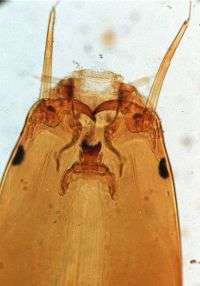
The head of a fossilised midge. Credit: University of Liverpool

Fossilised midges have helped scientists at the University of Liverpool identify two episodes of abrupt climate change that suggest the UK climate is not as stable as previously thought.

The episodes were discovered at a study in Hawes Water in Northern Lancashire, where the team used a unique combination of isotope studies and analysis of fossilised midge heads. Together they indicated where the climate shifts occurred and the temperature of the atmosphere at the time.

The first shift detected occurred around 9,000 years ago and the second around 8,000 years ago. Evidence suggests that these shifts were due to changes in the Gulf Stream, which normally keeps the UK climate warm and wet.

During each shift the North West climate cooled with an average summer temperature fall of 1.6 degrees – approximately three times the amount of temperature change currently attributed to global warming.

Scientists found that the atmosphere cooled rapidly and cold periods lasted up to 50 years for one event and 150 years for the other. The detection of these events will allow experts to understand more clearly what can happen when the climate system is disturbed.

Professor Jim Marshall, from the University’s Department of Earth and Ocean Sciences, explains: “At Hawes Water mud has been deposited continuously without any gaps, which allows us to measure an accurate timeline of events. We have monitored the modern environment of the lake for the past eight years and this has shown us how to read the past climate record from the ancient mud in the lake.

“Isotope analysis helped us identify the episodes of climate change. We then used fossilised heads of non-biting midges, which are preserved in every spoonful of mud. They tell us the temperature at the time the mud was deposited. We compare the population of midge heads in each sediment sample with the population of midges in Scandinavian lakes, which span a wide range of modern day temperatures.”

The team found the two abrupt climate changes correlated directly with two episodes of sharp climate deterioration in areas such as Greenland, suggesting that a change in the Gulf Stream had occurred.

Professor Marshall added: “People are worried that the melting of the polar ice caps could result in a slow-down of what we call the ‘Atlantic Conveyer’. This is where cold water that sinks in the far north is replaced by warmer water from the tropics in its circulation of the North Atlantic Ocean. A number of studies suggest that the conveyer may be unstable and may be able to slow down or switch off completely, making our climate suddenly colder. Our study provides evidence that the two climate shifts we detected were directly linked to a slow-down in the conveyer.”

Scientists believe that this new data will provided a unique test for the global climate computer models that are being used to simulate future climate change.

The research - in collaboration with University of Swansea; the Open University; University of Exeter; Edge Hill University and University College London - is published in Geology.

Source: University of Liverpool


print this article email this article download pdf blog this article bookmark this article     Digg this Stumble it share on Facebook share on Reddit add to delicious save to Yahoo! bookmarks
4.6/5 after 15 votes


July 12th, 2007 all stories
Space & Earth / Earth Sciences

Comments: 0
Rank: 4.6/5 after 15 votes

  • Stumble this up

  • Digg this

  • Share it:
  • share on Facebook
  • share on MySpace
  • share on Slashdot
  • rss-newsfeed
  • share on Google
  • share on Reddit
  • add to delicious
  • save to Yahoo! bookmarks
  • share on Windows Live
  • Add to Mixx!
Rating: 4.6/5 after 15 votes

  • Related Stories

  • Growing Population Warming East African Nights?
    created Mar 31, 2009 | popularity not rated yet | comments 0
  • Dust may settle unanswered questions on Antarctica
    created Mar 29, 2009 | popularity not rated yet | comments 0
  • Liquid saltwater is likely present on Mars, new analysis shows
    created Mar 17, 2009 | popularity not rated yet | comments 0
  • Is the Dead Sea dying?
    created Mar 04, 2009 | popularity not rated yet | comments 0
  • Invasive Parasite Spreading Among West Coast Estuaries
    created Feb 26, 2009 | popularity not rated yet | comments 0

Tags


  • Transform a ball into a rock -- or make it invisible -- using transformation optics
    Transform a ball into a rock -- or make it invisible -- using transformation optics
    Physics / General Physics
    created 10 hours ago | popularity 3.7 / 5 (3) | comments 0
  • Could a quantum motor do work?
    Physics / General Physics
    created Jul 07, 2009 | popularity 4 / 5 (12) | comments 0
  • Physicists Demonstrate Quantum Memory with Matter Qubits
    Physicists Demonstrate Quantum Memory with Matter Qubits
    Physics / General Physics
    created Jul 03, 2009 | popularity 4.5 / 5 (20) | comments 1
  • 'Holey' Nanosheets for Wastewater Dye Removal
    Nanotechnology / Nanomaterials
    created Jul 01, 2009 | popularity 5 / 5 (5) | comments 1
  • Jellyfish Robot Swims Like its Biological Counterpart
    Jellyfish Robot Swims Like its Biological Counterpart
    Electronics / Robotics
    created Jun 26, 2009 | popularity 4.4 / 5 (9) | comments 1
  • Other News

    Living fossils hold record of 'supermassive' kick

    Living fossils hold record of 'supermassive' kick

    Space & Earth / Astronomy

    created 3 hours ago | popularity 4.5 / 5 (2) | comments 1

    The tight cluster of stars surrounding a supermassive black hole after it has been violently kicked out of a galaxy represents a new kind of astronomical object and a fossil record of the kick.


    Methane-eating microbes can use iron and manganese oxides to 'breathe'

    Methane-eating microbes can use iron and manganese oxides to 'breathe'

    Space & Earth / Earth Sciences

    created 6 hours ago | popularity 4.7 / 5 (3) | comments 0

    Iron and manganese compounds, in addition to sulfate, may play an important role in converting methane to carbon dioxide and eventually carbonates in the Earth's oceans, according to a team of researchers ...


    Tremors on southern San Andreas Fault may mean increased quake risk

    Tremors on southern San Andreas Fault may mean increased quake risk

    Space & Earth / Earth Sciences

    created 5 hours ago | popularity not rated yet | comments 0

    (PhysOrg.com) -- Increases in mysterious underground tremors observed in several active earthquake fault zones around the world could signal a build-up of stress at locked segments of the faults and presumably ...


    A Galaxy Collision in Action

    A Galaxy Collision in Action

    Space & Earth / Astronomy

    created 5 hours ago | popularity 4.8 / 5 (4) | comments 1

    This beautiful image gives a new look at Stephan's Quintet, a compact group of galaxies discovered about 130 years ago and located about 280 million light years from Earth. The curved, light blue ridge running ...


    NASA sails through countdown, weather outlook poor (AP)

    NASA sails through countdown, weather outlook poor

    Space & Earth / Space Exploration

    created 3 hours ago | popularity not rated yet | comments 0

    (AP) -- NASA is sailing through the countdown for Saturday's launch of space shuttle Endeavour, with weather the lone concern.