The Gobbling Dwarf that Exploded
July 13th, 2007 The gobbling dwarf that exploded

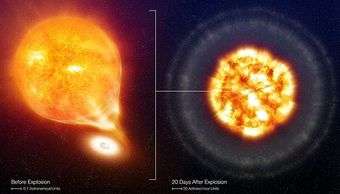
Left: artist´s impression of the favoured configuration for the progenitor system of SN2006X before the explosion. The White Dwarf (on the right) accretes material from the Red Giant star, which is losing gas in the form of stellar wind (the diffuse material surrounding the giant). Only part of the gas is accreted by the White Dwarf, through a so-called accretion disk which surrounds the compact star. The remaining gas escapes the system and eventually dissipates into the interstellar medium. The Red Giant star has a radius about 100 times larger than our Sun, while the White Dwarf is about 100 times smaller than the Sun. Right: Once the mass of the White Dwarf has reached a critical limit, a thermonuclear explosion completely disrupts the star, ejecting its material with velocities up to a tenth of the speed of light. Twenty days after the explosion, when the supernova reaches its maximum brightness, the ejected material has reached a size of roughly 450 times the distance from Earth to the Sun. The enormous amount of light emitted by the supernova passes through the surrounding material before being detected by us, thus revealing gas shells which were ejected by the Red Giant in the last few hundred years before the explosion. These density enhancements were produced either by fluctuations in the mass-loss rate of the Red Giant, or by small recurrent explosive episodes on the surface of the White Dwarf in the final phases of its existence. Credit: ESO

A unique set of observations, obtained with ESO's VLT, has allowed astronomers to find direct evidence for the material that surrounded a star before it exploded as a Type Ia supernova. This strongly supports the scenario in which the explosion occurred in a system where a white dwarf is fed by a red giant.

Because Type Ia supernovae are extremely luminous and quite similar to one another, these exploding events have been used extensively as cosmological reference beacons to trace the expansion of the Universe.

However, despite significant recent progress, the nature of the stars that explode and the physics that governs these powerful explosions have remained very poorly understood.

In the most widely accepted models of Type Ia supernovae the pre-explosion white dwarf star orbits another star. Due to the close interaction and the strong attraction produced by the very compact object, the companion star continuously loses mass, 'feeding' the white dwarf. When the mass of the white dwarf exceeds a critical value, it explodes.

The team of astronomers studied in great detail SN 2006X, a Type Ia supernova that exploded 70 million light-years away from us, in the splendid spiral Galaxy Messier 100. Their observations led them to discover the signatures of matter lost by the normal star, some of which is transferred to the white dwarf.

The observations were made with the Ultraviolet and Visual Echelle Spectrograph (UVES), mounted at ESO's 8.2-m Very Large Telescope, on four different occasions, over a time span of four months. A fifth observation at a different time was secured with the Keck telescope in Hawaii. The astronomers also made use of radio data obtained with NRAO's Very Large Array as well as images extracted from the NASA/ESA Hubble Space Telescope archive.

"No Type Ia supernova has ever been observed at this level of detail for more than four months after the explosion," says Ferdinando Patat, lead author of the paper reporting the results in this week's issue of Science Express, the online version of the Science research journal. "Our data set is really unique."

The most remarkable findings are clear changes in the absorption of material, which has been ejected from the companion giant star. Such changes of interstellar material have never been observed before and demonstrate the effects a supernova explosion can have on its immediate environment. The astronomers deduce from the observations the existence of several gaseous shells (or clumps) which are material ejected as stellar wind from the giant star in the recent past.

"The material we have uncovered probably lies in a series of shells having a radius of the order of 0.05 light-years, or roughly 3 000 times the distance between Earth and the Sun", explains Patat. "The material is moving with a velocity of 50 km/s, implying that the material would have been ejected some 50 years before the explosion."

Such a velocity is typical for the winds of red giants. The system that exploded was thus most likely composed of a white dwarf that acted as a giant 'vacuum cleaner', drawing gas off its red giant companion. In this case however, the cannibal act proved fatal for the white dwarf. This is the first time that clear and direct evidence for material surrounding the explosion has been found.

"One crucial issue is whether what we have seen in SN 2006X represents the rule or is rather an exceptional case," wonders Patat. "But given that this supernova has shown no optical, UV and radio peculiarity whatsoever, we conclude that what we have witnessed for this object is a common feature among normal SN Ia. Nevertheless, only future observations will give us answers to the many new questions these observations have posed to us."

These results are reported in a paper in Science Express published on 12 July 2007 ("Detection of circumstellar material in a normal Type Ia Supernova", by F. Patat et al.).

Source: European Southern Observatory


print this article email this article download pdf blog this article bookmark this article     Digg this Stumble it share on Facebook share on Reddit add to delicious save to Yahoo! bookmarks
4.7/5 after 35 votes


July 13th, 2007 all stories
Space & Earth / Astronomy

Comments: 0
Rank: 4.7/5 after 35 votes

  • Stumble this up

  • Digg this

  • Share it:
  • share on Facebook
  • share on MySpace
  • share on Slashdot
  • rss-newsfeed
  • share on Google
  • share on Reddit
  • add to delicious
  • save to Yahoo! bookmarks
  • share on Windows Live
  • Add to Mixx!
Rating: 4.7/5 after 35 votes

  • Related Stories

  • Unusual shape of exploded star puzzles scientists
    created Jun 17, 2009 | popularity not rated yet | comments 0
  • Supernova remnant is an unusual suspect
    created Jun 09, 2009 | popularity not rated yet | comments 0
  • Scientists discover a nearly Earth-sized planet (Update)
    created Apr 21, 2009 | popularity not rated yet | comments 0
  • Solar systems around dead Suns?
    created Apr 20, 2009 | popularity not rated yet | comments 0
  • Cool Stars Have Different Mix of Life-Forming Chemicals
    created Apr 07, 2009 | popularity not rated yet | comments 0

Tags


  • Physicists Demonstrate Quantum Memory with Matter Qubits
    Physicists Demonstrate Quantum Memory with Matter Qubits
    Physics / General Physics
    created Jul 03, 2009 | popularity 4.4 / 5 (17) | comments 1
  • 'Holey' Nanosheets for Wastewater Dye Removal
    Nanotechnology / Nanomaterials
    created Jul 01, 2009 | popularity 5 / 5 (5) | comments 1
  • Jellyfish Robot Swims Like its Biological Counterpart
    Jellyfish Robot Swims Like its Biological Counterpart
    Electronics / Robotics
    created Jun 26, 2009 | popularity 4.4 / 5 (8) | comments 1
  • Could Maxwell's Demon Exist in Nanoscale Systems?
    Could Maxwell's Demon Exist in Nanoscale Systems?
    Physics / General Physics
    created Jun 24, 2009 | popularity 4.4 / 5 (18) | comments 29
  • Living Safely with Robots, Beyond Asimov's Laws
    Living Safely with Robots, Beyond Asimov's Laws
    Electronics / Robotics
    created Jun 22, 2009 | popularity 4.6 / 5 (52) | comments 40
  • Other News

    Forty years ago man first walked on the moon

    Space & Earth / Space Exploration

    created 6 hours ago | popularity 5 / 5 (2) | comments 0

    Forty years ago on July 20, 1969, American astronaut Neil Armstrong realized the oldest dream of human civilizations when he became the first man to walk on the moon.


    The least sea ice in 800 years

    The least sea ice in 800 years

    Space & Earth / Earth Sciences

    created Jul 01, 2009 | popularity 4.3 / 5 (59) | comments 52

    New research, which reconstructs the extent of ice in the sea between Greenland and Svalbard from the 13th century to the present indicates that there has never been so little sea ice as there is now. The ...


    Gas around young galaxy

    Intense heat killed the Universe's would-be galaxies, researchers say

    Space & Earth / Astronomy

    created Jul 01, 2009 | popularity 3.2 / 5 (19) | comments 25

    (PhysOrg.com) -- Our Milky Way galaxy only survived because it was already immersed in a large clump of dark matter which trapped gases inside it, scientists led by Durham University's Institute for Computational ...


    Scientists' Drill Hits Magma: Only Third Time on Record

    Scientists' Drill Hits Magma: Only Third Time on Record

    Space & Earth / Earth Sciences

    created Jun 29, 2009 | popularity 4.7 / 5 (20) | comments 19

    (PhysOrg.com) -- Scientists drilling a borehole deep into Iceland’s rocky crust to explore new methods of using geothermal energy hit a major roadblock on Thursday: Their drill ran into molten rock at a depth ...


    NASA manager pitches a cheaper return-to-moon plan

    Space & Earth / Space Exploration

    created Jun 30, 2009 | popularity 4 / 5 (7) | comments 18

    (AP) -- Like a car salesman pushing a luxury vehicle that the customer no longer can afford, NASA has pulled out of its back pocket a deal for a cheaper ride to the moon.