Geologists witness unique volcanic mudflow in action in New Zealand
July 13th, 2007 Geologists witness unique volcanic mudflow in action in New Zealand

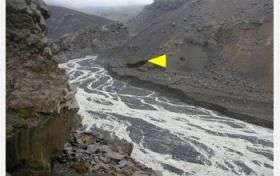
This image of the lahar channel shows the area right after the collapse of New Zealand's Crater Lake's walls. Credit: University of Hawaii

Volcanologist Sarah Fagents from the School of Ocean and Earth Science and Technology (SOEST) at the University of Hawaii at Manoa had an amazing opportunity to study volcanic hazards first hand, when a volcanic mudflow broke through the banks of a volcanic lake at Mount Ruapehu in New Zealand.

Fagents and colleagues were there on a National Science Foundation (NSF)-funded project to study the long-forecast Crater Lake break-out lahar at Mount Ruapehu. A lahar is a type of mudflow composed of water and other sediment that flows down from a volcano, typically along a river valley.

Lahars are caused by the rapid melting of snow and/or glaciers during a volcanic eruption, or as in the case of Mount Ruapehu, the breakout of a volcanic lake.

"Lahars can be extremely hazardous, especially in populated areas, because of their great speed and mass," said William Leeman, NSF program director for petrology and geochemistry. "They can flow for many tens of miles, causing catastrophic destruction along their path. The 1980 eruptions at Mount St. Helens, for example, resulted in spectacular lahar flows that choked virtually all drainages on the volcano, and impacted major rivers as far away as Portland, Ore."

Fagents visited stretches of the lahar pathway before the breakout to assess pre-event channel conditions. Although the event was predicted to occur in 2007, the recent decreased filling rate of Crater Lake suggested that the lake bank actually would not be overtopped until 2008.

However, several days of intense rainfall and increased seepage through the bank ultimately caused it to collapse much sooner, on March 18, 2007.

A lahar warning system had been installed at Mount Ruapehu, and was hailed a success after it successfully alerted officials to the onset of the lahar. In total, about 1.3 million cubic meters of water were released from Crater Lake.

"We found a broad area covered in a veneer of mud and boulders," said Fagents. "It was an unprecedented opportunity to see the immediate aftermath of such an event. It's particularly motivating for the students who were along to learn first-hand about lahar processes in such a dynamic environment."

Fagents and colleagues returned to New Zealand a month later to conduct a more detailed analysis of the deposit. "Because the Crater Lake breakout had been long forecast, there was an unprecedented amount of instrumentation installed in the catchment by our New Zealand colleagues to capture the event," says Fagents.

"The 2007 event is the best studied lahar in the world," she said.

Prediction of the effects of the events is of critical importance in populated volcanic regions. Many other volcanoes around the world, including Mount Rainier in Washington State, and Galunggung in Indonesia, are also considered particularly dangerous due to the risk of lahars, according to Leeman.

Fagents is developing a computer model to simulate lahar emplacement and to predict the associated hazards. "The intent is to adapt this model to account for different lahar triggering mechanisms, and for different locations, to make it widely applicable," said Fagents. "The ultimate goal is provide a useful hazards assessment tool for future lahars."

Source: National Science Foundation


print this article email this article download pdf blog this article bookmark this article     Digg this Stumble it share on Facebook share on Reddit add to delicious save to Yahoo! bookmarks
3.8/5 after 12 votes


July 13th, 2007 all stories
Space & Earth / Earth Sciences

Comments: 0
Rank: 3.8/5 after 12 votes

  • Stumble this up

  • Digg this

  • Share it:
  • share on Facebook
  • share on MySpace
  • share on Slashdot
  • rss-newsfeed
  • share on Google
  • share on Reddit
  • add to delicious
  • save to Yahoo! bookmarks
  • share on Windows Live
  • Add to Mixx!
Rating: 3.8/5 after 12 votes

  • Related Stories

  • New Zealand quake causes volcano concern
    created Oct 05, 2006 | popularity not rated yet | comments 0

Tags


  • Physicists Demonstrate Quantum Memory with Matter Qubits
    Physicists Demonstrate Quantum Memory with Matter Qubits
    Physics / General Physics
    created Jul 03, 2009 | popularity 4.4 / 5 (17) | comments 1
  • 'Holey' Nanosheets for Wastewater Dye Removal
    Nanotechnology / Nanomaterials
    created Jul 01, 2009 | popularity 5 / 5 (5) | comments 1
  • Jellyfish Robot Swims Like its Biological Counterpart
    Jellyfish Robot Swims Like its Biological Counterpart
    Electronics / Robotics
    created Jun 26, 2009 | popularity 4.4 / 5 (8) | comments 1
  • Could Maxwell's Demon Exist in Nanoscale Systems?
    Could Maxwell's Demon Exist in Nanoscale Systems?
    Physics / General Physics
    created Jun 24, 2009 | popularity 4.4 / 5 (18) | comments 29
  • Living Safely with Robots, Beyond Asimov's Laws
    Living Safely with Robots, Beyond Asimov's Laws
    Electronics / Robotics
    created Jun 22, 2009 | popularity 4.6 / 5 (53) | comments 40
  • Other News

    China environmental phenomena monitored from space

    Space & Earth / Earth Sciences

    created 59 minutes ago | popularity not rated yet | comments 0

    China is in a very seismically active area and has had many catastrophic earthquakes during its history. A joint European-Chinese team is using satellite radar data to monitor ground deformation across major continental faults ...


    California to require sun-blocking car windows

    Space & Earth / Environment

    created 2 hours ago | popularity 2.3 / 5 (3) | comments 4

    New cars sold in California must include windshields that block or absorb the sun's rays beginning in 2012, the state's Air Resources Board recently ruled.


    Scientists: Silent tremors may foretell next Big One

    Space & Earth / Earth Sciences

    created 2 hours ago | popularity not rated yet | comments 0

    The seismometer is snugged in its hole and tamped over with dirt. Now it's time for the stomp test.


    Steam billows from the cooling towers at a nuclear power generating station in Byron

    Tropical zone expanding due to climate change: study

    Space & Earth / Earth Sciences

    created 5 hours ago | popularity 3 / 5 (4) | comments 1

    Climate change is rapidly expanding the size of the world's tropical zone, threatening to bring disease and drought to heavily populated areas, an Australian study has found.


    The least sea ice in 800 years

    The least sea ice in 800 years

    Space & Earth / Earth Sciences

    created Jul 01, 2009 | popularity 4.1 / 5 (65) | comments 60

    New research, which reconstructs the extent of ice in the sea between Greenland and Svalbard from the 13th century to the present indicates that there has never been so little sea ice as there is now. The ...