Clues to future evolution of HIV come from African green monkeys
Monkey viruses related to HIV may have swept across Africa more recently than previously thought, according to new research from The University of Arizona in Tucson.
A new family tree for African green monkeys shows that an HIV-like virus, simian immunodeficiency virus, or SIV, first infected those monkeys after the lineage split into four species. The new research reveals the split happened about 3 million years ago.
Previously, scientists thought SIV infected an ancestor of green monkeys before the lineage split, much longer ago.
"Studying SIV helps us learn more about HIV," said the paper's first author Joel Wertheim, a doctoral candidate in the UA department of ecology and evolutionary biology. "This finding sheds light on the future direction of HIV evolution."
All SIVs and HIVs have a common ancestor, added senior author Michael Worobey, a UA assistant professor of ecology and evolutionary biology.
The new work suggests African green monkeys' SIVs, or SIVagm, may have lost their virulence more recently than the millions of years previously thought. Green monkeys almost never get sick from SIVagm. If SIVagm was once a monkey killer, the change in its virulence may shed light on the future course and timing of the evolution of HIV.
The new research also challenges the idea that one ancient SIV was transmitted vertically, down through time, and evolved into many SIVs as its original host diverged into many different species.
Wertheim and Worobey suggest various SIVs arose because SIVs were transmitted horizontally, between primate species, and evolved into a new host-specific form only after transmission.
HIV arose from chimpanzee SIV that was transmitted to humans, probably when people had contact with chimpanzee blood from hunting and butchering the animals, Worobey said.
The team's research article, "A Challenge to the Ancient Origin of SIVagm Based on African Green Monkey Mitochondrial Genomes," is in the July issue of PLoS Pathogens and can be found at http://www.plospathogens.org. The National Science Foundation and National Institutes of Health funded the research.
Previous research had sketched out the family trees, or phylogenies, of the four species of African green monkeys and their accompanying SIVagm, but Wertheim wanted to know more.
"I wasn't convinced by the evidence out there that these monkeys were infected before they speciated," Wertheim said. "So I set out to perform a rigorous test of that hypothesis."
He extensively sequenced the mitochondrial DNA genes of the four species of African green monkeys. Mitochondrial DNA is passed from mother to child.
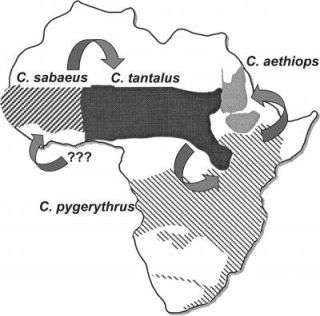
The four green monkeys he studied are the sabaeus monkey, Chlorocebus sabaeus, which lives in western Africa; the tantalus monkey, Chlorocebus tantalus, which is found in central Africa; the vervet monkey, Chlorocebus pygerythrus, which lives in eastern and southern Africa; and the grivet monkey, Chlorocebus aethiops, which lives in northeast Africa.
The scientists used the genetic sequences to sort out the ancestral relationships among the different species of monkeys. Other researchers had already constructed phylogenies for the four different SIVagm that showed their relationships.
"We put together, for the first time, a really solid phylogeny for African green monkeys, which we didn't have before," Worobey said.
If the monkeys' ancestor had been infected with an ancient SIV, the SIV family tree should match that of the four monkey species.
The trees didn't match.
"The monkey tree was significantly different from the virus tree," Wertheim said.
The researchers then looked at the geographic distribution of the four African green monkey species. The relative ages and information on which pairs of SIVagm were most closely related revealed the probable transmission route of SIV.
The researchers hypothesize that the infection started in the westernmost species, sabaeus monkeys, moved east into neighboring tantalus monkeys, and then took one of two paths: southeast into vervets and then north into grivets or northeast into grivets and then south into vervets.
Wertheim said, "I was surprised that the geography could explain the virus phylogenetic tree, how well it fit. You just look and -- there it is!"
The UA researchers suggest that in the border zones where two African green monkey species' ranges come in contact, transmission probably happened during interspecies sexual encounters or fights. Wertheim pointed out that hybrid monkeys have been seen in the wild in the border zones.
Worobey said, "Some of the trends we see give new evidence on how quickly or slowly these changes take place."
Citing some laboratory research that suggests HIVs from the late 1980s are more virulent than HIVs from the 2000s, Worobey added, "For HIV, the really cool thing is that these changes can take place on a more rapid timeline that previously thought."
Wertheim adds, "Understanding how emerging infectious diseases evolve in their natural host organism helps us understand the disease's possible trajectory."
The team's next steps are figuring out exactly when SIV infected African green monkeys and studying SIVs in other species of monkeys.
Source: University of Arizona


