Researchers unlock mystery of layer encircling the Earth's core
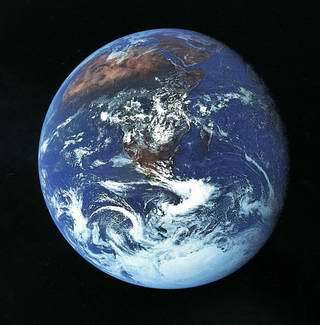
January 30, 2006 Earth from space

University of Minnesota associate professor of chemical engineering Renata Wentzcovitch and her team of researchers have confirmed the properties of a mineral (post-perovskite) that may form near the Earth's core in a layer called the D'' region.

The work offers new insight for interpreting properties of this region. The D'' (Dee double prime) layer surrounds Earth's core and is between 0 and 186 miles thick. It is at the interface between two chemically distinct regions, the rocky mantle and the metallic core. The article, "MgSiO3 post-perovskite at D'' conditions," was published on Jan. 17 in Proceedings of the National Academy of Science.

The research "tells us how to better model Earth's internal processes," said Wentzcovitch. "Proper geodynamical modeling of the Earth is necessary to get a better grasp of the dynamics of the surface. You can't fully understand Earth's surface motion without understanding how it moves inside. What's unbelievable is how well we can model Earth on a big scale. At this scale, small details don't matter."

In 2004, Japanese researchers at the Tokyo Institute of Technology found that high temperatures and pressures transform perovskite, the major mineral in Earth's mantle, into a new mineral called post-perovskite. Wentzcovitch's group contributed to this discovery by determining the structure of post-perovskite and by calculating the pressure and temperature conditions for its existence. They matched the conditions in the D'' layer.

In the current work, Wentzcovitch and colleagues demonstrate that the seismic properties of post-perovskite are much like the previously inexplicable properties found in the D'' layer. This is the most convincing evidence that post-perovskite is in the D'' layer and produces its strange seismic properties.

"As the Earth cools, D'' becomes thicker. Its thickness is related to Earth's age and its aging processes. The discovery of post-perovskite in the D'' layer will also help us understand how the Earth has evolved," Wenttzcovitch said.

On the web: http://www.pnas.org/content/vol103/issue3/#GEOPHYSICS

Source: University of Minnesota


print this article email this article download pdf blog this article bookmark this article     Stumble it Digg this share on Facebook retweet share on Reddit add to delicious
Rate this story - 3.3 /5 (18 votes)


January 30, 2006 all stories

Comments: 0

3.3 /5 (18 votes)
  • Stumble this up

  • Digg this

  • share this

  • hide
  • Related Stories


Other News

New computer-developed map shows more extensive valley network on Mars

New computer-developed map shows more extensive valley network on Mars

Space & Earth / Space Exploration

created 7 hours ago | popularity 4.5 / 5 (4) | comments 0

New research adds to the growing body of evidence suggesting the Red Planet once had an ocean.


Supervolcano eruption -- in Sumatra -- deforested India 73,000 years ago

Supervolcano eruption -- in Sumatra -- deforested India 73,000 years ago

Space & Earth / Earth Sciences

created 9 hours ago | popularity 4 / 5 (6) | comments 1

A new study provides "incontrovertible evidence" that the volcanic super-eruption of Toba on the island of Sumatra about 73,000 years ago deforested much of central India, some 3,000 miles from the epicenter, ...


Spitzer Telescope Observes Baby Brown Dwarf

Spitzer Telescope Observes Baby Brown Dwarf

Space & Earth / Astronomy

created 6 hours ago | popularity 4.8 / 5 (5) | comments 0

(PhysOrg.com) -- NASA's Spitzer Space Telescope has contributed to the discovery of the youngest brown dwarf ever observed -- a finding that, if confirmed, may solve an astronomical mystery about how these ...


Is global warming unstoppable?

Space & Earth / Environment

created 18 hours ago | popularity 3.9 / 5 (22) | comments 22

In a provocative new study, a University of Utah scientist argues that rising carbon dioxide emissions - the major cause of global warming - cannot be stabilized unless the world's economy collapses or society builds the ...


Scientist: Leak of climate e-mails appalling

Space & Earth / Environment

created 12 hours ago | popularity 3 / 5 (7) | comments 7

(AP) -- A leading climate change scientist whose private e-mails are included in thousands of documents that were stolen by hackers and posted online said Sunday the leaks may have been aimed at undermining next month's ...