NRL scientists demonstrate efficient electrical spin injection into silicon
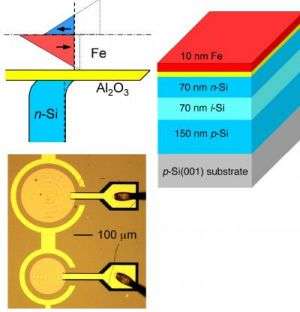
Scientists at the Naval Research Laboratory (NRL) have efficiently injected a current of spin-polarized electrons from a ferromagnetic metal contact into silicon, producing a large electron spin polarization in the silicon. Silicon is by far the most widely used semiconductor in the device industry, and is the basis for modern electronics.
This demonstration by NRL scientists is a key enabling step for developing devices which rely on electron spin rather than electron charge, a field known as semiconductor spintronics, and is expected to provide higher performance with lower power consumption and heat dissipation. The complete findings of this study titled, “Electrical spin injection into silicon from a ferromagnetic metal/tunnel barrier contact” are published in the August 2007 issue of Nature Physics.
The electronics industry to date has relied largely on the control of charge flow through size scaling (i.e. reducing the physical size of elements such as transistors) to increase the performance of existing electronics. This trend, predicted in a seminal paper published in 1965 by Gordon Moore (who later co-founded Intel) and widely known as “Moore’s Law,” has been remarkably successful, as evidenced by the powerful desktop computers and handheld devices available at modest cost to the consumer.
However, size scaling clearly cannot continue indefinitely as atomic length scales are reached, and new approaches must be developed. Basic research efforts at NRL and elsewhere have shown that spin angular momentum, another fundamental property of the electron, can be used to store and process information in metal and semiconductor based devices. Subsequently, the International Technology Roadmap for Semiconductors (ITRS) has identified the use of the electron’s spin as a new state variable which should be explored as an alternative to the electron’s charge. This approach is known as “semiconductor spintronics.”
Much of the initial basic research success was realized in III-V semiconductors with a direct band gap such as gallium arsenide, where powerful optical spectroscopic techniques are relatively easy to apply and enable detailed probing of the spin system. High spin polarization of the electrons in the semiconductor, one of the key metrics for success, was obtained.
In contrast, little progress has been made in silicon, despite its overwhelming dominance of the semiconductor industry. Efficient spin injection and transport in silicon is regarded as the “holy grail” of semiconductor spintronics. This very recent work by NRL scientists demonstrates that high electron spin polarizations can be achieved in silicon by electrical injection of current from a ferromagnetic metal, such as an iron film. This contact is applied by vacuum deposition after a simple wet chemical cleaning of the silicon wafer.
Their approach injects spin-polarized electrons near the silicon conduction band edge with near unity conversion efficiency and low bias voltages (~ 2 eV) compatible with CMOS technology. By analyzing the weak electroluminescence generated in the silicon, the NRL research team determined a lower bound for the electron spin polarization of 30%. For comparison, the spin polarization of the electrons in common magnetic metals such as permalloy or iron is ~ 40- 45%. The realization of efficient electrical injection and significant spin polarization using a simple magnetic tunnel barrier compatible with "back-end" silicon processing should greatly facilitate development of silicon-based spintronic devices.
Source: Naval Research Laboratory


