Wobbly polarity is key to preventing magnetic avalanches on disk drives
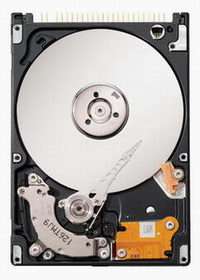
Push two magnets together and you'll set off an avalanche of activity, forcing atoms on each magnet to align their polarity with the intruding magnetic field. It may sound like a party trick for physicists, but you do it every time you press "Save" on your computer.
New research brings models of magnetic avalanches much closer to reality, helping physicists understand both why they happen and why they don't run out of control, wiping disk drives clean. The research, by Joshua Deutsch, professor of physics at the University of California, Santa Cruz, and Andreas Berger, who did the research while at Hitachi Global Storage Technologies, appeared in the July 13 online edition of Physical Review Letters. The knowledge may help engineers design more reliable materials for disk drives.
Correcting even a single typo in an e-mail means changing dozens of bits of information. For each bit, a magnetic head grazes a tiny patch of your disk drive, forcing its polarity, or "spin," to align up or down--the magnetic equivalent of a one or a zero. The patch's polarity in many magnetic materials changes in a haphazard series of large and small jumps that physicists liken to an avalanche--though Deutsch's research shows it often behaves more like an explosion or runaway fire.
"The big advance in this paper is that in previous models of avalanches, the spin just flips from up to down as soon as they apply a magnetic field, and they're done. But that's not the way spin behaves in the real world," Deutsch said.
Deutsch and Berger realized that such an ideal model overlooked an effect, called spin precession, that each magnetic field exerts on its neighbors. They envisioned an individual bit of information as a tiny pincushion bristling with individual magnetic fields. As the disk drive head nears, each pin tends to wobble in a widening circle--pointing neither up nor down but somewhere in between--before it settles on its new polarity. That wobbling is called precession and resembles the way a spinning top draws out circles as it rotates.
"It takes around a few nanoseconds for a precession to die down," said Deutsch. "That's not that fast compared to computers today. It's not as fast as the time-scale you get for a transistor to switch." (A nanosecond is one-billionth of a second.) During that brief time, each magnetic field contributes forces that affect the precession of neighboring fields.
"There's a lot of stored energy in a magnet. It's sort of a battery in a way," Deutsch said. "As each spin flips from up to down, it liberates a small amount of energy that can do more work."
The combined effects can add up to a wave of energy that topples adjacent pins and spreads across the magnet's surface.
Deutsch and Berger suggested that one of the reasons that avalanches die down is because the magnetic material has an inherent ability to damp out the spin precession. The damping comes from the way the spins interact with their nonmagnetic surroundings, including electrons and minute vibrations called phonons.
Materials with poor damping are susceptible to long-running avalanches, and those with higher damping would be better candidates for use in disk drives. But all real materials feature much lower damping than the infinite damping assumed in previous models, Deutsch said.
"Obviously, disk drive makers have already learned by an enormous amount of ingenuity and trial and error what materials make good disks," Deutsch said. "But now we understand a lot better one of the reasons why--because the materials are good at damping, and we can quantify how damping will stop runaway avalanches. We still can’t calculate their damping, but at least we can measure it."
Source: University of California - Santa Cruz


