One giant leap for space fashion -- MIT designs sleek, skintight spacesuit
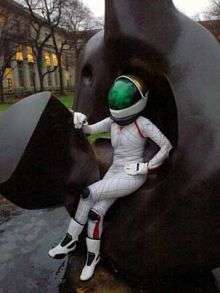
In the 40 years that humans have been traveling into space, the suits they wear have changed very little. The bulky, gas-pressurized outfits give astronauts a bubble of protection, but their significant mass and the pressure itself severely limit mobility.
Dava Newman, a professor of aeronautics and astronautics and engineering systems at MIT, wants to change that.
Newman is working on a sleek, advanced suit designed to allow superior mobility when humans eventually reach Mars or return to the moon. Her spandex and nylon BioSuit is not your grandfather's spacesuit-think more Spiderman, less John Glenn.
Traditional bulky spacesuits “do not afford the mobility and locomotion capability that astronauts need for partial gravity exploration missions. We really must design for greater mobility and enhanced human and robotic capability,” Newman says.
Newman, her colleague Jeff Hoffman, her students and a local design firm, Trotti and Associates, have been working on the project for about seven years. Their prototypes are not yet ready for space travel, but demonstrate what they're trying to achieve-a lightweight, skintight suit that will allow astronauts to become truly mobile lunar and Mars explorers.
Newman anticipates that the BioSuit could be ready by the time humans are ready to launch an expedition to Mars, possibly in about 10 years. Current spacesuits could not handle the challenges of such an exploratory mission, Newman says.
A NEW APPROACH
Newman's prototype suit is a revolutionary departure from the traditional model. Instead of using gas pressurization, which exerts a force on the astronaut's body to protect it from the vacuum of space, the suit relies on mechanical counter-pressure, which involves wrapping tight layers of material around the body. The trick is to make a suit that is skintight but stretches with the body, allowing freedom of movement.
Over the past 40 years, spacesuits have gotten progressively heavier, and they now weigh in at about 300 pounds. That bulk -- much of which is due to multiple layers and the life support system coupled with the gas-pressurization -- severely constrains astronauts' movements. About 70 to 80 percent of the energy they exert while wearing the suit goes towards simply working against the suit to bend it.
“You can't do much bending of the arms or legs in that type of suit,” Newman says.
When an astronaut is in a micro-gravity environment (for example, doing a spacewalk outside the International Space Station), working in such a massive suit is manageable, but, as Newman says, “It's a whole different ballgame when we go to the moon or Mars, and we have to go back to walking and running, or loping.”
Another advantage to her BioSuit is safety: if a traditional spacesuit is punctured by a tiny meteorite or other object, the astronaut must return to the space station or home base immediately, before life-threatening decompression occurs. With the BioSuit, a small, isolated puncture can be wrapped much like a bandage, and the rest of the suit will be unaffected.
Newman says the finished BioSuit may be a hybrid that incorporates some elements of the traditional suits, including a gas-pressured torso section and helmet. An oxygen tank can be attached to the back.
The MIT researchers are focusing on the legs and arms, which are challenging parts to design. In the Man-Vehicle Lab at MIT, students test various wrapping techniques, based on 3D models they've created of the human in motion and how the skin stretches during locomotion, bending, climbing or driving a rover.
Key to their design is the pattern of lines on the suit, which correspond to lines of non-extension (lines on the skin that don't extend when you move your leg). Those lines provide a stiff “skeleton” of structural support, while providing maximal mobility.
To be worn in space, the BioSuit must deliver close to one-third the pressure exerted by Earth's atmosphere, or about 30 kPa (kilopascals). The current prototype suit exerts about 20 KPa consistently, and the researchers have gotten new models up to 25 to 30 KPa.
STAYING IN SHAPE
The suits could also help astronauts stay fit during the six-month journey to Mars. Studies have shown that astronauts lose up to 40 percent of their muscle strength in space, but the new outfits could be designed to offer varying resistance levels, allowing the astronauts to exercise against the suits during a long flight to Mars.
Although getting the suits into space is the ultimate goal, Newman is also focusing on Earth-bound applications in the short term, such as athletic training or helping people walk.
The new BioSuit builds on ideas developed in the 1960s and 1970s by Paul Webb, who first came up with the concept for a “space activity suit,” and Saul Iberall, who postulated the lines of non-extension. However, neither the technology nor the materials were available then.
“Dr. Webb had a great idea, before its time. We're building on that work to try to make it feasible,” says Newman.
Source: Massachusetts Institute of Technology


