Accident-prone? Scientists link brain function to knee injuries
A torn anterior cruciate ligament (ACL) is among an athlete's most-dreaded injuries, often requiring surgery and months of rehab, as has been the case with Philadelphia Eagles quarterback Donovan McNabb.
While being tackled in football or hurtling into an embankment on an icy ski course can tear this major knee ligament, most athletes actually “do themselves in”--they don't collide with a person or object, they end up injuring themselves when they land off-balance during a jump or run.
But why?
In a first-ever study of its kind, University of Delaware scientists have shown that differences in brain function may be to blame, predisposing some of us to “noncontact” knee injuries.
The research, which involved scientists from UD, Michigan State University, West Chester University and St. Joseph's University, is reported in the June edition of the American Journal of Sports Medicine.
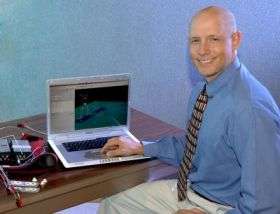
“We had some data from previous research which suggested that these noncontact knee injuries occur when a person gets distracted or is 'caught off guard,'“ Charles Buz Swanik, the UD assistant professor of health sciences who led the study, said. These awkward movements have the biomechanical appearance of a knee buckling, but can be reproduced safely in the lab to study how people mentally prepare and react to unanticipated events.
“This made me wonder if we could measure whether these individuals had different mental characteristics that made them injury-prone,” Swanik said.
To identify subjects for their study, the researchers administered neurocognitive tests to nearly 1,500 athletes at 18 universities during the preseason. This testing also provided baseline data for athletes who might sustain a concussion after the season started, Swanik said.
Visual memory, verbal memory, processing speed, and reaction time all were assessed.
For example, a color-matching test was used to measure reaction time and processing speed. Each athlete was asked to click in a box as quickly as possible only if the word “red” was displayed on the computer screen in a red color, not if the word appeared in the color green or blue.
After the season started, a number of the tested athletes ended up sustaining noncontact ACL injuries. These athletes were identified, and 80 of them were matched up to a control group of 80 noninjured athletes according to height, weight, age, gender, sport, position and years of experience at the college level.
Male and female athletes in 10 intercollegiate sports were represented, including football, soccer, lacrosse, basketball, volleyball, field hockey, gymnastics, wrestling, fencing and softball.
Then the preseason test results from the two groups of athletes were compared.
In analyzing the data, the scientists found that the athletes who ended up with noncontact ACL injuries demonstrated significantly slower reaction time and processing speed and performed worse on visual and verbal memory tests when compared to the control group.
“These results suggest that slower processing speed and reaction time, as well as lower visual and verbal memory performance may predispose certain individuals to errors in coordination during physical activity that can lead to injury,” Swanik said.
But can we do anything to improve our brain function and protect ourselves from injury"
“This study means that there may be an alternative application for neurocognitive testing in the area of injury prevention,” Swanik noted. “It's hard to say at this point how much we can alter these characteristics with training, but certainly the brain has great potential for learning and adaptation. Controlling stress and anxiety must be considered, as both cause changes in muscle tone and concentration and the narrowing of our attentional field,” he said.
“There is likely an optimal state of arousal for each individual to maximize performance and injury avoidance, but future studies will have to determine the relationship between our results and anxiety,” Swanik added.
A follow-up study is now under way in UD's state-of-the-art Human Performance Laboratory with support from the University of Delaware Research Foundation.
“We're trying to identify people who are or are not 'caught off guard' during different landing tasks,” Swanik said. “Then we'd like to match the neurocognitive characteristics of people who are easily distracted or have awkward landings. This would allow us to search for injury-prone or perhaps accident-resistant people.”
So what light might this study shed on Donovan McNabb's ACL injury in that ill-fated game with the Tennessee Titans last November"
“It's a challenge to explain how such a highly conditioned, muscular and coordinated athlete is injured, unless we consider that he was momentarily distracted the instant before his foot contacted the ground, resulting in an awkward landing,” Swanik said.
But McNabb is not alone. An estimated 200,000 anterior cruciate ligament injuries occur annually in the United States, mostly in young, healthy, active individuals.
According to Swanik, it is not uncommon to have one or two ACL injuries every season on a football team, and the incidence is likely even greater on women's sports teams.
“Young women are actually at the highest risk for these injuries, particularly in soccer and basketball,” Swanik said.
Source: University of Delaware


