University of Pennsylvania engineers discover natural 'workbench' for nanoscale construction
July 17, 2007 Superlattice

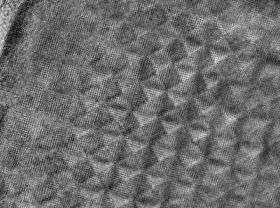
Lattice image of a grain of composition fow which both chessboard and diamond contrast are apparent. The scale bars are 20nm. Credit: University of Pennsylvania

Engineers at the University of Pennsylvania have taken a step toward simplifying the creation of nanostructures by identifying the first inorganic material to phase separate with near-perfect order at the nanometer scale. The finding provides an atomically tuneable nanocomposite “workbench” that is cheap and easy to produce and provides a super-lattice foundation potentially suitable for building nanostructures.

The findings appear in the August issue of Nature Materials.

Alerted by an unusual diffraction effect of a common ceramic material, researchers used imaging to identify a two-phase structural pattern ideal as the first step towards nanodevice construction. Practical application of nanotechnology will rely upon engineering’s ability to manipulate atoms and molecules into long-range order to produce materials with desired functionalities. The Penn findings provide a simpler method for the ordering of composite parts on the nanometer scale, which is integral to the incorporation of nano-objects such as particles and wires that make up nanodevices.

The material used in the Penn study is an ionically- conductive, crystalline ceramic (Nd2/3-xLi3x)TiO3 that engineers observed with transmission electron microscopy. The powdered perovskite exhibited two distinct patterns at the atomic scale with identical periodicity: a nanoscale chessboard pattern and a diamond pattern that indicated periodic separation into two phases within the structure. This spontaneous separation of phases could present a new foundation on which to build nanodevice technology. This material – made using standard and easily reproducible ceramic processing methods – represents the formation of a spontaneous microscopic surface controlled on the nanoscale with atomic precision.

Further study revealed that the separation of the structure into two distinct phases was a result of the oxide separating into lithium rich squares and lithium poor stripes. By varying the amount of lithium and neodymium, two ingredients in the ceramic powder, engineers controlled the length and spacing of the alternating phases, thereby tuning the workbench upon which nanodevices could be built.

On a larger-than-atomic scale, the research extends science’s knowledge of the properties of a most common oxide structure type, currently used for superconducting materials, magnetoresistive materials and ferroelectrics.

“This study represents great potential for the use of standard ceramic processing methods for nanotechnology,” said Peter K. Davies, chair of the Department of Materials Science and Engineering at Penn. “The phase separation occurs spontaneously, providing two phases whose dimensions both extend into the nanometer scale. This unique feature could lead to its application as a template for the assembly of nanostructures or molecular monolayers.”

Source: University of Pennsylvania


print this article email this article download pdf blog this article bookmark this article     Stumble it Digg this share on Facebook retweet share on Reddit add to delicious
Rate this story - 4.4 /5 (19 votes)


July 17, 2007 all stories

Comments: 0

4.4 /5 (19 votes)
  • Stumble this up

  • Digg this

  • share this

  • hide
  • Related Stories

  • Electricity from straw
    created Feb 03, 2009 | popularity not rated yet | comments 0
  • Unique Material May Allow Capacitors to Store More Energy
    created Jul 20, 2007 | popularity not rated yet | comments 0
  • Researchers take the lead out of piezoelectrics
    created Nov 13, 2009 | popularity not rated yet | comments 0
  • Hydrogen milestone moves energy independence one step forward
    created Nov 10, 2009 | popularity not rated yet | comments 0
  • INL scientist is harnessing the power of plasma
    created Oct 27, 2009 | popularity not rated yet | comments 0


  • hide
  • Relevant PhysicsForums posts

Other News

carbon fiber

Ultra-Long Carbon Nanotubes Could Serve as Future Transmission Lines

Nanotechnology / Nanomaterials

created Nov 10, 2009 | popularity 4.9 / 5 (22) | comments 13

(PhysOrg.com) -- When it comes to carbon nanotubes, the majority of research so far has focused on small-scale applications. But now, a team of researchers from Rice University has created carbon nanotubes ...


Researchers turn algae into high-temperature hydrogen source

Researchers turn algae into high-temperature hydrogen source

Nanotechnology / Nanophysics

created Nov 12, 2009 | popularity 3.6 / 5 (7) | comments 5

In the quest to make hydrogen as a clean alternative fuel source, researchers have been stymied about how to create usable hydrogen that is clean and sustainable without relying on an intensive, high-energy ...


Argonne 'homegrown' hybrid solar cell aims for low-cost power

Argonne 'homegrown' hybrid solar cell aims for low-cost power

Nanotechnology / Nanomaterials

created Nov 10, 2009 | popularity 4.2 / 5 (11) | comments 3

(PhysOrg.com) -- Scientists at the U.S. Department of Energy’s (DOE) Argonne National Laboratory have refined a technique to manufacture solar cells by creating tubes of semiconducting material and then "growing" ...


Nanoparticles for gene therapy improve

Nanoparticles for gene therapy improve

Nanotechnology / Bio & Medicine

created Nov 06, 2009 | popularity 5 / 5 (5) | comments 3

(PhysOrg.com) -- About five years ago, Professor Janet Sawicki at the Lankenau Institute in Pennsylvania read an article about nanoparticles developed by MIT's Robert Langer for gene therapy, the insertion ...


In touch with molecules

In touch with molecules

Nanotechnology / Nanophysics

created Nov 12, 2009 | popularity 5 / 5 (2) | comments 2

The performance of modern electronics increases steadily on a fast pace thanks to the ongoing miniaturization of the utilized components. However, se-vere problems arise due to quantum-mechanical phenomena ...