Catching the Gravitational Wave
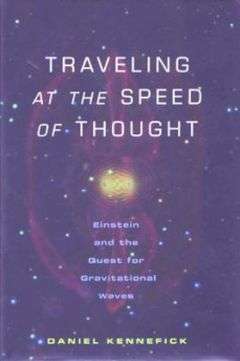
For nearly a century, scientists searched to uncover the tremors Einstein believed were produced by waves in the fabric of space and time.
At first, Albert Einstein believed that gravitational waves existed, ripples small and large in the curvature of space and time. But he repeatedly changed his mind, first doubting their existence, then believing, and then changing his mind again.
In the end, after decades of debate, scientists confirmed every main point of Einstein's early theory of gravitational waves. In his new book, Traveling at the Speed of Thought: Einstein and the Quest for Gravitational Waves, published by Princeton University Press, University of Arkansas professor Daniel Kennefick traces the history of a theory that researchers believe will help them one day better understand some of the greatest mysteries in the universe.
The story of Einstein's angry response when an anonymous colleague attempted to correct him forms a central part of the book. In the end, Einstein finally admitted that gravitational waves might exist after all in the manner he had first predicted.
The idea of gravitational waves is only 100 years old, but since the day it was first posited, the theory has aroused great controversy among some of the most noted scientists of the century, including John Wheeler, Richard Feynman and Hermann Bondi.
"In the broader universe these waves may play a role in the later development of star systems," said Kennefick. "It's possible that when pulsars, which start out spinning very rapidly after they are created from the collapse of a normal star, lose a lot of their spin with time, the reason is that they are losing energy to the gravitational waves they emit. Understanding these waves could lead us to a great deal more knowledge about the nature of these dying stars."
Most important, Kennefick said, is that researchers might unravel the mystery of the black holes thought to exist at the center of galaxies. When the Earth orbits around the sun, it produces small gravitational waves, completely imperceptible, analogous to the tiny ripples formed when a pebble is thrown into a pond. But a massive black hole can contain millions or billions of suns, hard to see with ordinary telescopes, and each time one swallows a star, the gravitational waves created are far stronger, like tossing a heavy stone into a pond.
"Astronomers have seen binary neutron stars emitting gravitational waves that carry some energy with them as they go off," said Kennefick. "As binary stars lose energy and decay, we can see that their orbital period decreases because the two stars are getting closer to each other. Each orbit takes less and less time, and when we measure that change, we find it agrees very precisely with Einstein's 1918 calculation."
The book should be of interest to anyone wanting to learn more about the history of science, as well as to teachers in the classroom. One chapter has been translated into Japanese already, and Princeton University Press plans to translate the entire book.
Kennefick left the California Institute of Technology to come to the University of Arkansas in 2004.
Source: University of Arkansas


