Bird sized airplane to fly like a swift
July 18, 2007
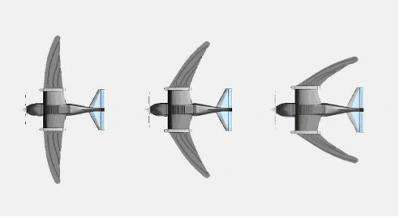
RoboSwift can sweep its wings back and forth, changing the shape and the surface area. By doing so the airplane can fly more efficiently and more agilely than fixed-wing aircraft. The airplane is powered by means of a special propeller that folds during gliding to minimize air drag. Credit: RoboSwift team
Nine Dutch Aerospace Engineering students at the Delft University of Technology, together with the Department of Experimental Zoology of Wageningen University, designed the RoboSwift.
RoboSwift is a micro airplane fitted with shape shifting wings, inspired by the common swift, one of nature’s most efficient flyers. The micro airplane will have unprecedented wing characteristics; the wing geometry as well as the wing surface area can be adjusted continuously. This makes RoboSwift more maneuverable and efficient. Resembling the common swift, RoboSwift will be able to go undetected while using its three micro cameras to perform surveillance on vehicles and people on the ground. Furthermore, it can be employed to observe swifts in flight, thus enabling new biological research.
The RoboSwift team presented the design on the yearly Design Synthesis symposium at TU Delft. The team will build the high-tech micro airplane in the following months; it is expected to fly in January 2008. The student team will build three RoboSwifts to participate in March 2008 in the First American-Asian Micro Air Vehicle competition in India.
RoboSwift will have a span of 50 cm span and 80 grams weight. It can follow a group of swifts up to 20 minutes and perform ground surveillance up to one hour thanks to its lithium-polymer batteries that power the electromotor, which drives a propeller. The propeller folds back during gliding to minimize air drag.
The unique morphing-wing design features are taken from the swift. Morphing means the wings can be swept back in flight by folding feathers over each other, thus changing the wing shape and reducing the wing surface area. RoboSwift also steers by morphing its wings. Doing so, the micro airplane can perform optimally, flying efficiently and highly maneuverable at very high and very low speeds, just like the swift.
The students found out that using only four feathers, much less than the bird uses, already provides the wing with sufficient morphing capacity; this feature makes actual production of the design feasible. Steering RoboSwift is done by asymmetrically morphing the wings. Sweeping one wing back further than the other creates a difference in lift on the wings that is used to roll and turn the micro plane in the air.
The team based the project on research performed by its tutor ir. David Lentink, who published a study into the swift’s flight characteristics in this year’s April issue of Nature.
During its life, a common swift flies a distance that goes up to five times the distance to the Moon and back. Lentink c.s. found the swift is such an able flyer because it continuously adjusts (‘morphs’) its wings to the prevailing flight conditions to fly more efficient and more maneuverable. Airplanes can do a lot, but so far they do not fly nearly as well as birds in terms of performance and efficiency. In a ‘standard’ civil aircraft, the wings are held a fixed position with respect to the fuselage during the full length of the flight. This is inefficient because flight conditions change in different flight phases. With their variable wings, birds can easily deal with the different conditions encountered during flight, thus increasing their flight efficiency and agility up to a factor three.
Although a few military aircraft, such as the F14 Tomcat and the English-German Tornado, are equipped with so-called swing wings, none of these aircraft significantly reduces the surface area of the wing, thus missing out on the benefits made possible by morphing. Also, these aircraft do not steer by means of the variable wing shape.
Source: Delft University of Technology
-
Studying butterfly flight to help build bug-size flying robots
Feb 02, 2012 |
5 / 5 (2) |
1
-
Aero-engineers debut open-source fluid dynamics design application
Jan 24, 2012 |
5 / 5 (6) |
1
-
Winged dinosaur Archaeopteryx dressed for flight
Jan 24, 2012 |
4.8 / 5 (4) |
3
-
Dinosaurs with killer claws yield new theory about flight
Dec 14, 2011 |
4.8 / 5 (11) |
2
-
Study finds pigeons use bodies to turn rather than wing force
Nov 29, 2011 |
4.3 / 5 (7) |
14
-
Engineers build first sub-10-nm carbon nanotube transistor
Feb 01, 2012 |
4.9 / 5 (33) |
30
-
Something old, something new: Evolution and the structural divergence of duplicate genes
Jan 31, 2012 |
4.6 / 5 (7) |
1
-
The hidden nanoworld of ice crystals: Revealing the dynamic behavior of quasi-liquid layers
Jan 30, 2012 |
5 / 5 (4) |
1
-
Stock market network reveals investor clustering
Jan 27, 2012 |
3.9 / 5 (23) |
8
-
Of microchemistry and molecules: Electronic microfluidic device synthesizes biocompatible probes
Jan 26, 2012 |
5 / 5 (2) |
0
-
How to calculate total compressibility in liquid porous solid system
2 hours ago
-
Need help reading 3-D
22 hours ago
-
A way to send and receive wireless data
Feb 11, 2012
-
Calling function with no input argument
Feb 10, 2012
-
Force free body diagram problem on gym equipment
Feb 10, 2012
-
Empirical data regarding shower heads and water
Feb 10, 2012
- More from Physics Forums - General Engineering
More news stories
Google might launch Drive for cloud storage soon
(PhysOrg.com) -- Google's next big move, according to the Wall Street Journal, is a cloud storage service called Drive. Hardly first to the plate, Google is simply catching up to introducing its cloud reposi ...
Iran blocks email, restricts net access: reports
Iran has further restricted access to the Internet and blocked popular email services for the past few days, in a move a top lawmaker said could "cost the regime dearly," media reports said on Sunday.
4 hours ago |
5 / 5 (1) |
3
Love a click away in Indonesia's Twitter Republic
He was a geeky kid from Yogyakarta, she a glamorous city girl in Jakarta. In a country with one of the world's most vibrant social networking scenes they fell in love on Twitter.
12 hours ago |
4 / 5 (1) |
0
Walney offshore wind farm is world's biggest (for now)
(PhysOrg.com) -- The Walney wind farm on the Irish Sea--characterized by high tides, waves and windy weather--officially opened this week. The farm is treated in the press as a very big deal as the Walney ...
Navy to begin tests on electromagnetic railgun prototype launcher
The Office of Naval Research (ONR)'s Electromagnetic (EM) Railgun program will take an important step forward in the coming weeks when the first industry railgun prototype launcher is tested at a facility ...
Feb 06, 2012 |
4.5 / 5 (17) |
94
|
Overeating may double risk of memory loss
New research suggests that consuming between 2,100 and 6,000 calories per day may double the risk of memory loss, or mild cognitive impairment (MCI), among people age 70 and older. The study was released today and will be ...
Scientists discover molecular secrets of 2,000-year-old Chinese herbal remedy
For roughly two thousand years, Chinese herbalists have treated Malaria using a root extract, commonly known as Chang Shan, from a type of hydrangea that grows in Tibet and Nepal. More recent studies suggest that halofuginone, ...
New method to examine batteries -- MRI from the inside
There is an ever-increasing need for advanced batteries for portable electronics, such as phones, cameras, and music players, but also to power electric vehicles and to facilitate the distribution and storage of energy derived ...
Lab study raises questions over nano-particle impact
Tests involving chickens have raised questions about the impact on health from engineered nano-particles, the ultra-fine grains commonly used in drugs and processed foods, scientists said on Sunday.
Injured boomers beware: Know when to see doctor
(AP) -- It happened to nurse Jane Byron years after an in-line skating fall, business owner Haralee Weintraub while doing "men's" push-ups, and avid cyclist Gene Wilberg while lifting a heavy box.
A mitosis mystery solved: How chromosomes align perfectly in a dividing cell
Although the process of mitotic cell division has been studied intensely for more than 50 years, Whitehead Institute researchers have only now solved the mystery of how cells correctly align their chromosomes during symmetric ...